

Commentary
Dmitri Trenin
{
  "authors": [
    "Dmitri Trenin"
  ],
  "type": "legacyinthemedia",
  "centerAffiliationAll": "",
  "centers": [
    "Carnegie Endowment for International Peace",
    "Carnegie China",
    "Carnegie Russia Eurasia Center"
  ],
  "collections": [
    "China’s Foreign Relations"
  ],
  "englishNewsletterAll": "",
  "nonEnglishNewsletterAll": "",
  "primaryCenter": "Carnegie Endowment for International Peace",
  "programAffiliation": "",
  "programs": [],
  "projects": [],
  "regions": [
    "East Asia",
    "China",
    "Japan",
    "Russia",
    "Caucasus"
  ],
  "topics": [
    "Foreign Policy"
  ]
}
Source: Getty
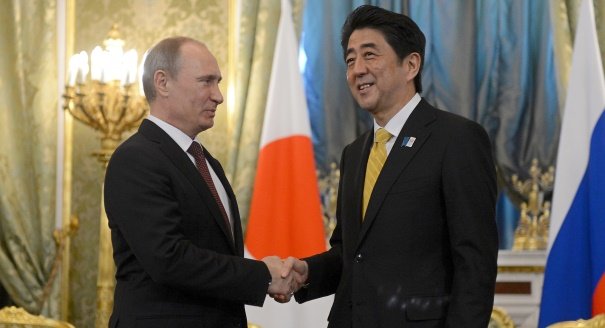
A stronger relationship between Russia and Japan would serve both countries well and pose no threat to China.
Source: Global Times
Japan's Prime Minister Shinzo Abe is coming to Moscow earlier than expected. Evidently, developments in East Asia have pushed foreign and security policy issues higher on Tokyo's agenda.
The recent spike in nuclear tensions on the Korean Peninsula provoked by Pyongyang, the continuing Sino-Japanese territorial dispute in the East China Sea and the growth of China's military capabilities have all impacted on the thinking of Japan's elite.
Putting economic issues to one side, Abe has involved himself in security matters.He has restated his long-term goal of amending Japan's postwar pacifist Peace Constitution; has vowed to use force to defend "Japan-held islands" against China; and condoned a massive visit to the Yasukuni Shrine by his fellow party members, including three cabinet ministers.
Early in his tenure, Abe was in Washington to meet US President Barack Obama, and has since conferred with US Secretary of State John Kerry on the latter's recent trip to Tokyo.
The Japanese government welcomes the Obama administration's pivot to the Asia-Pacific, and seeks to use it to strengthen the alliance with the US.
At the same time, Tokyo realizes that the pivot suggests how much is at stake for Washington in US-China relations. US support for Japan is solid and real, but it cannot be taken for granted in all cases where Japan's and China's interests clash.
In the East China Sea dispute, Washington, while preaching nonviolence with both sides, has been trying to mediate between Beijing and Tokyo.
Abe's turn to Moscow can be easily explained by a number of geopolitical and economic reasons.
Japan is getting about 10 percent of its oil and gas from Russia, an insurance policy in view of the instability in the Middle East.
It also appreciates Russia's sheer physical presence in Northeast Asia, and Moscow's desire to play a more active role in the Asia-Pacific region.
Russia shares a 2,700-mile long border with China, and has a vibrant trading relationship with its neighbor. Japan clearly does not want Moscow's Asia policy to be dominated by its relationship with Beijing. Right-wing Japanese politicians even muse about a Japanese-Russia alignment to contain China.
Moscow, which only a month ago played host to Chinese President Xi Jinping on his first trip abroad, looks forward to the Japanese prime minister's visit.
As a lone great power constantly in search of a balance, Russia seeks to diversify its economic and political relationships as widely as possible, in order to gain more options.
After thoroughly defeating Japan in a brief campaign at the end of World War II, Moscow bears no historical grudge against Tokyo. Indeed, Russians, by and large, are if anything friendlier toward the Japanese than the other way round.
The dispute over the South Kuril Islands, which the Japanese call their Northern Territories, while occasionally getting noisy, usually at Japan's initiative, is considered to be safely under control, with almost no likelihood of it degenerating into a military confrontation.
A resolution of the Russian-Japanese territorial dispute is not on the cards yet, though both sides feel that some kind of a compromise formula has to be hammered out for their relationship to be fully normalized and live up to its potential. China should not expect Russia to build a common front against Japan, based on reciprocal solidarity in both countries' territorial issues with Tokyo.
China, however, should not fear the fantasies of Japanese rightists. Russia values its relations with China enough not to allow itself to be swayed in Japan's direction. This stance is unlikely to change as long as Moscow regards Beijing as a good neighbor and bona fide partner.
Russia, however, will continue to reemerge as an independent player in the Asia-Pacific region.
It will be guided by its national interests, the top of which is domestic development, particularly between the Urals and the Pacific coastline.
Moscow will reach out to all relevant players, but will seek a balance in all those relationships.
It has sufficient experience and enough common sense not to tilt too much in any particular direction, unless, of course, this is deemed necessary to restore geopolitical and strategic equilibrium.
At this point, a stronger relationship between Russia and Japan would serve both countries well and pose no threat to China.
Former Director, Carnegie Moscow Center
Trenin was director of the Carnegie Moscow Center from 2008 to early 2022.
Recent Work
Dmitri Trenin
Dmitri Trenin

For every ruble allocated to social policy, health, and education in 2027, double that amount is earmarked for the army, the police, and the security services.

Alexandra Prokopenko
The acknowledgment has sparked fears of a new arms race with China and Russia.

Chris O’Meara

Smaller powers cannot go it alone, but Canadian history shows that integration with the United States will not always be benign.
Paul Samson

The European Commissioner for Trade is headed to China. But after President Xi’s bridge-building visit to Washington, can a more isolated EU overcome Beijing’s stranglehold on critical raw materials? Who will blink first?

Rym Momtaz, ed.
The summit may be remembered as a fatal blunder, when Washington, Beijing, and the AI industry collectively chose ceremony over action.

Jeffrey Prescott