

Commentary
The EU can impose sanctions but struggles to enforce them without the United States. With Washington increasingly disinterested in backing European interests, the bloc must now fend for itself.
Nicu Popescu, Tiago Antunes
{
  "authors": [
    "Thomas Carothers",
    "Diane de Gramont"
  ],
  "type": "legacyinthemedia",
  "centerAffiliationAll": "dc",
  "centers": [
    "Carnegie Endowment for International Peace",
    "Carnegie China"
  ],
  "collections": [
    "China and the Developing World",
    "Democracy and Governance"
  ],
  "englishNewsletterAll": "democracy",
  "nonEnglishNewsletterAll": "",
  "primaryCenter": "Carnegie Endowment for International Peace",
  "programAffiliation": "DCG",
  "programs": [
    "Democracy, Conflict, and Governance"
  ],
  "projects": [],
  "regions": [],
  "topics": [
    "Democracy",
    "Economy",
    "Foreign Policy"
  ]
}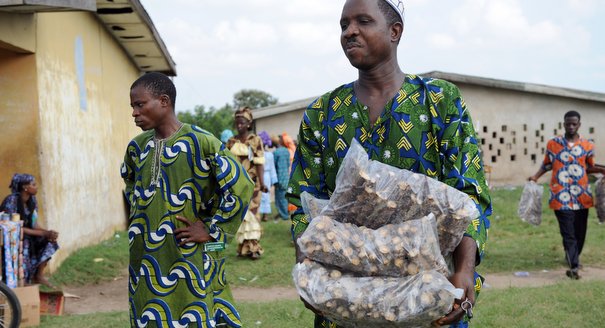
Source: Getty
Within the aid community, there are sharply divergent views on how political development assistance is and how political it should be.
Source: Oxfam From Poverty to Power
How political is development assistance? How political should it be? These questions provoke divergent reactions within the aid community. For some, being political means using aid to advance geopolitical interests aside from development. Others emphasize the far-reaching political consequences aid can have on recipient countries, from bolstering dubious strongmen to undermining systems of domestic accountability. These two perspectives highlight how aid’s political motivations or side effects can limit its effectiveness in advancing developmental change.
Yet in recent years many development practitioners and scholars have been arguing that aid should become more, not less, political. What do they mean by this? They are not talking about political side effects or prioritizing geostrategic motives. Rather they are referring to efforts by development aid actors intentionally and openly to think and act politically for the purpose of making aid more effective in fostering development.
As we chronicle in our new book, Development Aid Confronts Politics: The Almost Revolution, donors have increasingly incorporated politics into their work in two major ways. First, they now pursue explicit political goals in developing countries, whether expressed as advancing democracy, democratic governance, or effective governance. Second, they are trying to adopt politically smart methods, moving away from the idea of aid as a narrowly technical input to considering it a facilitating agent of local processes of change, which requires aid providers to conduct political analyses, adapt programs to local political contexts, and reach a diverse range of socio-political actors within developing countries.On the face of it, political goals appear to have advanced farther than politically smart methods. All major bilateral and multilateral donors now formally embrace political goals of one sort or another and together spend around $10 billion a year on political aid programs broadly defined. Advocates of politically smart methods, on the other hand, often feel like they are fighting for a foothold within their organizations. Political economy analysis is still far from a regular part of program planning processes and the bureaucratic structures of aid agencies tend to hinder flexible, politically savvy programming.
Nevertheless, in presenting our book at aid agencies, think tanks, and universities in Europe and the United States, we have been struck by how much more receptive many people are to the idea of politically smart methods than political goals. Some listeners are at first uncomfortable with our use of the term political methods, but when we say that we mean politically smart development, most heads nod. It is hard to argue against basing programs on solid political understanding and context-specific implementation. Political goals like democratic governance, on the other hand, still engender considerable skepticism even though they have been part of the aid agenda for two decades now.
Owen Barder of the Center for Global Development summarized this perspective well in his comments on our book at an Overseas Development Institute event. He noted the distinction between politically smart methods and political goals and said that “it seems to me that there should be nobody left who doesn’t think we should be doing the first of those. You would be insane to think how do we get better teaching in schools without thinking about the power of the teacher’s union or the role of the Ministry of Education.”[1] But he also argued that there is less evidence that donors know how to change power relations in developing countries and “if we don’t know how to do that, why would we want to take money from something we do know how to do, which helps people live better lives, and spend it on something that we are not sure is going to work?”[2]
Owen’s question is a good one, and it was repeated in different forms at many of the presentations we gave. So can donors adopt politically smart methods without bothering with political goals? It is an appealing idea. Trying to engender political change in developing countries is difficult and many aid interventions in this area have fallen short of their goals. Moreover, sharp debates persist both in scholarly and practitioner circles about the value of democratic governance for socioeconomic change. Scholars such as Acemoglu and Robinson make the case for the developmental value of inclusive institutions but others point to the developmental success of not just China but also authoritarian regimes in Ethiopia and Rwanda as evidence against the democratic governance consensus.
Given this lack of consensus, why not just focus on politically smart approaches to delivering the socio-economic goods we know (or at least hope) that aid programs can do well, from vaccines to food assistance to road building?
We don’t think donors can—or should—step away from political goals that easily. The initial embrace of governance by development agencies was driven by frustration with the persistent failures of aid in badly governed countries and the important insight that in many contexts sustained development progress will remain out of reach without governance progress. If donors are to be more than indefinite service providers in poor countries, they need to pay attention to building effective institutions, which ultimately translates into political goals.
Furthermore, development aid is always going to have an effect on power relations and involve political choices and values. Whoever controls foreign aid resources gains power as a result, meaning for example that choices about directing aid through governments versus through local civil society are fraught with political implications.
Embracing politically smart methods but avoiding political goals can lead donors down a troubling road. If a political analysis reveals that the easiest way to get a donor-supported economic policy reform in place is by encouraging the president to adopt it through decree rather than legislative action and citizen consultation, is that the right way to go? The only way to answer such a question is by reference to political values, and behind those values lie political goals, such as inclusive and transparent governance.
None of this means that development aid can or should be the primary mover of political change in recipient countries. There should be vigorous debate around the contribution and limits of donor efforts to promote better governance in developing countries. But the idea that donors can draw a sharp line between politically smart aid and the pursuit of political goals is an illusion, an updated version of technocratic temptations of decades past.
[1] http://www.youtube.com/watch?v=ZK9S3vqJMZU, 35:30
[2] http://www.youtube.com/watch?v=u7bOAz1hzGM, 12:30
This article was originally published on Oxfam's From Poverty to Power.

Harvey V. Fineberg Chair for Democracy Studies; Senior Fellow, Democracy, Conflict, and Governance Program
Thomas Carothers, a senior fellow in the Carnegie Endowment for International Peace’s Democracy, Conflict, and Governance Program, is a leading expert on comparative democratization and international support for democracy.
Diane de Gramont
Former Nonresident Research Analyst, Democracy and Rule of Law Program
Diane de Gramont was a nonresident research analyst in Carnegie’s Democracy and Rule of Law Program.
Carnegie does not take institutional positions on public policy issues; the views represented herein are those of the author(s) and do not necessarily reflect the views of Carnegie, its staff, or its trustees.

The EU can impose sanctions but struggles to enforce them without the United States. With Washington increasingly disinterested in backing European interests, the bloc must now fend for itself.


Nicu Popescu, Tiago Antunes
Global and rising powers will need to engage with Africa’s priorities and agency in order to secure the continent’s increasingly attractive partnerships.

Fonteh Akum

Rubio’s recent visit brought welcome attention, but more capital requires governance changes that may be a hard sell for regional governments.

Jennifer B. Murtazashvili

America’s foreign-policy objectives have grown more demanding while Americans have demanded greater focus on their own affairs.

Stephen Wertheim

Japan’s long-term security policy is driven by concerns about China, and there is little appetite for (or interest in) pursuing a confrontation with Moscow.

James D.J. Brown