

Commentary
It should address the shortcomings of previous crisis communication efforts and adapt to the demands of frontier AI.
Lucy Luo
{
  "authors": [
    "W.H. Luers",
    "Jessica Tuchman Mathews",
    "T.R. Pickering"
  ],
  "type": "legacyinthemedia",
  "centerAffiliationAll": "",
  "centers": [
    "Carnegie Endowment for International Peace",
    "Malcolm H. Kerr Carnegie Middle East Center",
    "Carnegie Russia Eurasia Center"
  ],
  "collections": [
    "Iranian Proliferation"
  ],
  "englishNewsletterAll": "",
  "nonEnglishNewsletterAll": "",
  "primaryCenter": "Carnegie Endowment for International Peace",
  "programAffiliation": "",
  "programs": [],
  "projects": [],
  "regions": [
    "Middle East",
    "Iran"
  ],
  "topics": [
    "Nuclear Policy",
    "Foreign Policy"
  ]
}
Source: Getty
The United States should be able to address Iran’s focus on getting an understanding of the “endgame” in return for substantial Iranian agreement on the compelling nuclear issues.
Source: Reuters
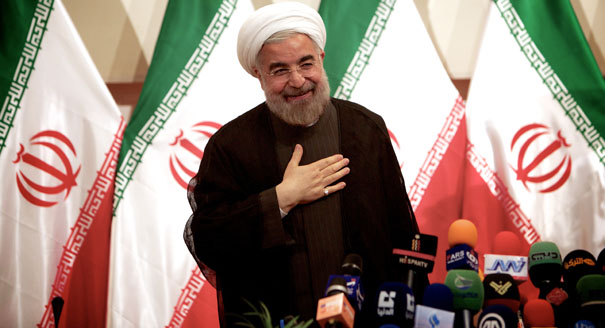
Iran’s recent elections produced a striking result. In a six-man race, one candidate won an easy victory without the expected runoff. More to the point, Hassan Rohani campaigned for policies of negotiation and engagement with the West, to lessen Iran’s international isolation.
The Supreme Leader gave his blessing — at least for now — by choosing not to interfere in the vote count. The new president, then, appears to have a mandate to engage the United States — if Washington is willing — in practice as well as in words.
Rohani, who officially takes office this weekend, is an experienced, well- informed and shrewd insider in Iran’s leadership. It is too early to know how much he can deliver, but there are positive signs. The Holocaust denier, former President Mahmoud Ahmadinejad, is out of the picture.Rohani’s 40-year friendship with the Ayatollah Khamenei suggests a level of trust that could make him an effective interlocutor. He knows the nuclear issue inside out. He speaks fluent English. He has broad, popular support. Yet his mandate will be short-lived if he cannot show results.
U.S.-Iranian negotiations, now realistic for the first time in many years, are both more difficult and more important to U.S. interests than any Washington has faced in decades. Just getting started will be difficult.
Iran’s leaders question Washington’s long-term intentions and believe it may be institutionally unable to reduce its efforts to isolate Iran. So, their first priority is clarification of the negotiations’ distant goals. The United States, meanwhile, wants an agreement soonest to prevent Iranian acquisition of nuclear weapons.
Iran sees this insistence on an immediate nuclear package as Washington’s attempt to trick Tehran into giving up its major bargaining chip at the start. The United States considers Iran’s focus on the endgame as typical Iranian obfuscation — a delaying tactic as the nuclear program moves closer to a weapons capability.
To overcome such challenges, mutual respect and a permanent direct channel of communications will be required. Tehran will want to know that the Obama administration is prepared to negotiate without threats. Washington will want to know that the Rohani government will have the authority from the Supreme Leader to negotiate a verifiable agreement on nuclear issues. Each side will have to drop exaggerated demands in return for minimal concessions.
What do Iran and the U.S. each seek and what might they both want?
Iran will likely want: recognition of Iran as a major player in the Middle East and acknowledgment of what it sees as its full rights as well as obligations under international law, in particular the right to enrichment under the Nuclear Non-Proliferation Treaty; the lifting of all sanctions; Iran’s full participation in all international bodies; all U.S. military forces out of the region; Israel as a single state (with an Arab majority); assurances that the U.S. will not adopt a policy in the region of supporting its Sunni friends against Shi’ites; resolution of all outstanding Iranian claims against the U.S. on a basis satisfactory to Iran, and assurances that Washington does not intend to revert to a policy of trying to overthrow the Islamic Republic.
The United States will likely want steps that assure against a nuclear weapons breakout and allow a full understanding of Iran’s civil nuclear program; maximum transparency of that program, plus additional controls to constrain Iran in any race toward building a nuclear weapon; no plutonium reprocessing and limits on enrichment to civil purposes; cessation of threats against Israel, including the end of Iran’s support for Hezbollah; recognition of the role that the United States plays in the region; Tehran’s human rights practices made consistent with standards of international law; a separate Palestinian state alongside Israel, and the resolution of outstanding claims against Iran on a satisfactory basis.
Notwithstanding this chasm, there are common interests. Both Washington and Tehran want peace and stable development in Iraq and Afghanistan; the defeat of al Qaeda and the Taliban; the maintenance of the Iraqi state within its existing borders; an end to the civil war in Syria; greater stability in the Persian Gulf; a reduction in drug trafficking, particularly from Afghanistan; a lifting of sanctions that could lead to both a settlement of issues between them and more vibrant trade in a region now strapped by conflict and economic decline.
Given these factors a negotiating agenda is imaginable that would give Tehran enough of what it wants so that talks could produce what Washington and its allies require. The United States should be able to address Iran’s focus on getting an understanding of the “endgame” in return for substantial Iranian agreement on the compelling nuclear issues.
The two could advance their discussions by keeping in mind the Shanghai Communique. Like the U.S.-China effort resulting in that 1971 document, Washington and Tehran could agree to recognize that they have profound differences, identify common purpose where cooperation can be explored, and commit to resolving and narrowing differences to avoid conflict. Framing the discussion in this manner might eventually lead to a public document, which could take a long time — but merely discussing it can help each side understand and address the other’s concerns.
Rohani’s win reveals that the majority of Iranians seek moderate policies at home and abroad. How far he and the Supreme Leader will follow the peoples’ lead remains to be tested.
Washington – the administration and Congress — should ready themselves for serious work, following former Secretary of State Dean Acheson’s reminder that “Negotiation in the classic diplomatic sense assumes parties more anxious to agree than to disagree.”
The difficulties are immense. Yet clearly exceeded by the consequences of failure: escalating tension, a nuclear armed Iran or even another Middle East war.
W.H. Luers

Distinguished Fellow
Mathews is a distinguished fellow at the Carnegie Endowment for International Peace. She served as Carnegie’s president for 18 years.
T.R. Pickering
Carnegie does not take institutional positions on public policy issues; the views represented herein are those of the author(s) and do not necessarily reflect the views of Carnegie, its staff, or its trustees.

It should address the shortcomings of previous crisis communication efforts and adapt to the demands of frontier AI.

Lucy Luo

Washington’s decision to support some UN functions while letting others wither is pulling the organization apart at the seams.

Stewart Patrick, Theodore Zaritsky

Are Germany’s economic, industrial, and political struggles becoming a liability for the EU’s ability to rise to the geopolitical moment?

Rym Momtaz, ed.

China’s police training infrastructure construction projects provide benefits to recipient countries, promote China’s image as a major global security provider, and are likely to reinforce alignment between Beijing’s security priorities and those of countries in the Global South.


Cameron Waltz, Sheena Chestnut Greitens, Kim Nguyen, …

The Bureau of Industry and Security needs to adjust its focus and practices to maintain its position as the U.S. government’s primary champion of international technological competition.

Geoffrey Irving