

Commentary
The acknowledgment has sparked fears of a new arms race with China and Russia.
Chris O’Meara
{
  "authors": [
    "Thomas R. Pickering",
    "Jessica Tuchman Mathews"
  ],
  "type": "legacyinthemedia",
  "centerAffiliationAll": "dc",
  "centers": [
    "Carnegie Endowment for International Peace",
    "Malcolm H. Kerr Carnegie Middle East Center",
    "Carnegie Russia Eurasia Center"
  ],
  "collections": [
    "Iranian Proliferation"
  ],
  "englishNewsletterAll": "menaTransitions",
  "nonEnglishNewsletterAll": "",
  "primaryCenter": "Carnegie Endowment for International Peace",
  "programAffiliation": "MEP",
  "programs": [
    "Middle East"
  ],
  "projects": [],
  "regions": [
    "North America",
    "United States",
    "Middle East",
    "Iran"
  ],
  "topics": [
    "Security",
    "Foreign Policy",
    "Nuclear Policy",
    "Military"
  ]
}
Source: Getty
As current events demonstrate, the security challenges of the Middle East cannot be permanently solved solely through the use of American military power. On Iran and other regional challenges, the only lasting solutions will be diplomatic ones.
Source: Cleveland Plain Dealer
"It's because of Iran's strategic importance and its influence in the Islamic world that we chose to probe for a better relationship between our countries.”
President Ronald Reagan’s words, spoken almost three decades ago, ring true today. Despite the difficulties and the longstanding disagreements between the two countries, it is squarely in America’s national security interest to explore the new opening that now exists in U.S.-Iranian relations.
The election of a new, more moderate president in Iran and the departure of Mahmoud Ahmadinejad have set the stage for possible progress on nuclear negotiations. And precisely because the prospect of a nuclear-armed Iran poses tremendous security risks for the United States and our allies, the United States must test this opportunity.The Iranian nuclear program is also not the only reason to “probe for a better relationship.” As the Syria crisis deepens, it becomes increasingly clear that diplomacy is the only way to achieve long-lasting resolution to the security challenges the United States faces in the Middle East.
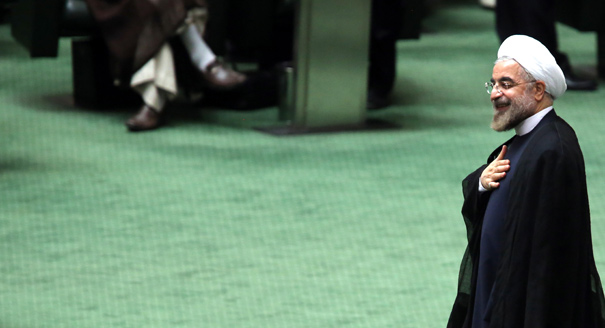
While caution is necessary, there have been several signals from the new Iranian president, Hasan Rouhani, that bode well for nuclear negotiations.
“Our nuclear program is transparent but we’re ready to take steps to make it more transparent,” he said, and that Iran is “ready to engage in serious and substantial talks without wasting time."
This is consistent with his explicit campaign platform over the summer. His appointment of a U.S.-educated foreign minister and now nuclear negotiator for Iran, Javad Zarif, was widely interpreted as an indication that the new president is willing to back up his rhetoric with action. Zarif not only has close ties to the West but also has extensive experience with the nuclear file, having served as Iran’s nuclear negotiator with European counterparts during his time as the Iranian ambassador to the United Nations.
Rouhani has also struck a different note on Syria, by “strongly condemn[ing the] use of chemical weapons.” And the International Atomic Energy Agency has already scheduled another round of talks with Iran in late September.
The sanctions imposed by the international community have taken a toll on Iran’s economy, but frankly, they have failed to induce a change in Iran’s nuclear policies and have arguably strengthened the hand of Iranian hardliners who oppose negotiations.
While economic pressure can provide important leverage for U.S. diplomats, that is only true if they have the opportunity to use that leverage in negotiations. Economic pressure divorced from a diplomatic strategy will not succeed. An effective strategy for resolving the nuclear conflict in the short-term will employ targeted and flexible sanctions as a complement to diplomatic engagement. The first step, however, must be to resume negotiations.
There should also be a long-term vision in the U.S. approach. After several decades of mistrust and miscommunication, building confidence on both sides will be an enormous challenge, but the cost of abandoning negotiations is unconscionably high. A military strike against Iran would be a likely catastrophe, from endangering U.S. personnel and further destabilizing the Middle East to threatening the global economy and spurring another decadelong war in the Middle East.
Importantly, the military option would almost certainly fail to achieve the primary immediate goal -– preventing a nuclear-armed Iran. At best, military strikes may set Iran’s nuclear program back a few years. They would not eliminate it. Meanwhile, Western military action would likely unite Iran behind building a bomb, accelerate the nuclear program and drive it underground, and initiate a spiral into a full-scale war.
The liabilities of pursuing the military option argue strongly for taking on the challenge of negotiations. And there is good reason to be hopeful that negotiations will be successful, provided each side is willing to seriously engage.
There are specific steps that the United States will have to take in order to reach an agreement with Iran: First, accept Iran’s nuclear program under transparent and verifiable limits with proper safeguards. Second, be prepared to relax sanctions as Iran takes action.
These steps are just a beginning; a comprehensive deal will require more intensive negotiations and defining the end result for both sides.
As current events demonstrate, the security challenges of the Middle East cannot be permanently solved solely through the use of American military power. On Iran and other regional challenges, the only lasting solutions will be diplomatic ones.
This article was originally posted in the Cleveland Plain Dealer.
Thomas R. Pickering

Distinguished Fellow
Mathews is a distinguished fellow at the Carnegie Endowment for International Peace. She served as Carnegie’s president for 18 years.
Carnegie does not take institutional positions on public policy issues; the views represented herein are those of the author(s) and do not necessarily reflect the views of Carnegie, its staff, or its trustees.
The acknowledgment has sparked fears of a new arms race with China and Russia.

Chris O’Meara

Smaller powers cannot go it alone, but Canadian history shows that integration with the United States will not always be benign.
Paul Samson

The European Commissioner for Trade is headed to China. But after President Xi’s bridge-building visit to Washington, can a more isolated EU overcome Beijing’s stranglehold on critical raw materials? Who will blink first?

Rym Momtaz, ed.
The summit may be remembered as a fatal blunder, when Washington, Beijing, and the AI industry collectively chose ceremony over action.

Jeffrey Prescott

European NATO countries are wrestling with the possibility of U.S. disengagement from the alliance. With the continent’s security increasingly uncertain, governments must restore the credibility of their collective defense.



Hans-Dieter Lucas, Adam Thomson, Pierre Vimont