

Article
Wang Tao
{
  "authors": [
    "Wang Tao"
  ],
  "type": "legacyinthemedia",
  "centerAffiliationAll": "",
  "centers": [
    "Carnegie Endowment for International Peace",
    "Carnegie China"
  ],
  "collections": [
    "U.S.-China Relations"
  ],
  "englishNewsletterAll": "",
  "nonEnglishNewsletterAll": "",
  "primaryCenter": "Carnegie China",
  "programAffiliation": "",
  "programs": [],
  "projects": [
    "Carnegie Oil Initiative"
  ],
  "regions": [],
  "topics": [
    "Climate Change"
  ]
}
Source: Getty
Struggling sales in the electric vehicle market have resulted in serious questions being raised about their viability.
Source: Scientific American
Struggling sales in the electric vehicle (EV) market have resulted in serious questions being raised about their viability. Despite Chinese government incentives, only a few Chinese EV pilot cities have met their target of putting 1,000 EVs on the road. Meanwhile, in the United States the GM Volt and Nissan Leaf have also missed their own sales targets for 2012 by wide margins. Even the good news from Tesla Motors of a profitable first quarter in 2013 was overshadowed by the gloom of a series of bankruptcies including Fisker Automotive, battery-manufacturer A123 Systems, and electric car company Better Place.
There is room for optimism, however, as the U.S.-China Working Group on Climate Change reconfirmed their joint efforts to develop clean fuel for transportation at the Fifth Strategic and Economic Dialogue this July. And before declaring EVs as a sinking ship, it is useful to consider the development of the first commercial automobile. Its own journey was by no means smooth. When proud owners of horse-drawn carriages in Europe saw the first three-wheeled Benz Motorwagen in 1885, only 25 were sold in the first five years.Similarly to the roadblocks that EVs are facing, early automobiles faced their own share of critiques. The internal combustion engine was unstable and even exploded in several notable incidents. Safety was a big concern as seat belts, four-wheel brakes, and windshields didn’t appear in automobiles until much later. Drivers had to learn a whole new set of skills in order to operate these unpredictable and fragile machines. The bumpy and unpaved roads were made mostly for horses-drawn carriages and without shock-absorbing suspension passengers did not have the most comfortable ride. There was not established network of gas station which limited the travel range. As a result, the automobile was widely regarded as an urban car for commuting and leisure instead of an all-purpose road cruiser. They were associated with societal status, representing power and success.
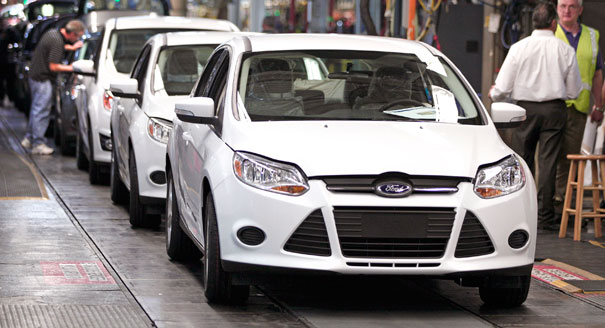
A breakthrough came in 1913 when Henry Ford incorporated the assembly line and interchangeable parts into the Ford automobile manufacturing process. Manufacturing efficiency had improved so much that Ford’s cars soon came off the assembly line in fifteen-minute intervals. The increase in production volume lowered the cost, making it so affordable that an assembly line worker could afford a Ford Model T with four months’ pay. This set off the explosive growth of automobile use and over the past century the United States has added an average of more than one million automobiles to the road every year.
With the explosion of demand for automobiles, technology quickly continued to improve as well. Increased demand also fostered the development of strong social and technological elements to support this growth such as better road infrastructure, regulations, cultural enthusiasm for cars, and improved user experiences. All the early barriers for automobiles were soon swept away.
It is striking how many of the barriers that the EV encounters today are similar to those faced by the automobile about a century ago. These include restricted travel range, safety concerns, mechanical difficulties, and a lack of infrastructure. The transition to EV use, if and when it comes, stands to be even quicker than that to automobiles. In 2011 and 2012, the United States saw about 70,000 new EVs on the road. EVs and hybrids combined made up 3 percent of the United States’ total car sales in 2012. New EV models are also gaining popularity in China and Europe. Globally, the number of charging stations is growing much more quickly than the gas station network thanks to government support.
EVs still need a more extensive charging station network. Better battery technology and a lower price sticker will both be vital. EVs are currently exclusive to the rich—like the early automobile. The technological equivalent of the “assembly line” breakthrough—where volume resulted in increased profit and a lower price in the automobile industry—has yet to come for EVs.
As few expected the success of assembly line in automobile manufacturing, it is the nature of “disruptive innovation” that one can hardly predict where and when the most crucial piece of the EV innovation jigsaw will come. Governments with great EV ambitions like the United States and China need to moderate their expectations and allow more time for technological breakthroughs to drive a transition into EVs. In the meantime, they should focus on developing policies that create the necessary infrastructure and business environment to facilitate this shift. As the assembly line demonstrated at the turn of the last century, new markets do not abide by mandates. Similarly, disrupting the gigantic infrastructure that has developed around the internal combustion engine will require ingenuity, persistence, patience, and a stroke of luck.
This article was originally published in Scientific American.

Former Nonresident Scholar, Carnegie-Tsinghua Center for Global Policy
Wang Tao was a nonresident scholar in the Energy and Climate Program based at the Carnegie–Tsinghua Center for Global Policy.
Recent Work
Wang Tao
Wang Tao, Yang Yifang
Carnegie does not take institutional positions on public policy issues; the views represented herein are those of the author(s) and do not necessarily reflect the views of Carnegie, its staff, or its trustees.

Natural disasters are no longer local incidents but sources of systemic risk that threaten vital infrastructure and the economy—and public support for international engagement.

Leonardo Martinez-Diaz
China’s central bank swap lines could help developing world leaders drive their energy transition—if they harness conditionality to protect their interests.
Ebipere K. Clark

It’s the early days of a new architecture for disaster recovery. Now is the time to build a better, more adaptive funding ecosystem.


Sarah Labowitz, Katie Mears

The EU’s new migration policy is not suited to today’s realities. With climate change increasingly becoming a driver of displacement, Europe needs to rethink its deterrence-focused approach.

Shana Tabak

Examples from Virginia and Lake Tahoe reveal complex situations that governments could use to fund critical grid upgrades.


Kate Gordon, Noah Gordon