

Q&A
- +1
Sheena Chestnut Greitens, Oriana Skylar Mastro, Yukon Huang, …
{
  "authors": [
    "Yukon Huang"
  ],
  "type": "legacyinthemedia",
  "centerAffiliationAll": "dc",
  "centers": [
    "Carnegie Endowment for International Peace"
  ],
  "collections": [],
  "englishNewsletterAll": "asia",
  "nonEnglishNewsletterAll": "",
  "primaryCenter": "Carnegie Endowment for International Peace",
  "programAffiliation": "AP",
  "programs": [
    "Asia"
  ],
  "projects": [],
  "regions": [
    "East Asia",
    "China"
  ],
  "topics": [
    "Economy"
  ]
}
Source: Getty
China’s unbalanced growth is the result of a healthy urbanization process which has been good for the economy, and this process is likely to continue generating unbalanced growth for a while longer.
Source: Financial Times
That China’s growth is unbalanced is a fact. Consumption as a share of GDP has declined steadily over the past decade to 35 percent — the lowest of any major economy — while its investment share rose to above 45 percent, correspondingly the highest (Figure 1). But are these imbalances a vulnerability — as most observers believe — or a consequence of China’s economic rise and therefore not inherently problematic?

Many analysts attribute these imbalances to low interest rates, supported by an undervalued exchange rate, which are seen as repressing consumption and encouraging excessive investment. But this argument is misleading since the primary reason for these imbalances is not financial repression but a broadly successful urbanisation cum industrialisation process. This process has caused household income to fall as a share of GDP and the savings rate to rise, which together explain the decline in consumption as a share of GDP over the past decade and half.
All this was laid out by Arthur Lewis in his Nobel Prize-winning model that showed how the transfer of surplus workers from the rural sector to the modern economy, complemented by rising investment, leads to rapid but unbalanced growth. His analysis also prescribed the conditions when labor supplies tighten, growth slows and the economy becomes more balanced – now commonly referred to as the “Lewis turning point”.These imbalances come from the impact of urbanisation on labor’s share of GDP as workers move from rural to urban-based activities. Assume for example that a typical Chinese farmer produces rice worth 10,000 RMB a year and nets 9,000 after paying for inputs. He then saves 2,000 and spends 7,000. In the national accounts, his activity translates into a consumption share of 70 percent of the value of production.
Suppose that he moves to Shenzhen and gets a job with Apple (Foxconn) and is paid a typical 30,000 RMB a year. Like most migrants, he saves half and consumes half, or 15,000. Apple combines his labor with capital and imported parts to produce iPads worth 60,000 in terms of valued added. His consumption as a share of industrial value added is now 25 percent.
As in Figure 2, this particular labor transfer shows up in the national accounts as labor’s share of output going from 90 percent to 50 percent and consumption as a share of GDP going from 70 percent to 25 percent.

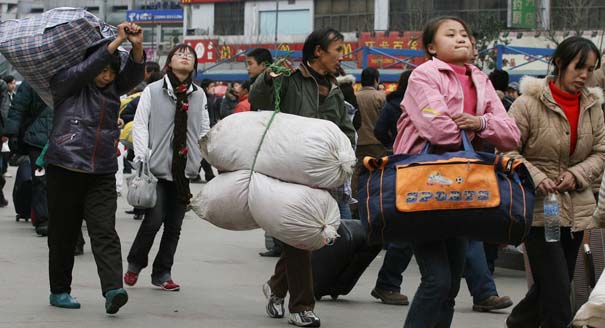
This story has been replicated through the transfer of tens of millions of migrant workers annually. This has led to a sharp decline in workers in agriculture from around 50 to 35 percent of the labor force and a commensurate increase in industry and services. (Figure 3a) Because labor’s share of output is much lower in industry, at around 50 percent compared with nearly 90 percent in agriculture (Figure 3b), labor’s share of GDP has plunged, as seen in Figure 4.

But there is nothing perverse about this decline, since migrant workers are earning and consuming multiples more than they used to, firms are able to expand through increased labor absorption and investments, and the country benefits from higher productivity and double-digit growth rates.


The impact of the urbanisation–industrialisation process becomes even clearer when the decline in household income as a share of GDP in Figure 4 is decomposed by region. If financial repression or exchange rates is the reason for China’s unbalanced growth, one would not expect the shape of the decline to vary by region since the pricing regime is similar nationwide. Further, if there are regional differences, then one might expect the decline to be more pronounced in the eastern region given its major industrial and commercial centers. In fact, the opposite is true. Since 2000 the far west — rather than the east coast — has experienced a huge 40 percentage point decline in the share of household income to GDP while the other regions have undergone a far more gradual decline over several decades. (Figure 5)
Clearly what has been happening is both location and event related. How does one explain this regionally differentiated pattern? The answer is the urbanisation–industrialisation process.
The sharp descent in the Western region reflects both its delayed urbanisation process relative to the rest of the country, which explains its high household income share prior to 2000, and the impact of Beijing’s “Develop the West” initiative launched in the late 90s. This programme supported massive investments in infrastructure and income generating activities which prompted a rapid decline in labor’s share of production as workers shifted from traditional rural activities to industry and services with much higher earnings potential.
While everyone recognizes that China’s imbalances have mushroomed over the past decade, few if any realize that this was due to the transfer of labor in the far west rather than developments along the coast. If they did, they would have understood that China’s unbalanced growth is caused by the urbanisation cum industrialisation process, not financial repression.
The decline in consumption as a share of GDP, however, was amplified by higher savings rates. There is a huge literature on why savings rates have risen during this period. Many reasons have been advanced, including China’s weak welfare system, aging population and low interest rates. But again largely ignored is the role that urbanisation – through labor migration – plays in explaining the increase. As seen in Figure 6, the increase in overall savings rates is due to escalating urban savings rates since rural savings rates have remained broadly unchanged. This regional differentiation comes from migrant workers being ineligible to access social services in cities due to lack of residency rights – which then forces them to save a much higher proportion of their income than established urban residents.

In sum, urbanisation largely explains both the decline in labor’s share of income and the increase in savings rates, which together explain the decline in consumption as a share of GDP. Also worth noting is that contrary to popular perceptions per capita consumption has been growing by 8 percent annually — the highest of any major economy — even as the consumption share to GDP has been falling.
China’s unbalanced growth pattern mirrors other successful emerging East Asian economies that went through a similar urbanisation–industrialisation process several decades ago. The consumption share of GDP for Japan, South Korea and Taiwan fell by 20-30 percentage points, bottoming out at adjusted per capita income levels in the range of US$12-15,000 compared with China’s current $9,000. The decline in the consumption share is mirrored by a sustained increase in the investment share of GDP in all three economies, peaking around 40 percent of GDP. The common thread linking all these East Asian countries is that widening imbalances were associated with urbanisation and high growth rates that allowed them to escape the middle income trap and eventually transition to more balanced outcomes as their economies matured.
Misinterpreting the reasons why China’s growth is unbalanced in terms of macro-aggregates leads to the wrong policy prescriptions, including the argument that China needs a more “consumption-led” growth model — a concept which does not exist in economic theory — or that China needs to grow more slowly so that the share of consumption to GDP will increase — which confuses means and end.
But China does face major economic problems brought on by declining productivity and surging debt levels. The challenge for the new leadership is to escape the middle income trap by implementing a complex set of structural reforms so that the economy can grow at around 7 percent for the remainder of this decade. This will not be easy. China needs to improve the efficiency of its urbanisation process and develop more appropriate financing sources. If it succeeds, then rebalancing will eventually occur as a byproduct of a more sustainable growth path but not as the intrinsic objective.
This article was originally published in the Financial Times.

Senior Fellow, Asia Program
Huang is a senior fellow in the Carnegie Asia Program where his research focuses on China’s economy and its regional and global impact.
Recent Work


Sheena Chestnut Greitens, Oriana Skylar Mastro, Yukon Huang, …


Yukon Huang, Isaac B. Kardon, Matt Sheehan

Russian strikes are weakening the economy sustaining Ukraine’s war effort. Closing the growing funding gap will require more European support and politically contentious reforms in Kyiv.

Balázs Jarábik

While the EU and European governments are embracing the much-lauded middle-power moment, this entails three difficult conundrums.

Richard Youngs

Europe is facing rising populism internally as well as external pressures from Russia, China, Turkey, and the United States.

Dimitar Bechev

Economic recovery has brought Sri Lanka a modicum of stability, but domestic strains and great-power rivalry could test how long it lasts.

Avinash Paliwal

Policy proposals on sovereign debt must both match the scale of the challenge and be implementable within existing political constraints.

David McNair