

Commentary
Dmitri Trenin
{
  "authors": [
    "Dmitri Trenin"
  ],
  "type": "commentary",
  "centerAffiliationAll": "",
  "centers": [
    "Carnegie Endowment for International Peace",
    "Carnegie Russia Eurasia Center"
  ],
  "collections": [],
  "englishNewsletterAll": "",
  "nonEnglishNewsletterAll": "",
  "primaryCenter": "Carnegie Russia Eurasia Center",
  "programAffiliation": "",
  "programs": [],
  "projects": [],
  "regions": [
    "Russia",
    "Eastern Europe",
    "Ukraine"
  ],
  "topics": [
    "Foreign Policy"
  ]
}
Source: Getty
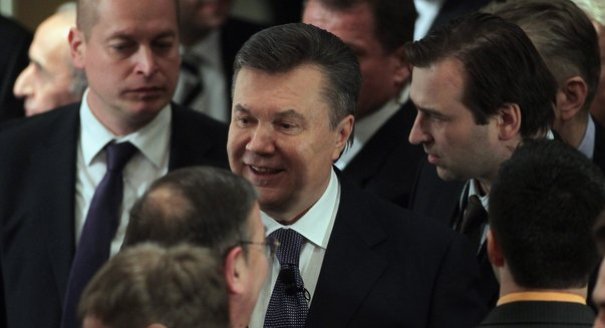
Ukraine will most probably sign an association agreement with the European Union. This is good news for Russia, including Vladimir Putin—although he would emphatically disagree.
Speaking in Bali, Vladimir Putin has conceded that Ukraine will most probably sign an association agreement with the European Union. This is good news for Russia, including for its president—although he would emphatically disagree. Suppose Ukraine had accepted Putin's courtship and decided to accede to the Customs Union of Russia, Belarus, and Kazakhstan. To reward its new partner in the Customs Union and demonstrate that Kiev made the right choice, Moscow would have had to start pouring money into Ukraine. It would have had to lower the price it charges for gas; it would have had to give Ukraine low-interest loans; and it would have had to share part of its arms procurement outlays with the Ukrainian defense industry.
Not only that. Putin would have needed to give Viktor Yanukovych a significant say in the decision-making process within the Customs Union. Ukraine's membership in the project, so much desired by Russia, would have come at a high price. President Yanukovych and his colleagues would have de facto acquired powers to arbitrate between Russia and the other members of the union, seeking more even benefits for Kiev. In case Russia and Ukraine had a serious disagreement, this would have threatened the very existence of the Customs Union. Finally and most importantly, no amount of Russian concession would have made Ukraine give up the one thing that unites the country's elite, east and west, government and opposition: a desire to be independent from Russia. It would always be looking for the exit.
There is something so simple and obvious, which Putin and many of his associates would never truly understand: that there can be no significant pro-Russian elements within the Ukrainian elite. Lviv, Kiev, Kharkiv, and Odessa all feel that real integration with Moscow would put an end to the Ukrainian national project. That made it virtually certain that Ukraine, even if it had become engaged to Russia, would have fled its suitor just before the actual wedding. Thus, by flatly rejecting Putin's offer, Yanukovych is doing a service to Russia.
A Eurasian Union without Ukraine would still make perfect sense. It would remain a useful if modest, largely geo-economic exercise, quietly and more or less successfully managed by Moscow. It would save Russia from investing in an illusory "civilizational" project with a huge negative yield and a bitter disappointment in the end. It would let Russia focus on itself and eventually seek to modernize its own politico-economic system as well as find its appropriate place and role in the world. It would make it imperative that Russia evolves to become a multi-ethnic nation state rather than a posthumous version of the defunct empire.
The European Union, by welcoming Ukraine into an association with itself, would need to pay attention—and more—to make the association live up to at least the minimal expectations on the Dnieper. It would have to help Ukraine modernize its economy, legal system, and governance. It would have to use stimuli to help Ukraine make the right choices, and stick to them. Yanukovych, Tymoshenko, and others will be Europe's problems, as well as Ukraine's. Those who will rise to replace them with something more modern will seek Europe's support in their endeavor. This Ukraine would never fly to the Moon, but, hopefully, it might be a more predictable partner and even offer useful modernization lessons to Russia.
Ukraine's association with the EU, however, will be a process, not an event. Vilnius will be an important milestone, not a capstone. President Putin still thinks he has lost a battle, but not yet the campaign. Moscow will try harder, often working at cross-purposes with itself. Those will be useful mistakes, destroying the great illusion that, as Putin put it, Ukrainians and Russians are one people. They are close, but precisely because of this their differences matter—and the sooner the Kremlin realizes this, the more realistic—and more successful—Russia's foreign policy will become.
Former Director, Carnegie Moscow Center
Trenin was director of the Carnegie Moscow Center from 2008 to early 2022.
Recent Work
Dmitri Trenin
Dmitri Trenin
Carnegie does not take institutional positions on public policy issues; the views represented herein are those of the author(s) and do not necessarily reflect the views of Carnegie, its staff, or its trustees.

Despite public disputes over trade and immigration, the strategic partnership’s foundations remain sturdy.

Sameer Lalwani
Russia spent years building a “sovereign internet,” concentrating web infrastructure exclusively within Russian territory. Ukrainian drone attacks have shown how vulnerable that approach has left the Russian internet.

Maria Kolomychenko

With its public finances in shambles, the far right polling at 35 percent ahead of the 2027 presidential election, and a growing protest movement, is France’s crisis a threat to the EU’s geopolitical awakening?

Rym Momtaz, ed.

Putin’s conservative staffing policies and search for ever greater control have cemented parliament’s transformation into a bureaucratic appendage of the executive branch.

Andrey Pertsev

Russia’s AI-driven propaganda campaigns operate in a fragmented, chaotic, and often illogical manner. That’s not necessarily a problem for the Kremlin, though: It’s much easier to mimic genuine public debate that way.

Ilya Klishin