

Commentary
Thomas de Waal
{
  "authors": [
    "Thomas de Waal"
  ],
  "type": "commentary",
  "centerAffiliationAll": "",
  "centers": [
    "Carnegie Endowment for International Peace",
    "Carnegie Europe",
    "Carnegie Russia Eurasia Center"
  ],
  "collections": [],
  "englishNewsletterAll": "",
  "nonEnglishNewsletterAll": "",
  "primaryCenter": "Carnegie Europe",
  "programAffiliation": "",
  "programs": [],
  "projects": [],
  "regions": [
    "Caucasus",
    "Azerbaijan"
  ],
  "topics": [
    "Political Reform"
  ]
}
Source: Getty
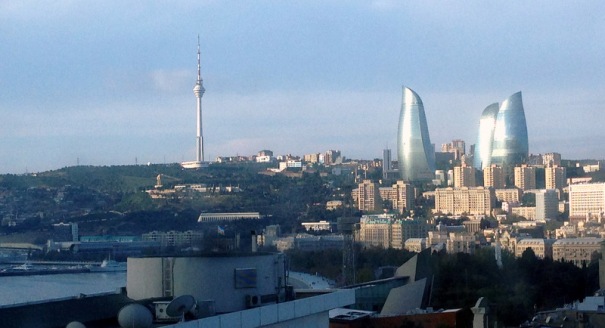
Ilham Aliyev is attempting modernization without wholesale political reform. Most of the veterans of the Azerbaijani elite remain in their jobs, including the elderly prime minister and presidential chief of staff. The skyline is changing in Baku, but so far the street-plan remains the same.
With every year, the transformation of Baku continues apace. New buildings fill the skyline. At night fire creeps up the facade of the giant Flame Towers. On Tuesday, the new breathtaking Heydar Aliyev Cultural Center, built by British architect Zaha Hadid, was inaugurated.
Tall buildings are of course little more than a statement of intent. What about down below? The post-election environment in Azerbaijan is less euphoric. The authorities are rowing with Western governments for their criticism of the conduct of the polls. The main non-governmental election-monitoring organization was raided by the police.
There has been one major change: Azerbaijan has a new defense minister, replacing the long-serving Safar Abiyev. Everyone says that Zakir Hasanov, formerly head of the interior forces, has been brought up to clean up the house. What does his appointment mean? Will he succeed?
Hasanov, whose family is originally from the Armenian town of Masis, is evidently the candidate of one clan in the Azerbaijani elite, those with roots in Armenia and Nakhichevan. He is said to be close to the Head of the General Staff Nejmeddin Sadiqov. That means that for the first time the leadership across all branches of the armed forces is working together.
Under its previous command, the Azerbaijani army was notorious for corruption, hazing, and the non-combat death of conscripts. A large portion of its vast budget was being siphoned off. Hasanov will now attempt to root that out (within limits), to modernize it, and to model it more on the Turkish rather than the Russian military.
Newly reelected President Ilham Aliyev is clearly sending a message to the Armenians and the international community on the Karabakh conflict: we intend to make our military threat more credible—take notice.
But everyone I speak to here says the domestic part is more important. That is a message by Aliyev to the public that he takes their concerns about abuses in the military seriously—after all every family in Azerbaijan has someone serving as a conscript. For similar reasons he removed the mayor of the town of Ismayili, whose high-handed behavior provoked protest riots earlier this year.
Before the election, Aliyev also sought to deal with another issue the public is unhappy about, the dreadful state of the education system, by appointing a young new education minister Mikayil Jabbarov.
But these appointments can also be seen as Aliyev's "Medvedev moment.” He is attempting modernization without wholesale political reform. Most of the veterans of the elite remain in their jobs, including the elderly prime minister and presidential chief of staff. The skyline is changing in Baku, but so far the street-plan remains the same.

Senior Fellow, Carnegie Europe
Thomas de Waal is a senior fellow at Carnegie Europe, specializing in Eastern Europe and the Caucasus.
Recent Work
Thomas de Waal
Thomas de Waal
Carnegie does not take institutional positions on public policy issues; the views represented herein are those of the author(s) and do not necessarily reflect the views of Carnegie, its staff, or its trustees.

Sergei Kiriyenko used Russia’s parliamentary vote to further hone his strategy of corporate mobilization that is designed to maximize votes for United Russia.

Andrey Pertsev

Before the next wave of EU enlargement takes place, the union needs to grapple with thorny questions of how power is distributed among its members.


Emil Sondaj Hansen, Ditte Brasso Sørensen

The European far right might fail to steer EU policy in the direction Russia wants, but they will create enough chaos inside Europe to benefit the Kremlin.

Dimitar Bechev

If the Russian-speaking community in Latvia cannot articulate their interests without being seen as disloyal, they could end up embracing a pro-Kremlin agenda.

Sergejs Potapkins

Russia’s ruling party would have benefited from Putin appearing as its distant patron, but as an active frontman imposing his views on the public, he has done nothing but harm both the party’s election campaign and the ruling system overall.
Andrey Pertsev