This year’s top three “men of the year” include Pope Francis, Vladimir Putin, and Edward Snowden.
Pope Francis came in first in the Time Magazine’s rating, with Snowden close behind him. Vladimir Putin was picked as this year’s number one in the Forbes list of the most powerful. Edward Snowden was the choice of his original “promoter,” The Guardian. None of the three publications can claim “objectivity:” the choice is made either by the publication’s editors or its readers. But the preferences of the American people at large were not dissimilar from those of the cited media—no wonder, since the people’s opinions are mostly shaped by the media. In a public opinion poll conducted by Rasmussen Reports, a prominent American pollster, Pope Francis was number one, President Obama came in second, and the third was Republican Senator Ted Cruz, an anti-Obamacare crusader. Cruz was also a runner-up in the Time Magazine’s list. The Russian people picked President Putin as their number one for 2013—as they have done every year since 1999, according to the Russian pollster FOM (Public Opinion Foundation).
The constancy of the Russian choice may be anomalous, yet easily explained by Putin’s uncontested political power and his status as the “leader-of-no-alternative.” In a politically diverse environment, such as the United States, “men of the year” vary year to year, yet the choice is amazingly self-evident. The Forbes rating of the world’s most powerful people is especially striking in this respect. The need to pick “the most powerful” has reduced the nominees to a small group of leaders of the most influential nations: Obama, Hu Jintao, Putin in 2009; Hu Jintao, Obama, King Abdullah of Saudi Arabia in 2010. The absence of the Russian leader at the top of the 2010 list was likely caused by the hope of a real transfer of power in the Russian Federation, but since no such thing happened, in 2011 Forbes is back to the familiar triad: Obama, Putin, and Hu Jintao. In 2012, the top three were Obama, Merkel, and Putin—the absence of the Chinese leader was likely due to the forthcoming change of guard in the People’s Republic. Finally, in 2013, with the new Chinese leader firmly in place the Forbes’ “most powerful” are Putin, Obama, and Xi Jinping.
The Time Magazine’s “Man of the Year,” launched in 1927, is not restricted to political figures, but still most of those who have appeared on its “man of the year” cover are national leaders. This collection includes almost every American president, some of them twice, as well as an array of heads of state, from monarchs to general secretaries of the communist party and the Paramount Leader Deng Xiaoping. In 1999, the “Man of the Year” was replaced by a politically correct “Person of the Year,” but the overwhelming majority of “persons” were still male figures—politicians or entrepreneurs.
Every now and then since the launch of the Time Magazine’s “Man of the Year” over 80 years ago, the editors have chosen not an individual, but a group or a category. For instance, in 1993 it was “The Peacemakers,” in 2002 “The Whistleblowers,” in 2005 “The Good Samaritans,” and in 2006 the choice of “You” celebrated “the individual content creator on the World Wide Web. (A couple of times the “man of the year” was an inanimate object: “The Computer” in 1982 and “The Endangered Earth” in 1988.)
By choosing The Whistleblowers or The Good Samaritans The Time editors probably wanted to offer their readers a diversion from the dull line of the topmost political and business figures. But another trend may be also at work here. Groups and categories first occurred in the 1950s and have appeared more often in recent times. This may reflect a somewhat lower role of the leaders and a larger role of the people in shaping their societies’ lives. Or, looking from a different perspective, this may have to do with the often lamented disappearance of great statesmen.
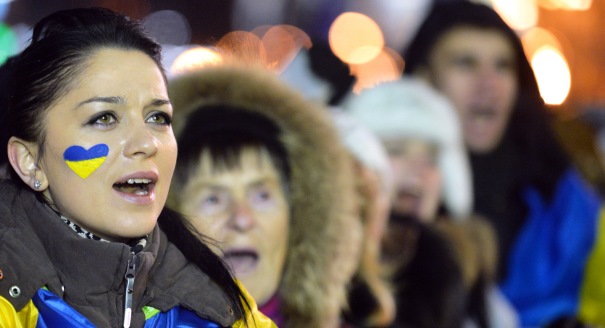
Anyhow, if I were to choose the “people who made history in 2013,” I would think about the actual people. I would vote for those Ukrainians who gathered in the Kiev Independence Square. Hundreds of thousands came to stand up for their compatriots severely beaten by the police. The Ukrainian people’s peaceful and mostly leaderless antigovernment protest was driven by a genuine and selfless desire to improve their country. They did not succeed. But their amazing tenacity and resilience made history in 2013.