

Commentary
If the Russian-speaking community in Latvia cannot articulate their interests without being seen as disloyal, they could end up embracing a pro-Kremlin agenda.
Sergejs Potapkins
{
  "authors": [
    "Alexandra McLees"
  ],
  "type": "commentary",
  "centerAffiliationAll": "",
  "centers": [
    "Carnegie Endowment for International Peace",
    "Carnegie Russia Eurasia Center"
  ],
  "collections": [],
  "englishNewsletterAll": "",
  "nonEnglishNewsletterAll": "",
  "primaryCenter": "Carnegie Endowment for International Peace",
  "programAffiliation": "",
  "programs": [],
  "projects": [],
  "regions": [
    "Eastern Europe",
    "Ukraine"
  ],
  "topics": [
    "Political Reform",
    "Democracy",
    "Civil Society"
  ]
}
Source: Getty
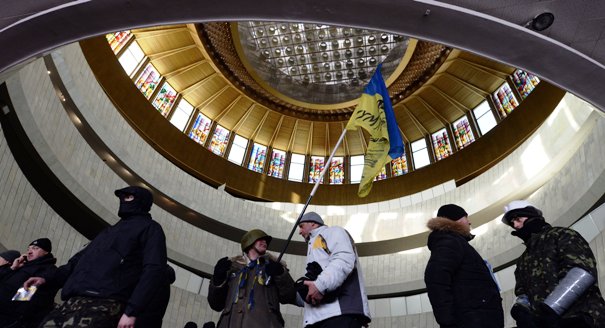
Ukrainians on the Maidan and in a growing number of cities across the country are standing in opposition to backsliding into autocracy, in defense of fundamental democratic values, and in defiance of a corrupt post-Soviet system.
The Euromaidan protests have been going on for almost two months now, with between 500-2,000 protesters permanently camped out on the square and weekly Sunday rallies, which have drawn almost a million people. These protests, which originated in response to the government’s decision to suspend association and free trade agreement negotiations with the EU, have evolved on a weekly basis, responding to concerning events and voicing further demands. Their lack of a unified leadership and breadth of demands has led many to doubt their ability to effect change.
The recent attempts to cripple the opposition with legislation aimed at curbing the continuing anti-government protests, the work of independent journalists and the activism of hundreds of civic organizations, backfired and resulted in an eruption of violence on the streets of Kiev. A too little, too late power share offer from President Viktor Yanukovych was rejected by opposition leaders this past weekend, after outrage erupted among the Euromaidan protesters highlighting a clarification of their demands. The rejection of this offer by the protesters themselves demonstrated that a cosmetic change of appointing opposition leaders to the posts of prime minister and deputy prime minister would not suffice even if this change in government could put Ukraine back on a pro-European path. It made clear that the underlying motivation inspiring protestors to stand in freezing cold weather is something far deeper than an association agreement with the EU.
The ongoing transformative process happening in Ukraine that began with the Orange Revolution in 2004 goes deeper than legislative amendments or even a response to police brutality. It is changing the national fabric of Ukraine. With the sanctioning of violence against the opposition and the passage of blatantly un-democratic anti-protest laws, Yanukovych has highlighted a cause that goes beyond the divisive choice of Russia or Europe. The recent measures undertaken by Yanukovych and his government against the protesters have underscored the increasing threat to democracy and the corruption prevailing throughout the system of governance. Ukrainians on the Maidan and in a growing number of cities across the country are standing in opposition to backsliding into autocracy, in defense of fundamental democratic values, and in defiance of a corrupt post-Soviet system. There is a growing realization that the country is in need of a fundamental structural change that would stamp out corruption, ensure a sustained democratic process and bring stability to Ukraine.
With the realization that cosmetic changes and efforts at appeasement are as fruitless as repression and violence, Yanukovych’s alternatives are limited. As German Foreign Minister Steinmeier said, “The route taken by President Yanukovych is a dead end. Repression cannot be the response to a politically contentious debate.” What Ukrainians are calling for is the political space to independently and peacefully, through a free and fair democratic process, decide the course of their country’s future.
Alexandra McLees
Former Junior Fellow, Russia and Eurasia and Energy and Climate Programs
Carnegie does not take institutional positions on public policy issues; the views represented herein are those of the author(s) and do not necessarily reflect the views of Carnegie, its staff, or its trustees.

If the Russian-speaking community in Latvia cannot articulate their interests without being seen as disloyal, they could end up embracing a pro-Kremlin agenda.

Sergejs Potapkins

Russia’s ruling party would have benefited from Putin appearing as its distant patron, but as an active frontman imposing his views on the public, he has done nothing but harm both the party’s election campaign and the ruling system overall.

Andrey Pertsev
Despite myriad challenges and occasional stumbles, the new Hungarian government is moving ahead with energy and conviction to uproot years of illiberalism and corruption and rebuild Hungarian democracy.

Thomas Carothers

European Commission President Ursula von der Leyen is about to give her annual address on the state of the EU. Here’s what she won’t—but should—say.

Rym Momtaz

Radical-right parties are expected to do well in upcoming elections in four of the EU's biggest member states. If successful, they could prevent the union from addressing key challenges ahead.

Stefan Lehne