

Commentary
Bayram Balci
{
  "authors": [
    "Bayram Balci"
  ],
  "type": "legacyinthemedia",
  "centerAffiliationAll": "dc",
  "centers": [
    "Carnegie Endowment for International Peace",
    "Malcolm H. Kerr Carnegie Middle East Center"
  ],
  "collections": [],
  "englishNewsletterAll": "menaTransitions",
  "nonEnglishNewsletterAll": "",
  "primaryCenter": "Carnegie Endowment for International Peace",
  "programAffiliation": "MEP",
  "programs": [
    "Middle East"
  ],
  "projects": [],
  "regions": [
    "Middle East",
    "Türkiye"
  ],
  "topics": [
    "Foreign Policy"
  ]
}
Source: Getty
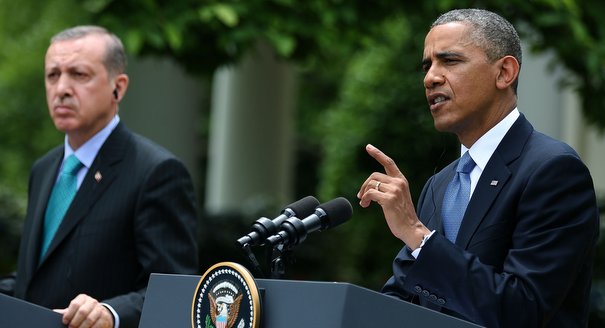
Turkey’s authoritarian drift is undoubtedly complicating relations with the United States. However, Washington should not allow this to undermine an invaluable alliance.
Source: National Interest
Turkey’s authoritarian drift is undoubtedly complicating relations with the United States. However, Prime Minister Recep Tayyip Erdoğan remains one of the most tolerable heads of state in the region and Washington should not allow this to undermine an invaluable alliance. A huge corruption scandal implicating figures with close ties to Erdoğan has been at the top of the agenda in Turkey over the past month, tarnishing his image together with that of his government. Three of his ministers were forced to resign, spurring an unprecedented cabinet reshuffle. This was followed by dismissals within the police force and judiciary. An overconfident Erdoğan’s growing authoritarianism is paradoxically undermining him and polarizing Turkish society, leading the country toward instability in a Middle East in which Turkey had previously been a stabilizing force.
The AKP, which came to power in 2002 with the aim of bringing justice and transparency to politics, has been caught up in an unparalleled corruption scandal at the highest levels of government. Serious in and of itself, the scandal has also marked a definitive rupture between Turkey’s two most important political and religious forces whose alliance led to considerable economic progress over the past 10 years, and even advances in governance. But the honeymoon is now over between the political establishment represented by Erdoğan and the spiritual forces embodied by Fethullah Gülen—a cleric who heads a very powerful transnational religious community that wields influence over education, the media, business and now politics, with his sympathizers suspected of having infiltrated the police and judiciary.
After 12 years of jointly opposing the powerful Turkish army, once the linchpin of the political system and now defeated, the Erdoğan-Gülen alliance has been shattered by a fratricidal competition in which each party is revealing its true nature: the AKP is falling back on an authoritarian Islamist ideology, while the Gülen movement is unveiling ambitions that are more political than spiritual. Both have much to lose in this contest, but Turkey could lose more.
Erdoğan categorically denies corruption within his cabinet. Speaking of a Gülenist coup d’état, he has initiated an unprecedented purge of the shadowy forces that he sees as being against him in the police and the judiciary. In so doing, he is protecting himself in the short term, but by launching a witch hunt against Gülenists in government institutions, he is undermining the entire political system. This will most certainly create divisions within the country. As for the Gülen movement, its fight is existential, for its survival is at stake. It is convinced of this, because a few weeks before the events of December 17, the Prime Minister announced that he wanted to close the country’s dershane—private university preparatory schools that number in the thousands—nearly half of which are run by companies affiliated with the Gülen movement. If implemented in 2015 as planned, this measure could precipitate Gülen’s economic and spiritual ruin, as these schools represent a financial windfall while serving as incubators for Gülenist leaders.
Political and institutional instability is therefore likely to increase during 2014. And the regional context—itself subject to deep political upheavals—will not calm matters. In such a delicate situation, Washington will have to deal with its traditional Turkish ally in a rather different way.
It is now difficult to present the AKP as an ideological model for the new Arab world. Ultra-popular during the euphoric days of the Arab Spring, Erdoğan lost his popularity when that springtime turned into a nightmare in Syria. He was then repudiated when the military dictatorship returned to power in Egypt and overthrew his ideological allies, the Muslim Brotherhood. Since then, he has lost the upper hand.
Given this context, Washington should not further isolate Erdoğan by criticizing his encroaching authoritarianism, to avoid throwing Turkey into chaos. Excessive criticism would validate the claims of international conspiracy theorists. Indeed, in Turkey there are those in every political camp who believe that whatever the domestic crisis, the United States is behind it. Criticizing Erdoğan is counterproductive, feeds anti-Americanism, and only strengthens the Islamist electoral base in the Anatolian hinterlands. The fact that Gülen has been living in exile in Pennsylvania since 1999 and runs the most substantial religious community that now wields influence in the very heart of the state stokes the popular obsession with conspiracy theories.
Erdoğan’s shift, while troubling, can be explained by the tension of the regional situation, the failure of the Arab Spring, and the worsening of the Syrian crisis combined with Turkey’s unfortunate and inevitable involvement in it. Erdoğan remains one of the rare regional leaders to have been democratically elected. And Turkey remains a country in which the people and the government respect the power of the ballot box. Erdoğan’s reaction is easy to criticize, but it isn’t up to the U.S. to condemn him. Rather, Washington should take a patient approach and trust in Turkish voters to place their country on a more democratic path with the local elections in March and a presidential poll in August.
This article was originally published in the National Interest.
Former Nonresident Scholar, Russia and Eurasia Program
Balci was a nonresident scholar in Carnegie’s Russia and Eurasia Program, where his research focuses on Turkey and Turkish foreign policy in Central Asia and the Caucasus.
Recent Work
Bayram Balci
Bayram Balci, Daniyar Kosnazarov
Carnegie does not take institutional positions on public policy issues; the views represented herein are those of the author(s) and do not necessarily reflect the views of Carnegie, its staff, or its trustees.

The EU can impose sanctions but struggles to enforce them without the United States. With Washington increasingly disinterested in backing European interests, the bloc must now fend for itself.


Nicu Popescu, Tiago Antunes
Global and rising powers will need to engage with Africa’s priorities and agency in order to secure the continent’s increasingly attractive partnerships.

Fonteh Akum

Rubio’s recent visit brought welcome attention, but more capital requires governance changes that may be a hard sell for regional governments.

Jennifer B. Murtazashvili

America’s foreign-policy objectives have grown more demanding while Americans have demanded greater focus on their own affairs.

Stephen Wertheim

Japan’s long-term security policy is driven by concerns about China, and there is little appetite for (or interest in) pursuing a confrontation with Moscow.

James D.J. Brown