

In The Media
Lilia Shevtsova
{
  "authors": [
    "Lilia Shevtsova"
  ],
  "type": "legacyinthemedia",
  "centerAffiliationAll": "",
  "centers": [
    "Carnegie Endowment for International Peace",
    "Carnegie Russia Eurasia Center"
  ],
  "collections": [],
  "englishNewsletterAll": "",
  "nonEnglishNewsletterAll": "",
  "primaryCenter": "Carnegie Russia Eurasia Center",
  "programAffiliation": "",
  "programs": [],
  "projects": [],
  "regions": [
    "Eastern Europe",
    "Ukraine"
  ],
  "topics": [
    "Political Reform",
    "Economy",
    "Security"
  ]
}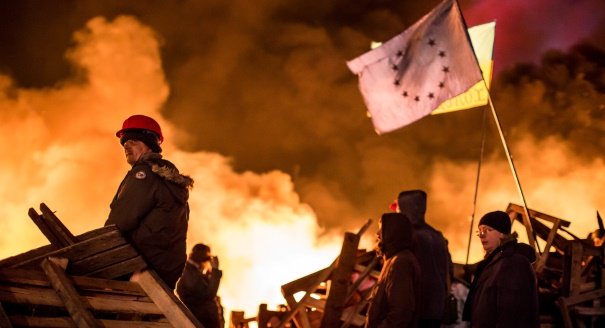
Source: Getty
It is not clear how long the uncertainty over Ukraine’s new course will last. But the challenges that the country is facing are more obvious.
Source: American Interest
It isn’t clear how long the uncertainty over Ukraine’s new course will last. But the challenges that the country is facing are more obvious. I will discuss ten major ones.
1. On the Ukrainian Revolution. So far, the Ukrainian rebellion has only caused the Yanukovych regime to fall. There are grounds for concern that the rebellion will eventually result in just another regime change, followed by the return of the old clannish system. The oligarchic groups will again be represented by the 2004 opposition (including Yulia Timoshenko), which is responsible for establishing the corrupt oligarchic system in the country. Besides, the leftovers of the Yanukovych regime represented by the Party of Regions retain strong positions in the south and east of Ukraine, preserving the threat of counter-revolution.2. On the Maidan. One of the great achievements of the protests was the emergence of nationwide, grassroots political organization. The new opposition, which bears no responsibility for the past wrongs, is still not influential enough; thus the Maidan remains the only force that can stop the country and its political elite from reverting to its corrupt past. Calls for disbanding the Maidan, issued by the representatives of the forces who took power, testify to their intention to make themselves unaccountable to the public. Another scenario—co-opting the Maidan forces into state structures—would also make it impossible for the people to control the government, since there is still no strong opposition independent of oligarchic influences.
3. On the reforms. Apart from changing the ruling team, Ukraine has to change the rules of the game. The return to the 2004 Constitution does not guarantee the creation of a rule-of-law state. The parliamentary system may become a convenient tool for advancing the interests of the oligarchic clans. It should come as no surprise, then, that the pro-Russian lobby supports this constitution. Only a government of national trust, one untarnished by past misdeeds, and one that includes people ready to sacrifice their political ambitions, can implement painful reforms. The current way of forming the new government, with the approval of the Maidan, seems to be a serious attempt on the part of the opposition to create a government trusted by the people. ...
Read the full text of this article in the American Interest.

Former Senior Associate, Russian Domestic Politics and Political Institutions Program, Moscow Center
Shevtsova chaired the Russian Domestic Politics and Political Institutions Program at the Carnegie Moscow Center, dividing her time between Carnegie’s offices in Washington, DC, and Moscow. She had been with Carnegie since 1995.
Recent Work
Lilia Shevtsova
Lilia Shevtsova
Carnegie does not take institutional positions on public policy issues; the views represented herein are those of the author(s) and do not necessarily reflect the views of Carnegie, its staff, or its trustees.

China’s political future will be shaped between now and next October. As the Communist Party enters its intense “campaign season” to prepare for a major political transition in 2027, reading Beijing's actions and responses may become more difficult as domestic politics weigh on its behavior more than usual.

Damien Ma

The EU can impose sanctions but struggles to enforce them without the United States. With Washington increasingly disinterested in backing European interests, the bloc must now fend for itself.


Nicu Popescu, Tiago Antunes

Rubio’s recent visit brought welcome attention, but more capital requires governance changes that may be a hard sell for regional governments.

Jennifer B. Murtazashvili

Japan’s long-term security policy is driven by concerns about China, and there is little appetite for (or interest in) pursuing a confrontation with Moscow.

James D.J. Brown

Russia is testing the waters of NATO’s mutual defense clause. What do strikes in Romanian territorial waters mean for the alliance’s posture toward Moscow?

Dimitar Bechev