

In The Media
Lina Khatib
{
  "authors": [
    "Lina Khatib"
  ],
  "type": "legacyinthemedia",
  "centerAffiliationAll": "dc",
  "centers": [
    "Carnegie Endowment for International Peace",
    "Malcolm H. Kerr Carnegie Middle East Center"
  ],
  "collections": [],
  "englishNewsletterAll": "menaTransitions",
  "nonEnglishNewsletterAll": "",
  "primaryCenter": "Malcolm H. Kerr Carnegie Middle East Center",
  "programAffiliation": "MEP",
  "programs": [
    "Middle East"
  ],
  "projects": [],
  "regions": [
    "Levant",
    "Syria",
    "Middle East"
  ],
  "topics": [
    "Political Reform",
    "Security"
  ]
}
Source: Getty
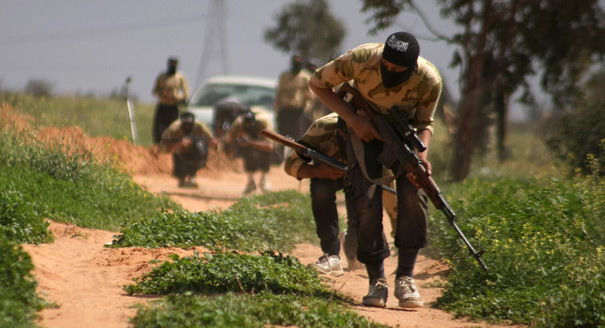
The growing influence of the Islamic State of Iraq and Syria and the National Defense Force may eventually lead to President Bashar al-Assad’s demise.
Source: Al Jazeera
The Syrian State Army's victory in the battle of Yabroud in early March is widely seen as evidence of the regime's increasing military dominance in the Syrian conflict. But this win is undermined by two strategic mistakes by President Bashar al-Assad, which are likely to eventually lead to his demise. Those mistakes revolve around the growing influence of the Islamic State of Iraq and Syria (ISIS) and the National Defense Force (NDF).
In attempting to quell the opposition in 2011, Assad opened prison doors, letting out jihadists who later became the founders of ISIS, a radical group that has been terrorising the Syrian population, and in doing so, confirming the regime's narrative that it is engaged in a fight against Islamist extremism. Reports from Syria show that the regime has been cooperating with ISIS both directly and indirectly, allowing ISIS access into certain towns, refraining from bombing areas under ISIS control, and even buying petrol from oil wells run by ISIS in the north.
But this strategic alliance with ISIS will backfire once ISIS becomes self-reliant. Like other mercenary groups, ISIS has been profiteering from the war economy. In Iraq, the group has reportedly become largely self-financing due to its control of oil wells. If ISIS in Syria heads in the same direction - a highly likely scenario - then it will become very difficult for the regime to control it.Assad later sponsored the creation of NDF, a name given to groups of "shabeeha" (pro-regime thugs) and mercenaries operating in a decentralised manner across Syria, which have been armed by the regime as a measure of "self-protection" against jihadists. As with ISIS, the NDF has also profiteered from the war, leading to the rise of several warlords whose economic stature has made it difficult for the regime to rein them in.
Even though the NDF is largely composed of Alawis, Christians, and Druze, its mercenaries have been indiscriminate in their raids on Syrian neighborhoods, sometimes attacking regime loyalists. This has led to growing dismay among the Alawi and other minority populations, who have started staging protests in rural Latakia against the NDF, calling on the regime for protection.
In looking at the above two trends, it appears that Assad first contributed to the creation of a problem - jihadism - then sought to create a solution for it - the NDF. But both the problem and its "solution" are slipping out of Assad's control. Because he needs the NDF to fight jihadist groups not linked with the regime, like al-Nusra Front, he will be forced to continue arming the NDF.
As the NDF becomes less reliant on regime funding, Assad will need to sustain NDF support to maintain its loyalty. The more the NDF is empowered, the less able the regime will be to meet the protection demands of minority groups threated by the NDF. As for ISIS, Islamist extremist groups rarely stay loyal to their original sponsors once they feel empowered enough to begin to set their own agendas.
Empowering those two groups may have helped Assad in the short term, but the long-term implications will not be in his favour. The power structure in Syria is changing from a top-down dictatorship into a decentralised, almost-failed state, one where different regions and even neighbourhoods are under the mercy of semi-independent groups.
Those groups' independence and influence grow as the conflict continues. Although Assad remains influential today, his strategic mistakes will eventually lead him to become captive to the volatile groups he has helped create, and whose loyalty he will need to buy in order to stay in power. But by then, staying in power will cease to mean having significant political or military influence.
Assad's own undoing may, therefore, not be at the hands of the opposition, but the result of his own shortsighted strategic decisions.
Former Director, Middle East Center
Khatib was director of the Carnegie Middle East Center in Beirut. Previously, she was the co-founding head of the Program on Arab Reform and Democracy at Stanford University’s Center on Democracy, Development, and the Rule of Law.
Recent Work
Lina Khatib
Lina Khatib
Carnegie does not take institutional positions on public policy issues; the views represented herein are those of the author(s) and do not necessarily reflect the views of Carnegie, its staff, or its trustees.
Understanding the climatic pain points is necessary for policymakers hoping to minimize the war’s negative environmental consequences.


Alejandro Martin Rodriguez, Joy Arkeh, Sarah Yerkes

Huawei pushed hard to enter the Egyptian data centers market, until the Americans made a better offer.

Angie Omar

The books, podcasts, and films that explain the world it made.

Andrew Leber

In the tenth year of his presidency, President Mirziyoyev’s system is becoming even more personalized than that of his predecessor Karimov.

Galiya Ibragimova

With the growth in points of friction between the great powers, organizations like the SCO will continue to play a role in the strategic adaptation of the smaller powers caught between them.

Temur Umarov