

Commentary
In an interview, Ian Lustick and Eli Clifton discuss their new book on why a prominent ally has so much influence in America.
Michael Young
{
  "authors": [
    "Akio Kawato"
  ],
  "type": "commentary",
  "centerAffiliationAll": "",
  "centers": [
    "Carnegie Endowment for International Peace",
    "Carnegie Russia Eurasia Center"
  ],
  "collections": [],
  "englishNewsletterAll": "",
  "nonEnglishNewsletterAll": "",
  "primaryCenter": "Carnegie Russia Eurasia Center",
  "programAffiliation": "",
  "programs": [],
  "projects": [],
  "regions": [
    "Russia",
    "Eastern Europe",
    "Ukraine"
  ],
  "topics": [
    "Political Reform",
    "Economy",
    "Foreign Policy"
  ]
}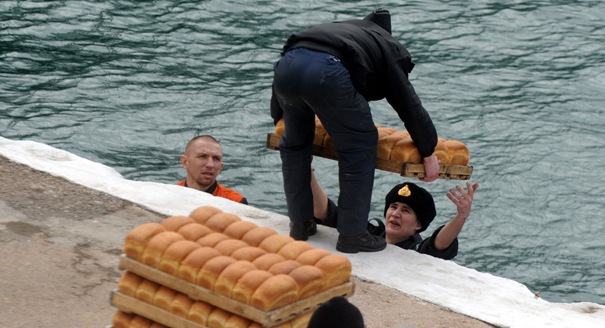
Source: Getty
In Crimea, Putin will face the financial burden which the annexation will incur. Crimea’s case may seem to be manageable at first, but the expenditure will absorb all money and Russia’s already dwindling investment will be brought to nil.
President Vladimir Putin is a judo player and he loves to liken foreign policy to judo. When your opponent pushes you, you retreat a while and then, using the opponent’s power, throw him or her down. Thus, Putin took advantage of Mikheil Saakashvili’s faux pas in August 2008 and President Barack Obama’s half-hearted Syria foray in September 2013 with military and political successes. This time he reacted to the belligerent Russophobia of the rightist radicals in Kyiv and those who supported them, enjoying an ephemeral victory. Putin may want to use the same technique in the Eastern Ukraine.
But my own experience in judo tells me that if your opponent is too heavy, you may be crashed by the weight during the attempt to throw it. In Crimea’s case Putin’s opponent is the financial burden which the annexation will incur. The Russian press present various calculations for its cost, ranging from 3 to 9 billion dollars. I have made my own rough counting as follows.
Crimea’s population is about 2 million, out of which 1.4 million belong to the working age and 0.3 million are retirees. I suppose that about 30 percent of the total working force should receive salary from the government (Putin once said that one third of the Russian working people receive salary from the state, though the real figure seems to be much higher). If every Crimean governmental officials and para-officials get 300 dollars per month, then their total salary would amount to 15 billion dollars annually (300 dollars×[1.4 million×0.3]×12 months). And if every pensioner gets 150 dollars a month, the total cost would be about 0.5 billion dollars annually. The total annual cost for both categories would be 15.5 billion dollars.
The Russian federal government’s annual expenditure is approximately 400 billion dollars, so Crimea’s (minimum) cost would mean “only” 3 percent increases in the Russian budget. It may look bearable, but when the Eastern Ukraine, Transnistria and some more lands opt for the Russian budget (Crimea’s officials envied Russian counterparts’ salary, which is four times as much as their own), the total burden may well exceed 50 billion dollars annually, which is about 13 percent of the state budget. And tax revenue from the Eastern Ukraine will be much lower than that (its industry is robust. But excluded from the EU market it will turn into a mere recipient of the Russian money). Furthermore, the Russian government will be required to take the lion’s share in Ukraine’s external debt of 138 billion dollars.
This tedious calculation shows that the whole Ukrainian adventure may seem to be manageable at first, but the expenditure will absorb all money and Russia’s already dwindling investment will be brought to nil. The Russians will be forced to go back to the Soviet planned economy, in which they effectively rationed oil revenue in a closed circuit. Russians are now applauding the decision on Crimea, but sooner or later coming inflation will drastically change their attitude.
Ideally thinking, some modus vivendi should be devised, so that Ukraine can further proceed on its own as a unique entity in which both EU and Russia (and all WTO members including Japan, of course) will get favorable treatment. The genie of bigotry, greed, hatred, violence and conspiracy should be pushed back into Aladdin’s lamp. Otherwise, Russia will play into the hands of those, who wish to destroy her economy, and at the same time wish to discredit the U.S. government for its introvert policy. In judo you can win with one decisive throw (ippon). But endless power game may turn out to be lethal.
Akio Kawato
Writer
Akio Kawato is a former Japanese diplomat and blogger.
Carnegie does not take institutional positions on public policy issues; the views represented herein are those of the author(s) and do not necessarily reflect the views of Carnegie, its staff, or its trustees.

In an interview, Ian Lustick and Eli Clifton discuss their new book on why a prominent ally has so much influence in America.

Michael Young
Germany, India, and other middle powers can’t build frontier AI alone, and they risk being cut off if they depend on the United States or China. The way through is to build the capacity for a frontier sprint while hoping never to use it.
Anton Leicht, Sam Winter-Levy

Sergei Kiriyenko used Russia’s parliamentary vote to further hone his strategy of corporate mobilization that is designed to maximize votes for United Russia.

Andrey Pertsev

The Plaza Accord was not an externally imposed punishment of Japan but part of a broader restructuring that Japanese economists and policymakers themselves recognized was necessary. Its effects were undermined, however, when Tokyo responded to the resulting slowdown with policies that exacerbated investment, credit expansion, and the very imbalances the adjustment was intended to resolve.

Michael Pettis

Before the next wave of EU enlargement takes place, the union needs to grapple with thorny questions of how power is distributed among its members.


Emil Sondaj Hansen, Ditte Brasso Sørensen