

Paper
George Perkovich
{
  "authors": [
    "George Perkovich"
  ],
  "type": "legacyinthemedia",
  "centerAffiliationAll": "dc",
  "centers": [
    "Carnegie Endowment for International Peace"
  ],
  "collections": [
    "U.S. Nuclear Policy"
  ],
  "englishNewsletterAll": "ctw",
  "nonEnglishNewsletterAll": "",
  "primaryCenter": "Carnegie Endowment for International Peace",
  "programAffiliation": "NPP",
  "programs": [
    "Nuclear Policy"
  ],
  "projects": [],
  "regions": [
    "North America",
    "United States",
    "South Asia",
    "East Asia",
    "Russia"
  ],
  "topics": [
    "Nuclear Policy",
    "Arms Control"
  ]
}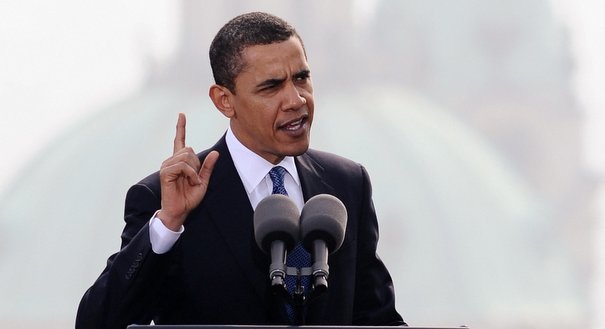
Source: Getty
Today, five years after Prague, the idea of seeking to eliminate all nuclear weapons has nearly evaporated from international politics.
Source: National Interest
On April 5, 2009, in Prague, President Barack Obama proclaimed the goal of freeing the world from the unique dangers posed by nuclear weapons. The massive Czech crowd applauded, as did many others around the world. Six months later, the Norwegian Nobel Committee awarded Obama its Peace Prize.
Today, five years after Prague, the idea of seeking to eliminate all nuclear weapons has nearly evaporated from international politics. Vladimir Putin’s invasion of Ukraine inflames memories of the Soviet invasion of Prague in 1968. Russia’s bullying leaders cling to nuclear weapons as badges of great power and bulwarks against Western and Chinese coercion. In Asia, China and Japan mobilize air and naval forces to contest disputed islands in the East China Sea, prompting the U.S. to buttress capabilities and resolve to defend Japan while warning both sides not to precipitate a crisis.
Long before Crimea and the Senkaku islands entered their consciousness, Republicans in the U.S. Senate determined to block ratification of new treaties. They refuse even to discuss limitations on ballistic-missile defenses and other forms of arms control that could motivate Russia and China to limit and perhaps reverse the modernization of their forces.
Meanwhile, France bristles at anything that might complicate its perpetual retention of nuclear weapons. Pakistan and India expand their nuclear arsenals. North Korea rattles its nuclear sabre. And non-nuclear-weapon states such as South Africa and Brazil that could have been expected to support the disarmament agenda by strengthening nonproliferation rules and their enforcement instead stand on the sidelines and grumble.
In this environment it is tempting to dismiss the goal of nuclear abolition as a fleeting dream of a new president and international do-gooders. However, turning away from fundamental questions about the future role of nuclear weapons cedes too much importance to transient political trends and neglects issues of great strategic import. The happenings of the past five years should not be allowed to foreclose serious analysis and debate looking to the future.Defenders of nuclear weapons (and opponents of Obama) emphasize that nuclear weapons deter warfare. The president knows this, of course. In Prague he said, “As long as these weapons exist, the United States will maintain a safe, secure and effective arsenal to deter any adversary, and guarantee that defense to our allies—including the Czech Republic.”
However, unlike many of his opponents, the president and his supporters remember that deterrence is not fail-proof—otherwise it would not work. The weapons deter because they could be used, and any use could escalate to mass destruction. Even if deterrence is stable between the U.S. and Russia, it may have a higher probability of failure between less experienced pairs or, more ominously, groups of nuclear-armed states. As the eminent nuclear strategist Sir Lawrence Freedman put it several years ago: “The case for abolition…is that it is hard to believe that the past 60 years of self-restraint can continue for the next 60 years.”
Rather than prejudicially dismiss or embrace the goal of nuclear abolition, it makes more sense to continually analyze what threats the U.S. and its allies plausibly face and whether nuclear weapons are necessary to deter or defeat them. In other words, if no one else had nuclear weapons, would the U.S. still need them?
Russia’s intervention in Ukraine raises—for some—the prospect of a similar future move into Estonia or Latvia, which also have large Russian minorities. Unlike Ukraine, the small Baltic states are now members of NATO. The United States and other allies are obligated to come to their defense if they are attacked. If NATO membership itself did not deter Russia from encroaching on these states, would NATO plausibly use nuclear weapons to stop it?
Russian forces thus far have not fired shots at Ukrainians. Against a NATO state Russia would be at least as careful. Launching massive-scale attack on a state or alliance that possesses nuclear weapons (or knows how to make them) would make sense only if the precipitating threat were of a scale commensurate with the risk of nuclear war. This is one reason why aggressors in recent years have kept the scope and scale of their attacks below the threshold that would invite nuclear use.
If Russia did intervene against a NATO state, then both sides would face strong pressures to escalate until the costs got so high that one was compelled to withdraw. Here the temptation to use or threaten to use nuclear weapons would arise. But if NATO went first it would invite Russian retaliation which would be more injurious to the Estonians or Latvians and other NATO members than the initial Russian intervention. This is one reason why it is difficult to imagine the twenty-eight democracies of NATO agreeing to initiate the use of nuclear weapons if Russia did not use its own nuclear weapons first. (A U.S. president independently could use nuclear weapons over the objections of many NATO allies, but that would have daunting consequences too.)
In a world without nuclear weapons, NATO would be more confident that over time it could muster conventional forces to compel Russia to withdraw or else face defeat. This is one reason why President Putin resists Obama’s Prague Agenda as a clever American plot. Russia’s resistance challenges the feasibility of achieving nuclear disarmament, but affirms that the goal itself could clarify what the U.S., other NATO states, and Russia can do to remove causes of potential conflict among them.
Before the Crimean crisis, U.S. officials were increasingly preoccupied with the escalating dispute between China and Japan over the tiny unpopulated Senkaku/Diaoyu islands. Here, too, the U.S. has a treaty commitment to defend an ally—Japan—that faces an assertive adversary—China. And, here too, nationalist politics and historical hangovers stoke bellicosity.
Were China to land forces on the islands or cordon them with naval forces, and Japan responded militarily, the U.S. would be obligated to respond militarily. In the resulting conflict the risks of escalation would be formidable. All sides would recognize that the initial stakes involved—the islands—would not justify the consequences of nuclear war, but would the antagonists be willing to step back to mutually acceptable positions? Contemplating such a scenario now raises important questions about the balance of risks and benefits that come with nuclear arsenals.
The East Asian and European situations highlight a moral hazard of nuclear weapons. States may rely on these “ultimate” weapons to spare or extricate themselves from all kinds of security disasters, only to discover that the real threats they face fall below the threshold that makes using nuclear weapons rational. Erroneously emboldened, these states may act provocatively and eschew diplomatic resolution of underlying conflicts. They may under-invest in more symmetrical military capabilities to block incursions or island-grabbing in the first place. The best way to avoid these moral-security hazards is to devise diplomatic policies and military capabilities as if nuclear weapons did not exist.
The abolition of nuclear weapons is more desirable than those who fear it recognize. It is also more difficult to achieve than many who long for it acknowledge. The U.S., Russia and China hold the key to any prospects of reducing and, eventually, eliminating nuclear weapons globally. If these three states do not develop much more cooperative political-security relationships, the U.S. and Russia will not reduce their total nuclear arsenals below, say, one thousand deployed weapons each. China will not agree to curtail the gradual expansion of its nuclear arsenal (which then inhibits India and Pakistan from reversing their nuclear build ups).
This perspective adds to the already pressing weight of the developments in Ukraine and the East China Sea. If Russia’s incursion into Ukraine results over time in a meaningful victory for its author, and if coercion changes the status quo in East Asia, weaker states will assign greater value to nuclear weapons as necessary for their defense. Conversely, if Russia loses more than it gains from the Ukraine gambit, and if peaceful means are found to accommodate the interests of China and its littoral neighbors, the conditions for further arms reductions can be created.
The fact that major-power relations are far from such cooperation today means that the objective of nuclear abolition will not be achieved soon. This might comfort those who fear nuclear disarmament, but it is cold comfort indeed. For, the world would be more secure if the three most influential nuclear powers were actively seeking to create the conditions that would allow them and others to do without the singular threat of nuclear war. This was the aspiration Barack Obama announced in Prague five years ago. Whether history will remember it as tragic, farcical, or prophetic, will depend most immediately on the actions of the United States, Russia, Ukraine, the European Union, China and Japan in the coming years.
This article was originally published in the National Interest.

Japan Chair for a World Without Nuclear Weapons, Senior Fellow
George Perkovich is the Japan Chair for a World Without Nuclear Weapons and a senior fellow in the Carnegie Endowment for International Peace’s Nuclear Policy Program. He works primarily on nuclear deterrence, nonproliferation, and disarmament issues, and is leading a study on nuclear signaling in the 21st century.
Recent Work
George Perkovich
George Perkovich
Carnegie does not take institutional positions on public policy issues; the views represented herein are those of the author(s) and do not necessarily reflect the views of Carnegie, its staff, or its trustees.
Despite the agreement’s uncertainty, it’s still a significant development in regional and nuclear policy.


Andrew Leber, Jane Darby Menton
“AI safety in parallel” is modest and pragmatic but vital.

Matt Sheehan

Trump is distracted and Ukraine wants Europe to step up. The continent’s leaders must find their voice and assert it in talks with Russia.

Alissa de Carbonnel

There is a deeply rooted assumption in post–Cold War American statecraft that overwhelming military and economic power translates directly into favorable political outcomes. But force alone is rarely enough. To meet the challenges of the mid-21st century, Washington needs a cultural shift toward a mindset that takes negotiation far more seriously.

Cecily Brewer

Mounting economic strain and battlefield losses will not necessarily make the Kremlin less dangerous. They could instead push Moscow toward a more aggressive hybrid campaign designed to test NATO’s Eastern flank, exploit allied hesitation, and fracture European resolve.

Maksym Beznosiuk