

Commentary
Matt Sheehan
{
  "authors": [
    "Matt Sheehan"
  ],
  "type": "commentary",
  "blog": "Emissary",
  "centerAffiliationAll": "dc",
  "centers": [
    "Carnegie Endowment for International Peace"
  ],
  "collections": [
    "Dynamic Technology Risks in Asia",
    "China and the World"
  ],
  "englishNewsletterAll": "asia",
  "nonEnglishNewsletterAll": "",
  "programAffiliation": "AP",
  "programs": [
    "Asia"
  ],
  "projects": [
    "China AI Initiative"
  ],
  "regions": [
    "United States",
    "China"
  ],
  "topics": [
    "AI",
    "Technology",
    "Foreign Policy",
    "Domestic Politics"
  ]
}
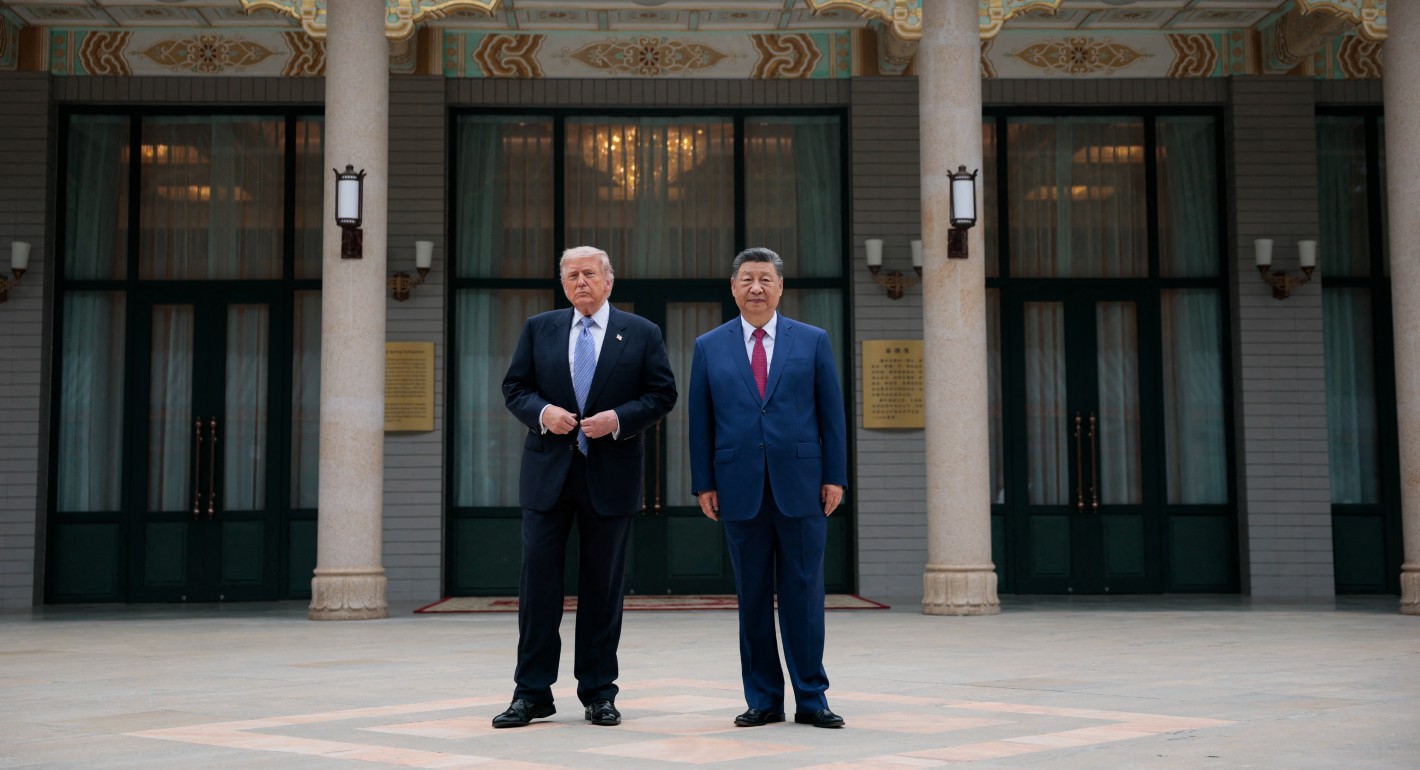
Trump and Xi in Beijing on May 15, 2026. (Pool photo by Evan Vucci/AFP via Getty Images)
“AI safety in parallel” is modest and pragmatic but vital.
The United States and China are the two countries building the world’s most advanced artificial intelligence systems. They are also rival superpowers, with each viewing AI as critical to the contest for supremacy. Together, these dynamics are driving an accelerating race to build the most powerful—and, potentially, dangerous—AI systems first.
Following the Beijing summit between U.S. President Donald Trump and Chinese President Xi Jinping, the two countries agreed to establish a governmental dialogue on AI. But can superpowers locked in a battle for AI supremacy also work to reduce the risks from the technology they’re competing over?
Yes, but it requires modest goals and a pragmatic approach. I call that approach “AI safety in parallel.”
The U.S. and China won’t move in lockstep on AI safety, and forging mutually binding agreements with real teeth is probably not possible right now. But they can move forward on parallel tracks, each advancing the technology and also acting to reduce the risks because they believe it is essential to their own national security—regardless of what the other does. In this process, the most impactful decisions will be made within the two countries, not between them. And those domestic decisions will be guided by the cold calculus of national (and political) self-interest.
But even within the realpolitik of great power competition in AI, strategic engagement between the United States and China still has a vital role to play. Engagement can advance two critical objectives: enhancing the safety of systems built in both countries and increasing mutual awareness of the safety practices employed (or not employed) in the other country. The first reduces the risk of AI catastrophes that could spill across borders, while the second can reduce some of the potentially dangerous race dynamics at play. At a time when everyone is moving into uncharted territory, there is value in maintaining some level of connective tissue that increases visibility and encourages safe development of the technology in both places.
The unsettling reality of AI today is that even the world’s leading AI scientists—whether in Silicon Valley, Shanghai, or elsewhere—don’t know how to ensure the technology remains safe as it grows more powerful. They are desperately trying to figure that out, often racing against the rapidly evolving capabilities of the models they are building. During this period, the United States and China agreeing to do the same things on AI safety is far less important than both countries getting better at actually building AI safely.
AI safety in parallel means creating touchpoints and information channels between the United States and China that strengthen the safety capabilities of each side. In practical terms, this could mean limited and strategic sharing of emerging threats and the best practices for detecting and mitigating dangerous AI capabilities. These exchanges can happen through the upcoming U.S.-China governmental dialogue and, for less sensitive areas of engagement, nongovernmental Track II dialogues between the countries.
Both the U.S. and China have experience worth sharing on AI safety and governance. Technical research on frontier AI safety has deep roots here in the United States but is a relatively newer field in China. One of the most valuable things that could come out of U.S.-China engagement on AI would be sharing approaches to testing for dangerous new capabilities in models: the ability to discover novel pathogens or to intentionally evade the control of a human operator.
Technical discussions along these lines are delicate but doable. In certain areas there is a fine line between figuring out how to test for a new capability and figuring out how to build that capability. The key is to tilt that balance heavily in favor of safety-enhancing rather than capability-enhancing techniques. If there is an intervention that would make a model 25 percent safer and 2 percent more capable, that’s probably the kind of technique that we would want even our adversaries to adopt. Closely monitoring that balance will be critical to any discussions. If direct technical exchanges are deemed too risky, conversations can be leveled up to focus on broader approaches to testing.
And although the United States may currently lead in developing these tests and safeguards, that lead is far from guaranteed. Chinese AI researchers have shown themselves to be incredibly inventive, even with access to far less computing power due to U.S. export controls. Future breakthroughs in AI testing and safety may just as well emerge from China’s ecosystem, and both the United States and China would benefit from sharing them.
Beyond technical research, China has extensive experience with the nuts-and-bolts processes of regulating AI. Over the past four years, China has rolled out the world’s most extensive and detailed regulations on AI, and it has done it in a way that didn’t dramatically slow down innovation. Regulators have built a flexible and constantly evolving system of mandatory registration and testing of models, combined with technical standards that are written by experts from across industry, academia, and government. China’s early regulations focused on controlling the way that AI created and disseminated information online, ensuring that the technology didn’t disrupt existing information controls. But in recent years regulators have put those tools to work creating an end-to-end system for labelling AI-generated content, strict rules for companion chatbots, and emerging safeguards on agentic AI.
The United States shouldn’t copy China’s approach to regulation. Many parts run directly counter to core American values on free speech and the state’s power over private companies. But we can learn from aspects of the regulatory and technical infrastructure. Despite our drastically different political systems, China’s AI policy community has no issue learning from and adapting good policy ideas from the United States. We should be willing to do the same.
Aside from this type of learning, AI safety in parallel critically enhances mutual awareness of what each side is doing on governance and technical safeguards. It’s unlikely that the United States and China agree on binding reciprocal action, but it’s crucial that we have some sense of the other side’s approach. In the absence of any information on testing or guardrails, leaders in both countries will understandably assume the worst: that the other side is sacrificing any action on safety in a reckless race for building the most powerful system. Structured dialogue is a key channel for explaining approaches and regulatory mechanisms that are often wildly misunderstood from afar.
This process isn’t predicated on trust, on believing that the other side is simply telling the truth or will follow through on good faith pledges. At this point, trust between the superpowers is both unrealistic and unnecessary. Instead, these discussions are designed to build confidence. This confidence isn’t in the other side’s intentions, but rather in their understanding: of the technology, the risks, and how to mitigate them.
If Chinese officials tell their American counterparts that they take a given AI risk “very seriously” and are testing for it, the Americans can’t just take their word for it. But in the course of a dialogue, it often becomes abundantly clear whether the other side has put serious thought into that risk and effort into building the needed guardrails. That’s not a guarantee that they will take action, but when combined with clear-eyed analysis of the other side’s interests, it’s a meaningful source of data for modeling what they might do. That type of mutual awareness will be important in navigating the years ahead.
Critically, a U.S.-China AI dialogue must not be treated as a venue for bargaining, with China offering to do more on safety in exchange for a loosening of U.S. export controls on chips. The safety of advanced AI systems is a complex and ever-evolving problem. Making real progress on it requires a genuine and sustained desire to tackle the issues. Doing it as a half-hearted concession made to another country simply won’t work. If that’s all that Chinese officials are interested in, we should walk away. But if they are interested in having a serious exchange, we should be prepared to engage in it.
Compared with some of the more ambitious proposals for international governance—a non-proliferation treaty for AI, for example—AI safety in parallel is modest in its goals. It treats binding agreements between the countries as a bonus rather than the immediate goal. Depending on where the technology goes in the coming years, this might well prove insufficient. If that’s the case, we will need to adapt quickly. But we have to start somewhere, and beginning with the mental model of safety in parallel could lay a more solid foundation and avoid the pitfalls of setting unrealistically high goals at the start.
Even if implemented perfectly, the approach of AI safety in parallel can’t guarantee that the United States and China will successfully navigate the changes and threats potentially brought on by the technology. Given the enormous technical and geopolitical uncertainties at play, almost nothing could provide that guarantee. As the United States and China both head toward this uncertain future, we’ll have a better shot if we know that we’re moving in the same direction.
The latest from Carnegie scholars on the world’s most pressing challenges, delivered to your inbox.

Senior Fellow, Asia Program, and Co-Director, China AI Initiative
Matt Sheehan is a senior fellow at the Carnegie Endowment for International Peace, where his research focuses on global technology issues, with a specialization in China’s artificial intelligence ecosystem. He is also co-director for the China AI Initiative.
Recent Work
Matt Sheehan

Scott Singer, Matt Sheehan
Carnegie does not take institutional positions on public policy issues; the views represented herein are those of the author(s) and do not necessarily reflect the views of Carnegie, its staff, or its trustees.

The summit may be remembered as a fatal blunder, when Washington, Beijing, and the AI industry collectively chose ceremony over action.

Jeffrey Prescott

Why governance of rapidly evolving technology will be distributed and complex.

Stewart Patrick, Scott Singer
It should address the shortcomings of previous crisis communication efforts and adapt to the demands of frontier AI.

Lucy Luo
AI capabilities are moving fast. Most institutions—including governments—can’t keep up.

Anton Leicht, Scott Singer
Lee’s tour shows how Seoul is reorganizing its diplomacy away from Pyongyang and toward industrial networks and the geography of the compute economy.

Darcie Draudt-Véjares