

Article
- +1
Toby Dalton, Mark Hibbs, Nicole Grajewski, …
{
  "authors": [
    "Mark Hibbs"
  ],
  "type": "legacyinthemedia",
  "centerAffiliationAll": "dc",
  "centers": [
    "Carnegie Endowment for International Peace"
  ],
  "collections": [
    "U.S. Nuclear Policy"
  ],
  "englishNewsletterAll": "ctw",
  "nonEnglishNewsletterAll": "",
  "primaryCenter": "Carnegie Endowment for International Peace",
  "programAffiliation": "NPP",
  "programs": [
    "Nuclear Policy"
  ],
  "projects": [],
  "regions": [
    "North America",
    "United States",
    "East Asia",
    "Southeast Asia"
  ],
  "topics": [
    "Nuclear Policy",
    "Nuclear Energy"
  ]
}
Source: Getty
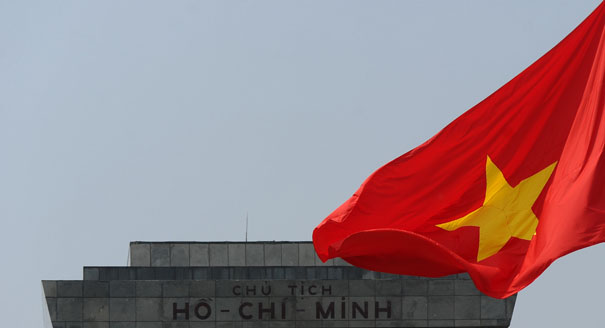
The concluded nuclear agreement with Vietnam should be viewed as an opportunity for U.S. government and industry to contribute to Vietnam’s energy security, not a counterproductive bilateral bone of contention.
Source: Hill
The Obama administration last week sent to Congress the text of a bilateral nuclear cooperation agreement signed last week by the United States and Vietnam. If lawmakers do not object during an ensuing 90 days of continuous session and review, the agreement will then enter into force.
Some critics argue that unless this agreement is renegotiated, the United States would take a step back in its global nonproliferation leadership role and thereby ease the way for Vietnam and other states to develop nuclear weapons capabilities. They note that four years ago the United Arab Emirates formally committed itself in a new bilateral nuclear pact with the U.S. not to enrich uranium or reprocess spent fuel. Thus, the argument goes, the lack of this provision in the agreement with Vietnam undercuts the UAE and signals to others that the U.S. is not steadfast.
Because uranium enrichment and reprocessing (ENR) can be used for both peaceful and non-peaceful aims, the future expansion of these capabilities should be limited. But the contexts for the UAE and Vietnam agreements are very different. Congress should not stand in the way of the Vietnam agreement on nonproliferation grounds.The UAE is one of a tiny number of countries which is immensely endowed with energy fuels, and its nuclear power aims therefore prompted suspicions because conflicting states in its neighborhood for decades secretly developed ENR capabilities. In light of this background, it made sense for the UAE to formally forego ENR in persuading foreign technology holders that it could be trusted with nuclear power.
The State Department’s architects of the U.S.-UAE agreement understood that the UAE case was unique and did not argue that its terms should be a global template for all future such agreements. Vietnam shows why.
First, Vietnam has a good nonproliferation record. For decades Hanoi has been a member of the Nuclear Nonproliferation Treaty (NPT) and has hosted safeguards inspections from the International Atomic Energy Agency (IAEA) without a blemish. In 2007, as its nuclear power ambitions were emerging, Hanoi concluded a so-called Additional Protocol with the IAEA, providing further assurance that all of Vietnam’s nuclear activities are declared and peaceful. A year later Vietnam enacted legislation formally banning the development of nuclear weapons and all forms of nuclear proliferation. Vietnam is a member of a regional nuclear weapons-free zone. It is a party to the global nuclear test ban treaty. And for good measure, in 2012 and 2013 Hanoi joined international conventions on nuclear safety and nuclear security. This week in New York, during a meeting of 190 NPT parties preparing for a five-year treaty review, Vietnam delivered a statement underscoring in detail its commitments and obligations in these areas. There are no reasons to doubt them.
Second, it is highly unlikely that Vietnam will resort to nuclear hedging out of regional political concerns. None of its Southeast Asian neighbors—bar China—are nuclear-armed, nor have they flirted with clandestine or exotic nuclear research and development programs. None are interested in uranium enrichment or reprocessing. The officials in charge of Vietnam’s nuclear program likewise have consistently reiterated since the 1990s that they have no interest in developing ENR capabilities. The text of the cooperation agreement in fact expressly makes that point.
Earlier this week, China set up an oil rig in a show of force in disputed waters off the coast of Vietnam, leading to an official protest from Hanoi including vows that Vietnam would defend its interests. Doesn’t that underscore the possibility that Vietnam might reach for nuclear weapons capabilities to hedge against Chinese power in the South China Sea?
Hardly. The completed nuclear cooperation agreement with the U.S. is one of a number of bilateral initiatives in recent years to forge closer political and economic ties. The nuclear agreement politically commits Hanoi to obtain nuclear reactor fuel it needs from the international market—not produce the material itself. With China raising the stakes in the region, Hanoi will have no interest in abrogating legal or political commitments it has made to Washington in that document.
Unlike the UAE, Vietnam wants nuclear energy because it has few domestic energy resources to spare. There are no grounds to suspect Vietnam of ulterior motives. If the bilateral nuclear cooperation agreement is not accepted by Congress, Vietnam can partner instead with others including Russia, which has already agreed to build Vietnam’s first two power reactors.
The recent Sino-Vietnamese confrontation over the site of an oil platform should therefore alert both the Administration and Congress that the concluded nuclear agreement should be viewed as an opportunity for U.S. government and industry to contribute to Vietnam’s energy security—not a counterproductive bilateral bone of contention.

Nonresident Senior Fellow, Nuclear Policy Program
Hibbs is a Germany-based nonresident senior fellow in Carnegie’s Nuclear Policy Program. His areas of expertise are nuclear verification and safeguards, multilateral nuclear trade policy, international nuclear cooperation, and nonproliferation arrangements.
Recent Work


Toby Dalton, Mark Hibbs, Nicole Grajewski, …
Mark Hibbs
Carnegie does not take institutional positions on public policy issues; the views represented herein are those of the author(s) and do not necessarily reflect the views of Carnegie, its staff, or its trustees.

In an interview, former ambassador Charles Freeman assesses the Trump administration’s war against Iran.

Michael Young

European states control several Overseas Countries and Territories around the world that carry strategic, economic, and environmental weight. As great powers challenge the rules-based order, defending them is a geopolitical imperative for Europe.

Marc Pierini
By focusing only on hard security, the Shield ignores the conditions that fuel cartel power.


Alejandro Martin Rodriguez, Kayly Ober

In supporting Europe’s far-right, MAGA and Russia both want the same thing: a weaker EU. Europe must defend itself without abandoning the openness these forces exploit.

Armida van Rij

Nuclear and maritime communities face a long and challenging journey to deploy commercial nuclear applications at sea.

Jamie Kwong, Toby Dalton