

Article
C. Raja Mohan, Darshana M. Baruah
{
  "authors": [
    "C. Raja Mohan"
  ],
  "type": "legacyinthemedia",
  "centerAffiliationAll": "dc",
  "centers": [
    "Carnegie Endowment for International Peace",
    "Carnegie India"
  ],
  "collections": [],
  "englishNewsletterAll": "ctw",
  "nonEnglishNewsletterAll": "",
  "primaryCenter": "Carnegie India",
  "programAffiliation": "SAP",
  "programs": [
    "South Asia"
  ],
  "projects": [],
  "regions": [
    "South Asia",
    "India",
    "East Asia",
    "China"
  ],
  "topics": [
    "Foreign Policy"
  ]
}
Source: Getty
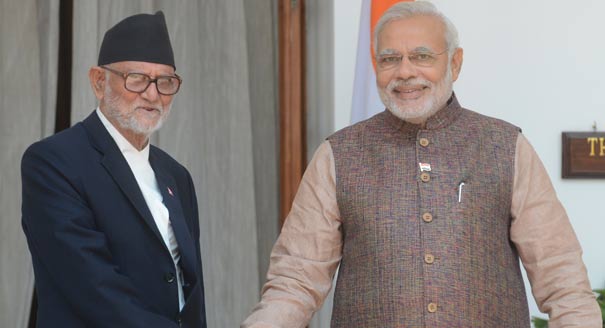
India can improve its Nepal engagement by simply helping itself through the development of frontier regions in Uttar Pradesh and Bihar, modernising border infrastructure, and upgrading transborder connectivity.
Source: Eurasia Review
When External Affairs Minister Sushma Swaraj arrives in Kathmandu this week to review the state of bilateral cooperation and prepare for Prime Minister Narendra Modi’s visit to Nepal, China is bound to loom large. For Beijing’s profile, Nepal has steadily risen in the last few years and has generated concerns in the Indian security establishment. As elsewhere on its borders, China is rapidly expanding its trans-frontier influence in Nepal.
It is upgrading the Araniko highway from the Tibet border to Kathmandu, built in the 1960s. It also has plans to extend the Tibet railway line to the Nepal border. China’s trade and investment ties with Nepal as well as development assistance have steadily risen in recent years, as Beijing’s economic influence radiates across the border. Chinese tourist arrivals in Nepal have grown at an average of nearly 25 per cent a year over the last few years. Beijing’s cultural presence has significantly expanded with the setting up a number of China Study Centres in Nepal, including in the Terai region, which shares a long border with India.China’s presence in Nepal has long been viewed as a “zero-sum-game” in New Delhi. If the security establishment in Delhi sees Nepal as part of an exclusive Indian sphere of influence, Beijing has affirmed the right, as the large northern neighbour, for a substantive engagement south of the Himalayas.
Given this structural tension in the approaches of Delhi and Beijing, China has been a useful card to play against India for some in Nepal’s elite. They have insisted on some kind of “non-alignment” between Nepal’s giant neighbours, much to the irritation of Delhi. This game has become somewhat complicated as economic relations between China and India have improved, despite their other political problems, including the boundary dispute.
China views many of its transport projects in Nepal as a means to access the large markets in the Gangetic plains. In the last few years, there have been repeated hints from Chinese think-tanks on the need for Delhi-Beijing economic cooperation in Nepal. Beijing has now formally suggested the idea of China and India developing a Trans-Himalayan zone of cooperation. It is one of a piece with the Silk Road strategy that Chinese President Xi Jinping has made his own.
Although there are many sceptics in Delhi who are deeply uncomfortable with the idea of economic cooperation with China across the land frontiers, there are signs of a shift within the foreign policy establishment. For example, Delhi was until recently cold to Chinese proposals on developing the so-called BCIM corridor, which would link Beijing’s Yunnan province with Myanmar, Bangladesh and eastern India. Delhi now appears more open to the idea of regional economic cooperation with China, which in turn sets a very different framework for Delhi’s engagement with Kathmandu.
The NDA government’s real challenge in Nepal, however, is not China. It is the tragic failure of Delhi’s own engagement with Kathmandu. Despite geographic proximity, cultural intimacy, economic interdependence and shared political values, India has stumbled in Nepal.
Consider, for example, two popular current images of India in Nepal in relation to China. One is the deep dismay at the pathetic state of infrastructure on the Indian side of the border, which stands in contrast to the shining new roads and bridges on the Chinese side. If Swaraj finds time to visit the Nepal border, she will understand why so many Nepalese crossing the frontier see India as belonging to the “Fourth World” rather than as a rising power.
India can improve its Nepal engagement by simply helping itself through the development of frontier regions in Uttar Pradesh and Bihar, modernising border infrastructure and upgrading transborder connectivity. India’s image in Nepal has also been bruised by the growing perception in Nepal that “India promises, China delivers”. India’s record of project implementation in Nepal is awful. Swaraj might want to see a summary of promises made to Kathmandu and kept in the last few decades before she arrives in Nepal. While there are many problems on the Nepal side, Swaraj must convince her interlocutors that the Modi government will remove all the obstacles from the Indian side for the timely implementation of projects.
Former Nonresident Senior Fellow, Carnegie India
A leading analyst of India’s foreign policy, Mohan is also an expert on South Asian security, great-power relations in Asia, and arms control.
Recent Work

C. Raja Mohan, Darshana M. Baruah


Alexander Gabuev, Paul Haenle, C. Raja Mohan, …
Carnegie does not take institutional positions on public policy issues; the views represented herein are those of the author(s) and do not necessarily reflect the views of Carnegie, its staff, or its trustees.

The aftermath of the Ceuta crisis shows Europe has drawn the wrong lessons. Rather than doubling down on failed migration policies, the EU needs to address the underlying roots of such episodes.

Richard Youngs
Congress should ask tough questions about the agreement’s more unique features and whether they advance U.S. interests or compromise them.

Jane Darby Menton

The ninety-three-year-old Biya’s absence and refusal to name a vice president threaten to upend domestic and regional stability.

Lesley Anne Warner

With the growth in points of friction between the great powers, organizations like the SCO will continue to play a role in the strategic adaptation of the smaller powers caught between them.

Temur Umarov
Amid celebrations of bilateral ties was a deeper focus on stability in the Middle East.

Amr Hamzawy