

Article
C. Raja Mohan, Darshana M. Baruah
{
  "authors": [
    "C. Raja Mohan"
  ],
  "type": "legacyinthemedia",
  "centerAffiliationAll": "dc",
  "centers": [
    "Carnegie Endowment for International Peace",
    "Carnegie India"
  ],
  "collections": [],
  "englishNewsletterAll": "ctw",
  "nonEnglishNewsletterAll": "",
  "primaryCenter": "Carnegie India",
  "programAffiliation": "SAP",
  "programs": [
    "South Asia"
  ],
  "projects": [],
  "regions": [
    "South Asia",
    "India"
  ],
  "topics": [
    "Economy",
    "Foreign Policy"
  ]
}
Source: Getty
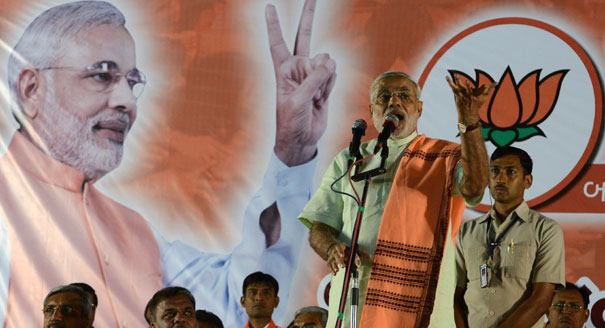
While continuing to engage with East and South East Asia, Indian Prime Minister Modi is ‘Linking West’ to increase India’s ties to the Middle East.
Source: Indian Express
Prime Minister Narendra Modi’s irrepressible rhetoric is marked by a passion for alliteration, temptation for recasting well known abbreviations and the use of juxtaposition to make important points.
This works well some times: for example in the PM’s current pitch for with Western investors on ‘democracy, demography and demand’. At other times it falls flat: FDI is not about foreign direct investment, but ‘first develop India’.
It could also often help frame a new policy initiative. Consider Modi’s proposition that India must not only ‘Look East’ but also ‘Link West’. It was easy to dismiss this when Modi first said it at the ‘Make in India’ conference in Delhi before he headed out to the U.S. on his first prime ministerial visit. It was impossible to ignore it when the PM said it again after his talks with President Barack Obama at the White House.‘Look East’ is a phrase that has been associated with India’s renewed efforts at connecting to East and South East Asia after the launch of economic reforms in the early 1990s by the Congress Prime Minister P.V. Narasimha Rao. The Look East Policy is now well-established, thanks to bipartisan support for it from all of Rao’s successors who led very different set of coalitions.
There is some talk of changing the Look East Policy to ‘Act East’ Policy. One hopes not; for the new name does not sound better than the old. To be sure there is a lot that India needs to do in the East, but there is no need a change the nomenclature. In any case, it breaks the symmetry with the idea of “Link West” that is Modi’s most recent invention.
It has been understood for a while that India needs a more focused approach to the Middle East (India is probably the only country in the world that calls it ‘West Asia’; the countries in the region certainly don’t).
During the first term of the UPA, Prime Minister Manmohan Singh talked of a “Look West” policy and cited the importance of the Middle East in India’s energy security. During UPA’s second term of the UPA, the idea of a “Look West” policy surfaced again. Nothing much came out though.
Unlike South East Asia, where a strong mechanism for regional cooperation existed in the form of ASEAN, there was no institutional framework in the Middle East that could routinise India’s engagement with the region. The political initiative, therefore, had to come from India.
Despite the vital importance of the Middle East for India, Delhi has been unwilling to devote significant political and diplomatic energies towards the region. For example, Dr. Singh barely traveled to the Middle East during his decade long tenure as the PM. Two of the five countries he visited (Egypt and Iran) were hosting Non-Aligned summits. His bilateral visits were to Saudi Arabia, Oman and Qatar.
In South East Asia, Delhi was prepared to discard much of its old baggage and start afresh in the region. In contrast, the policy towards the Middle East has been trapped in ideological inhibitions and outdated slogans. Above all, Delhi’s Middle East policy seemed a hostage to domestic politics.
Consider for example, India’s relations with Israel. It was Rajiv Gandhi who first reached out to the Jewish communities in the U.S. and initiated discussions on establishing full diplomatic relations with Israel in the late 1980s. Rao completed that task and Atal Bihari Vajpayee expanded ties with Israel.
Yet, when it returned to power in 2004, the Congress leadership seemed utterly reluctant to intensify political relations with Israel. Modi might be different. He has chosen to break from recent custom and met with American Jewish leaders as well as the Israeli Prime Minister Benjamin Netanyahu during his visit to New York. If all goes well, Modi could turn out to be the first Indian Prime Minister to visit Israel.
Building a closer relationship with Israel does not mean, India must down grade its relations with the Arabs. Delhi’s stakes in the Arab world are massive and range from energy security to counter terrorism. Neither Israel nor Arabs are asking India to choose between them; both of them want stronger and deeper relationship with Delhi.
Modi’s prospective ‘Link West’ policy could begin to address these growing demands for Indian attention from the region. At the same time, the new policy will have to navigate the new fractures within the Middle East—between Saudi Arabia and Iran as well as the Sunni and the Shia.
More broadly the region has entered a period of profound turbulence and traditional alliances and partnerships are breaking down. All this demands more and not less Indian engagement in the Middle East will all key countries in the region—from Turkey to Iran and Egypt to Saudi Arabia.
No other region in the world is as influenced by outside forces, especially the great powers, as the Middle East. In the past India avoided talking to major powers like the United States and Europe on the Middle East. Modi has hinted at a change in this approach by taking forthright positions on terrorism, nuclear proliferation and other controversial issues during his visit to the United States.
At the White House, the PM declared that “America is an integral part of our Look East and Link West policies”. As it deepens engagement with the U.S. on issues relating to the Middle Eas, India must also expand its consultations with other major powers like Russia and China on the regional issues.
After Modi’s references to a “Link West” policy, it is now up to the Ministry of External Affairs to explain the logic of this new diplomatic initiative to people at home and audiences abroad.
This article was originally published in the Indian Express.
Former Nonresident Senior Fellow, Carnegie India
A leading analyst of India’s foreign policy, Mohan is also an expert on South Asian security, great-power relations in Asia, and arms control.
Recent Work

C. Raja Mohan, Darshana M. Baruah


Alexander Gabuev, Paul Haenle, C. Raja Mohan, …
Carnegie does not take institutional positions on public policy issues; the views represented herein are those of the author(s) and do not necessarily reflect the views of Carnegie, its staff, or its trustees.

The acknowledgment has sparked fears of a new arms race with China and Russia.

Chris O’Meara
Smaller powers cannot go it alone, but Canadian history shows that integration with the United States will not always be benign.
Paul Samson

The European Commissioner for Trade is headed to China. But after President Xi’s bridge-building visit to Washington, can a more isolated EU overcome Beijing’s stranglehold on critical raw materials? Who will blink first?

Rym Momtaz, ed.

The summit may be remembered as a fatal blunder, when Washington, Beijing, and the AI industry collectively chose ceremony over action.

Jeffrey Prescott

European NATO countries are wrestling with the possibility of U.S. disengagement from the alliance. With the continent’s security increasingly uncertain, governments must restore the credibility of their collective defense.



Hans-Dieter Lucas, Adam Thomson, Pierre Vimont