

Article
C. Raja Mohan, Darshana M. Baruah
{
  "authors": [
    "C. Raja Mohan"
  ],
  "type": "legacyinthemedia",
  "centerAffiliationAll": "dc",
  "centers": [
    "Carnegie Endowment for International Peace",
    "Carnegie India"
  ],
  "collections": [],
  "englishNewsletterAll": "ctw",
  "nonEnglishNewsletterAll": "",
  "primaryCenter": "Carnegie India",
  "programAffiliation": "SAP",
  "programs": [
    "South Asia"
  ],
  "projects": [],
  "regions": [
    "South Asia",
    "India"
  ],
  "topics": [
    "Foreign Policy"
  ]
}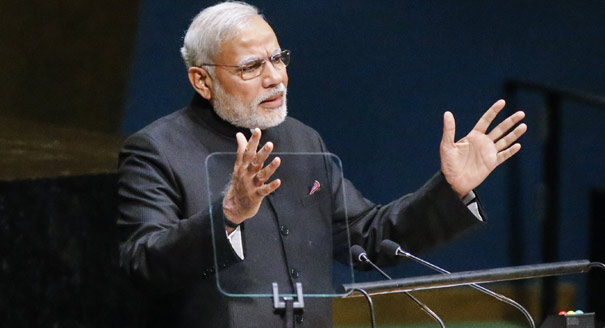
Source: Getty
What stands out at the end of Narendra Modi’s visit is his demonstration of political will and diplomatic ingenuity to rekindle the romance with America that had gone cold in recent years.
Source: Indian Express
What stands out at the end of Narendra Modi’s whirlwind tour of New York and Washington is the prime minister’s demonstration of political will and diplomatic ingenuity to rekindle the romance with America that had gone cold in recent years. In less than a week, Modi has turned the gathering pessimism about India’s relations with the US into an optimistic storyline. The results from the visit might be a while coming, but Modi and President Barack Obama have restored direction and energy to bilateral relations.
After Obama’s visit to India nearly four years ago, bilateral ties hit a plateau and headed soon enough to the south. In its first term, the UPA surprised the world with its openness to transforming the relationship with the US. In its second, it returned India to its bad old ways.
Delhi signalled it was not open for political or economic business with America. It preferred to posture rather than engage on differences and was hesitant about building on the many possibilities for partnering with America that emerged. Above all, the UPA government was paralysed by an ideological ambivalence towards America.During his visit to the US, Modi sought to convince the American corporate sector that India is back in business, signalled a readiness to engage on difficult issues like climate change and trade, and seized the moment for deepening defence and security cooperation. Modi also ran an impressive campaign of public diplomacy to mobilise the Indian American community and the political classes in Washington in favour of rejuvenating the bilateral partnership.
None of this was foreseen either in Delhi or in Washington. Coming from where he did, Modi, it was widely assumed, had little incentive to warm up to the US. His party, the BJP, had turned negative on America when it sat on the opposition benches during the decade-long rule of the UPA. It abandoned the legacy of Atal Bihari Vajpayee, who had declared that India and the US were natural allies, and joined hands with the CPM in opposing the civil nuclear initiative. On top of that, America made Modi a political untouchable by withdrawing his visa for 10 long years. Indeed, many in Delhi argued that Modi should not travel to the US unless there was an apology from Washington.
In overruling these sentiments and taking the first opportunity to visit Washington, Modi recognised that expanding cooperation with the US is critical to effectively pursuing India’s domestic development agenda as well as to raising its relative position in the world.
The joint statement issued after his talks with Obama stated Modi’s appreciation of the US unambiguously: “Prime Minister Modi emphasised the priority India accords to its partnership with the US, a principal partner in the realisation of India’s rise as a responsible, influential world power.”
This thesis is certainly not new. The idea was first articulated by the Bush administration in 2005, when it stated that it was in America’s interest to assist India’s rise to great power status. If there was much scoffing at this in the foreign policy establishment, the Congress virtually panicked at the thought of drawing close to the US. Even as he underlined the importance of American partnership in facilitating India’s rise, celebrated shared democratic values and highlighted the common interests in the region and beyond, Modi set his own terms for an equitable and mutually beneficial relationship.
On the question of economic reform, Modi made it clear that he was going to do it his own way and was not going to simply tick off the American checklist. The PM promised to make it easy for Americans to invest and do business in India, and invited them to take commercial decisions on the basis of practical evaluation of the new possibilities in the country rather than an abstract discussion on reforms.
Modi also brought a new pragmatism to resolving the multiple differences with the US. In the past, standing up to America had become a domestic political end in itself, whether it was trade, climate change or civil nuclear liability. India’s past grand-standing was rooted in a lack of national self-confidence and the inability to assess its own long-term interests at home and abroad. In contrast, Modi is saying a self-assured India is now ready to address difficult issues in a practical manner and on the basis of mutual give and take.
On geopolitics, too, Modi is shedding the traditional diffidence that marked India’s engagement with the US. In South Asia, India has long been wary of American partnership with Pakistan and, more recently, of US dependence on Rawalpindi to secure its interests in Afghanistan. As the northwestern marches of the subcontinent enter a more turbulent phase, Modi is eager to explore new opportunities for cooperation with the US in stabilising Afghanistan and in countering the sources of international terrorism in Pakistan.
In Washington, Modi has been more vigorous than his predecessors in highlighting India’s converging interests with America in East Asia. He is also a lot less hesitant on engaging the US in the Middle East, a region of vital economic interest and great political sensitivity for India.
Rekindling a romance is never easy. In 2005, when America unveiled a bold new approach towards India, Washington was at the apogee of the unipolar moment and Delhi was politically unprepared. A decade later, the US has greater stakes in India’s success and Modi has brought much-needed clarity to Delhi’s strategic calculus on America. If the expansive agenda unveiled by Modi and Obama is matched by bureaucratic purposefulness in Delhi and Washington, India and America have a second chance at building a strategic partnership of considerable consequence.
Former Nonresident Senior Fellow, Carnegie India
A leading analyst of India’s foreign policy, Mohan is also an expert on South Asian security, great-power relations in Asia, and arms control.
Recent Work

C. Raja Mohan, Darshana M. Baruah


Alexander Gabuev, Paul Haenle, C. Raja Mohan, …
Carnegie does not take institutional positions on public policy issues; the views represented herein are those of the author(s) and do not necessarily reflect the views of Carnegie, its staff, or its trustees.
Lee’s tour shows how Seoul is reorganizing its diplomacy away from Pyongyang and toward industrial networks and the geography of the compute economy.

Darcie Draudt-Véjares
Most migrants may have left Ceuta, but the effects may linger.


Alejandro Martin Rodriguez, Sarah Yerkes
There is a transnational far-right populist movement that links middle powers in a global movement that extends well beyond Trump.

Christopher S. Chivvis, Rohan Mukherjee, Milan Vaishnav

When faced with fuel shortages in the past, Central Asian governments could always count on additional supplies from Moscow. That safety net no longer exists.

Galiya Ibragimova
Saied’s main accomplishment has been to destroy a decade’s worth of democratic progress.
Sarah Yerkes