

Article
C. Raja Mohan, Darshana M. Baruah
{
  "authors": [
    "C. Raja Mohan"
  ],
  "type": "legacyinthemedia",
  "centerAffiliationAll": "dc",
  "centers": [
    "Carnegie Endowment for International Peace",
    "Carnegie India"
  ],
  "collections": [],
  "englishNewsletterAll": "ctw",
  "nonEnglishNewsletterAll": "",
  "primaryCenter": "Carnegie India",
  "programAffiliation": "SAP",
  "programs": [
    "South Asia"
  ],
  "projects": [],
  "regions": [
    "South Asia",
    "Afghanistan",
    "Pakistan"
  ],
  "topics": [
    "Security",
    "Foreign Policy"
  ]
}
Source: Getty
Partition has given Pakistan the power to disrupt Afghanistan, but not enough to construct a stable order. This tragic story of the Great Game is unlikely to change in 2015.
Source: Indian Express
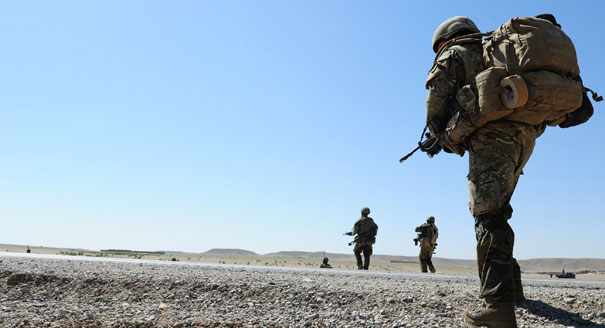
As America ends the combat role of its armed forces in Afghanistan this week, the coming year will severely test New Delhi’s Kabul policy. As Pakistan becomes, once again, the most important external actor in Afghanistan, Prime Minister Narendra Modi should resist the temptation to compete with Rawalpindi across the Durand Line. America’s hopes that Afghanistan will be a more secure place than it was five years ago, when Washington dramatically raised its military presence, have begun to fade. Amidst the resurgence of the Taliban, which has sanctuaries in Pakistan, Afghan forces have had one of the worst casualty and desertion rates this year.
Kabul has barely managed to organise an orderly succession after the new republic’s first president Hamid Karzai finished his second term earlier this year. America’s attempt to promote a political reconciliation between Kabul and the Taliban was a spectacular failure. The fanciful idea that putting all of Afghanistan’s neighbours in one room might produce a regional peace framework never really had a chance.
Matters will certainly come to a head next summer, when the Afghan forces face an all-out Taliban offensive to retake Kabul. Until then, we should see an intense diplomatic play, with the Pakistan army at centrestage.Raheel Sharif, Pakistan’s chief of army staff, was in Washington recently, wowing many with the promise of promoting peace in Afghanistan. General Sharif says Rawalpindi wants to focus on the multiple internal challenges confronting Pakistan and needs stability on the western frontier. Sharif has also reached out to Kabul. The president of Afghanistan, Ashraf Ghani, is apparently ready to take Rawalpindi’s words seriously, at least for the moment. After all, there can be no peace in Afghanistan without some support from the Pakistan army.
Many in India would scoff at General Sharif’s sweet talk on Afghanistan and shake their heads at American naivete in falling for the same trick that every Pakistani general performs with such ease in Washington. Realists in Delhi would say there is no reason to believe Rawalpindi will change its spots. Having invested so much blood and treasure over the decades to gain an enduring influence across the Durand Line, the Pakistan army is not about to turn a new leaf on Afghanistan. Delhi is probably right in believing that Rawalpindi is more likely to throw good money after bad in pursuit of “strategic depth” in Afghanistan. But it should learn to hold its tongue.
The doctrine of “strategic depth” is not an invention of the Pakistan army but a legacy from the British Raj. When British India reached the Indus, the proponents of a “forward policy” suggested that Calcutta must look beyond the natural riverine border, seek influence in the tribal areas, and make Afghanistan a strategic buffer against European rivals. This turned out to be a costly policy for the Raj, but Pakistan’s security establishment adopted it lock, stock and barrel after Partition. Like the Raj, Rawalpindi believes Pakistan’s security needs a pliable regime in Kabul and a less-than-sovereign Afghanistan.
There is a problem, though. Pakistan, as the successor state on the northwestern frontier, inherited the geography of the Raj, but not its vast resources. Partition, therefore, has given Pakistan much power to disrupt Afghanistan, but not enough to construct a stable order. This tragic story of the Great Game is unlikely to change in 2015.
If Pakistan is hobbled by the inheritance of the forward policy, the subcontinent’s post-Partition geography compels Delhi to adopt a different approach, whose lineage, too, goes back to the Raj. It is the school of “masterly inactivity” that challenged the tenets of the forward policy. Originally propounded by Lord John Lawrence, who rose from a provincial official in Delhi and Punjab to become the viceroy in the mid-19th century, “masterly inactivity” called for restraint across the Indus.
“Masterly inactivity” was certainly not about inaction, as its name suggested. It was about the virtues of “strategic patience”. It demanded constant vigil across the frontier, sustained intelligence-gathering, and an engagement with all relevant actors across the frontier. Above all, it was about conserving one’s scarce resources and deploying them at the most appropriate moment and location.
These must precisely be the attributes of Delhi’s policy towards Afghanistan at the current juncture. Delhi must not forget that the tyranny of geography limits India’s role in Afghanistan. Delhi is in no position to compete with Rawalpindi in Afghanistan. Nor can it dream of replacing American military power across the Durand Line.
For now, Delhi must welcome the current dialogue between Kabul and Rawalpindi. It must encourage good neighbourly relations between Pakistan and a united and sovereign Afghanistan. At the same time, Delhi must prepare for a “Plan B” when things begin to go wrong, again, in the northwestern marches of the subcontinent.
This article was originally published in the Indian Express.
Former Nonresident Senior Fellow, Carnegie India
A leading analyst of India’s foreign policy, Mohan is also an expert on South Asian security, great-power relations in Asia, and arms control.
Recent Work

C. Raja Mohan, Darshana M. Baruah


Alexander Gabuev, Paul Haenle, C. Raja Mohan, …
Carnegie does not take institutional positions on public policy issues; the views represented herein are those of the author(s) and do not necessarily reflect the views of Carnegie, its staff, or its trustees.

The EU can impose sanctions but struggles to enforce them without the United States. With Washington increasingly disinterested in backing European interests, the bloc must now fend for itself.


Nicu Popescu, Tiago Antunes
Global and rising powers will need to engage with Africa’s priorities and agency in order to secure the continent’s increasingly attractive partnerships.

Fonteh Akum

Rubio’s recent visit brought welcome attention, but more capital requires governance changes that may be a hard sell for regional governments.

Jennifer B. Murtazashvili
America’s foreign-policy objectives have grown more demanding while Americans have demanded greater focus on their own affairs.

Stephen Wertheim

Japan’s long-term security policy is driven by concerns about China, and there is little appetite for (or interest in) pursuing a confrontation with Moscow.

James D.J. Brown