

Article
C. Raja Mohan, Darshana M. Baruah
{
  "authors": [
    "C. Raja Mohan"
  ],
  "type": "legacyinthemedia",
  "centerAffiliationAll": "dc",
  "centers": [
    "Carnegie Endowment for International Peace",
    "Carnegie India"
  ],
  "collections": [],
  "englishNewsletterAll": "ctw",
  "nonEnglishNewsletterAll": "",
  "primaryCenter": "Carnegie India",
  "programAffiliation": "SAP",
  "programs": [
    "South Asia"
  ],
  "projects": [],
  "regions": [
    "South Asia",
    "India",
    "Middle East",
    "Saudi Arabia"
  ],
  "topics": [
    "Foreign Policy"
  ]
}
Source: Getty
As New Delhi turns to the Gulf in 2015 and tends to its high stakes in the region, an intensive engagement with Saudi Arabia must be at the top of Prime Minister Narendra Modi’s diplomatic priorities.
Source: Indian Express
At a moment when the world is marvelling at the bold Saudi strategy of driving down oil prices — this week they dipped for a moment below $50 a barrel — King Abdullah, 90, has been hospitalised with pneumonia, setting off speculation about the kingdom’s stability and the international consequences of a political transition in Riyadh.
Abdullah acceded to the Saudi throne in 2005, when his half-brother King Fahd passed away. But Abdullah had been the crown prince since 1982 and was in charge of the kingdom during Fahd’s prolonged illness in his final years.
The king of Saudi Arabia is more than a mere monarch. He is the custodian of the Muslim holy places in Mecca and Medina, and exercises great political influence in the Islamic world. Since the fall of Egypt’s Gamal Abdel Nasser in the late 1960s, Saudi Arabia has acquired a decisive influence in shaping the regional order in the Middle East. The kingdom has been a strong ally of the Anglo-Saxon powers and enjoyed great clout in shaping the world economy.With nearly a fifth of the world’s proven oil reserves and the very low costs of exploiting them, some have described the king of Saudi Arabia as the “custodian of the world’s oil prices”. As has been demonstrated in the last few weeks, Saudi Arabia remains the swing producer that can unilaterally determine the international price of oil.
Unlike in other monarchies, the Saudi succession has moved horizontally from one brother to another among the 40-odd sons that the founder of the kingdom, Abdul Aziz, fathered. Abdullah’s designated crown prince, Salman, is 79 years old; but he is said to be ill. The deputy crown prince Muqrin, the youngest of the second generation, is 69. Some analysts worry that Abdullah’s death might generate considerable internal jockeying for power in Riyadh.
Others believe that Abdullah has had enough time to organise a smooth transition to the third generation of leadership. There is speculation that Abdullah has positioned his son, Prince Miteb, currently the head of the powerful National Guard, at the top of the heap in the third generation. Some are betting that when King Abdullah abdicates or passes away, his son Miteb could be appointed deputy crown prince.
The internal problems of succession look rather simple in comparison to the massive external challenges that Saudi Arabia faces.
If his predecessors had the reputation for political passivity, King Abdullah had brought a measure of assertiveness to Saudi Arabia’s foreign policy.
Amidst growing perception that Saudi Arabia is losing its clout in the oil market, Abdullah has taken on high-cost oil production around the world, including shale gas exploitation in the US, by forcing lower prices. This involves considerable cost to Saudi Arabia in the near term and Abdullah has been willing to run the risk.
Angered by the American empathy for the Arab Spring and concerned that Washington might cut a nuclear deal with Iran, Abdullah has acted vigorously in the region. He sent troops into Bahrain to assist the minority Sunni elite in putting down a popular revolt. Abdullah offered strong support to the Egyptian army when it ousted the Muslim Brotherhood government in Cairo led by Mohammed Morsi. He actively sought to blunt the regional policies of Turkey and Qatar that backed the Brotherhood.
Fears of rising Iranian power and Tehran’s support to Shia formations across the region saw Abdullah back the Sunni militias in Syria and Iraq. The rise of Sunni extremism in the form of the Islamic State that threatens the interests of both Saudi Arabia and Iran has begun to encourage Abdullah to limit the regional rivalry with Tehran in the last few months.
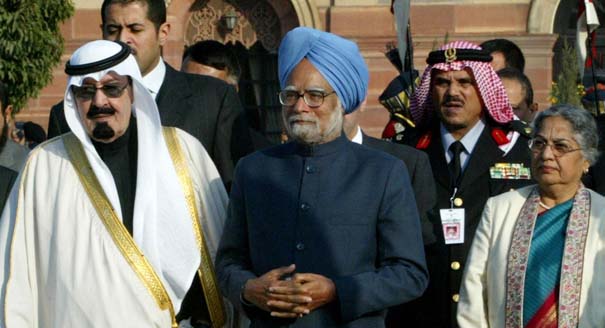
Over the last decade, Abdullah unveiled a “Look East” policy that lent Asia greater salience in the Saudi worldview. Abdullah became the first Saudi monarch ever to visit China. His trip to India as the chief guest on Republic Day in 2006 was the first by a Saudi king in more than 50 years.
If Beijing moved with great speed to consolidate the partnership with Riyadh, the UPA government seemed somewhat slow in seizing the new opportunities that opened up in Saudi Arabia under Abdullah.
The NDA government, focused as it has been on the immediate neighbourhood and the great powers, has not devoted sufficient attention to the Middle East in 2014. As New Delhi turns to the Gulf in 2015 and tends to its high stakes in the region, an intensive engagement with Saudi Arabia must be at the top of Prime Minister Narendra Modi’s diplomatic priorities.
This article was originally published in the Indian Express.
Former Nonresident Senior Fellow, Carnegie India
A leading analyst of India’s foreign policy, Mohan is also an expert on South Asian security, great-power relations in Asia, and arms control.
Recent Work

C. Raja Mohan, Darshana M. Baruah


Alexander Gabuev, Paul Haenle, C. Raja Mohan, …
Carnegie does not take institutional positions on public policy issues; the views represented herein are those of the author(s) and do not necessarily reflect the views of Carnegie, its staff, or its trustees.

The EU can impose sanctions but struggles to enforce them without the United States. With Washington increasingly disinterested in backing European interests, the bloc must now fend for itself.


Nicu Popescu, Tiago Antunes
Global and rising powers will need to engage with Africa’s priorities and agency in order to secure the continent’s increasingly attractive partnerships.
Fonteh Akum

Rubio’s recent visit brought welcome attention, but more capital requires governance changes that may be a hard sell for regional governments.

Jennifer B. Murtazashvili

America’s foreign-policy objectives have grown more demanding while Americans have demanded greater focus on their own affairs.

Stephen Wertheim

Japan’s long-term security policy is driven by concerns about China, and there is little appetite for (or interest in) pursuing a confrontation with Moscow.

James D.J. Brown