

Commentary
Pierre Vimont
{
  "authors": [
    "Pierre Vimont"
  ],
  "type": "other",
  "centerAffiliationAll": "dc",
  "centers": [
    "Carnegie Endowment for International Peace",
    "Carnegie Europe"
  ],
  "collections": [],
  "englishNewsletterAll": "ctw",
  "nonEnglishNewsletterAll": "",
  "primaryCenter": "Carnegie Europe",
  "programAffiliation": "EP",
  "programs": [
    "Europe"
  ],
  "projects": [],
  "regions": [
    "Europe",
    "Western Europe",
    "Iran"
  ],
  "topics": [
    "Security"
  ]
}
Source: Getty
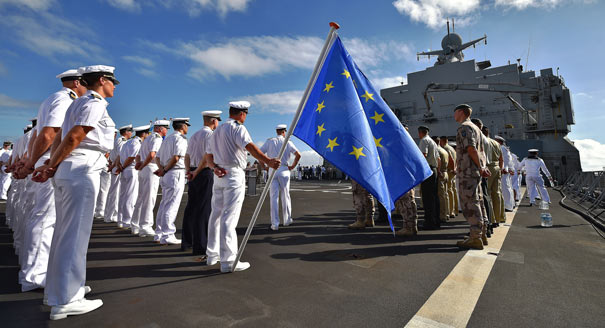
An enhanced Common Security and Defense Policy needs all EU member states to show strong political will and a clear vision of what they want this policy to be.
When one looks at the present state of the CSDP, one cannot help but look on with disenchantment at the energy that appears to have abandoned both institutions and Member States. Commentators increasingly take for granted that nothing much should be expected from this field of EU policy.
The reasons for this state of mind are well known: the recent economic and financial strains, which have impacted all EU action since 2008, means that most of the Member States will struggle to keep their defence budgets at their present level in the future, and we may even see reductions. Furthermore, and to put it mildly, most of the recent CSDP operations have also experienced a lack of enthusiasm. Adding to this overall trend, the EU is far from presenting a common vision of what security and defence should really mean. Many of the Member States do not want to be involved in all of today’s international turmoils, and they rarely share the strategic culture which inspires those Member States who see themselves as having special responsibilities in dealing with these crises. In the end it may be that Member States diverge fundamentally on the simple question of whether it is relevant for the EU to engage in most of the ‘hot’ crises Europe faces; many prefer to see Europe as a soft power, mostly dedicated to intervening on less dramatic fronts and more inclined to mend than to fight. For whatever reason given, it remains that if there is a lack of common understanding on what CSDP should really be about, it should not come as a surprise if this policy is presently in stalemate.As an additional blow, the Ukrainian crisis, which dragged on for the whole of last year, could only add to the downward spiral the EU has been experiencing, with a new Russia aggressively confronting Europe in a manner not too distant from the Cold War days. This attitude has triggered the natural reaction among EU Member States to seek reassurances from NATO about their own national security. Coupled with the return of France a few years ago into the integrated military command, NATO’s renewed relevance has sent a strong message to Europe about the military organisation’s credibility with regard to collective defence.
Surprisingly, this overall trend was gathering momentum at the same time as other more positive developments. The European Council of December 2013 dedicated its main session to CSDP: it underlined Europe’s role as a ‘security provider’ while adopting a very ambitious road map for Europe in all possible dimensions of the security sector. Hence the impression of a genuine boost to all EU institutions, which have been invited to join efforts and give CSDP a reinvigorated efficiency. In the same way, the increasing instability in Europe’s neighbourhood has also called for more EU operations: most recently in Iraq, Libya, Northern Nigeria or South Sudan. Pressure for further EU engagement has been one of the most constant features of the discussions taking place around these crises. Moreover, a growing number of EU partners in Asia, Latin America or Eastern Europe have shown a renewed eagerness to join CSDP missions in what sounds like a vote of confidence for EU capacities.
What kind of conclusion should be drawn from this contradictory situation? Probably that the EU has much more potential than it can sometimes figure out itself, if only it would be ready to adapt to the new global realities. But, more than anything else, an enhanced CSDP needs from all Member States strong political will and a clear vision of what they want this policy to be. Without this indispensable ingredient CSDP may continue to run its course, as it does today. It may even grow in efficiency but it will keep lacking the one resource that would definitely help it overcome all the present shortcomings that have prevented Europe from finding its true role and mission through the CSDP.
Member States remain central to EU security and defence policy. This is why this collection of essays is so valuable for assessing in no uncertain way the long road that lies ahead for any progress to be made.

Senior Fellow, Carnegie Europe
Pierre Vimont is a senior fellow at Carnegie Europe. His research focuses on the European Neighborhood Policy, transatlantic relations, and French foreign policy.
Recent Work
Pierre Vimont
Pierre Vimont
Carnegie does not take institutional positions on public policy issues; the views represented herein are those of the author(s) and do not necessarily reflect the views of Carnegie, its staff, or its trustees.
They face an uphill climb, but they could draw on a strategy that other diplomats have used in the past.


Shana Tabak, Alejandro Martin Rodriguez
Despite myriad challenges and occasional stumbles, the new Hungarian government is moving ahead with energy and conviction to uproot years of illiberalism and corruption and rebuild Hungarian democracy.

Thomas Carothers

European Commission President Ursula von der Leyen is about to give her annual address on the state of the EU. Here’s what she won’t—but should—say.

Rym Momtaz
Understanding the climatic pain points is necessary for policymakers hoping to minimize the war’s negative environmental consequences.


Alejandro Martin Rodriguez, Joy Arkeh, Sarah Yerkes

Radical-right parties are expected to do well in upcoming elections in four of the EU's biggest member states. If successful, they could prevent the union from addressing key challenges ahead.

Stefan Lehne