

Commentary
The EU can impose sanctions but struggles to enforce them without the United States. With Washington increasingly disinterested in backing European interests, the bloc must now fend for itself.
Nicu Popescu, Tiago Antunes
Source: Getty
Understanding the climatic pain points is necessary for policymakers hoping to minimize the war’s negative environmental consequences.
In a region already much affected by climate impacts and conflict dynamics, the continuation of the Iran war will reinforce their relationship and, in turn, result in serious humanitarian consequences.
Since the beginning of the U.S.-Israeli strikes on Iran in late February, analysts and policymakers have focused their attention on the geopolitical, economic, and energy-related fallout that a prolonged conflict brings to the world. So far, the war in Iran has claimed the lives of soldiers and civilians, including more than 100 children killed in a U.S. strike on an Iranian elementary school; disrupted economic systems, costing the United States 2 billion dollars each day; and shocked energy markets.
However, one of the war’s most serious consequences is also one of its least reported. Whereas the true cost of the war is only beginning to be tallied, one thing is already clear: It is worsening the climate crisis and degrading human security in an already climate-vulnerable region. Yet most discussion has not centered around the environmental, climate, and human mobility implications of the conflict.
West Asia is particularly affected by climate impacts and by conflict, fragility, and violence. Temperatures are expected to rise in the region by twice the global average during the twenty-first century, and countries such as Syria and Yemen have also witnessed civil wars and protracted humanitarian crises. Climate change and conflict have a complex, multidimensional relationship, and each may exacerbate the other.
The onset of the new Iran war is expected to reinforce the threat-multiplying relationship between conflict and climate impacts.
Emissions from military activities contribute greatly to the climate crisis. Russia’s war in Ukraine has so far generated emissions that are almost equal to the annual emissions of France, for instance. Conversely, climate impacts may undermine livelihoods and create grievances that lead to instability and conflict. In Syria, the great drought of 2005–2010 destabilized the country’s agriculture, undermining food security and precipitating mass internal migration—factors that at least exacerbated the civil war.
The onset of the new Iran war is expected to reinforce the threat-multiplying relationship between conflict and climate impacts, resulting in serious humanitarian consequences. These have led to displacement in the past, not only in the region but on a global scale. Here, we assess the different ways in which the conflict is exacerbating climate, environmental, and human vulnerabilities in West Asia, and how they could lead to increased displacement. This article looks at worsening water scarcity, threats to public health, exacerbated forest and farmland fires, increasing greenhouse gas emissions, and weakened state capacity as pressing consequences of renewed and increased conflict between parties in the Middle East.
The water resource situation in West Asia is already at a critical stage, with per capita water availability below the water stress threshold in the region. At the start of Operation Epic Fury, Iran and the Gulf region had already been experiencing a climate-induced drought for more than five years. In neighboring Iraq, 2025 marked the worst drought on record since 1933. The Iran war is worsening this fragile context, with strikes targeting civilian and industrial infrastructure that includes oil facilities and chemical plants, releasing toxic residues that pollute waterways. This is of particular concern for Iran, where water resources had already been depleted by drought and mismanagement.
Since the beginning of the war, desalination plants have been struck and water reservoirs have been damaged. Last March, Iran accused the United States of attacking Qeshm Island and its desalination plant, which provides water for thirty villages. The next day, Bahrain also announced that Iran had attacked one of its plants in a drone strike and the United Arab Emirates claimed that a similar attack had targeted its Fujairah F1 power and water plant. In June, Iran again announced that two of its water reservoirs had been targeted and damaged, causing thousands of people to lose access to drinking water; the Iranian government criticized American strikes as responsible for the worsening water situation in towns such as Jask and Sirik. Previously, attacks on water pipelines by Israel had also “decimated large sections of Gaza’s water infrastructure.”
Other civilian and industrial infrastructure has also been targeted. This includes attacks on oil facilities and chemical plants, polluting fragile waterways, which could lead to contaminated food, water, and air with severe health consequences for vulnerable populations, according to the World Health Organization (WHO).
Climate-induced water stress has already forced rural populations to move into cities. Many are now at risk of being displaced again.
This has huge implications in a region with four of the six most water-stressed countries on Earth, where desalination fulfills a significant percentage of total demand (up to 77.3 percent in Qatar and 67.5 percent in Bahrain, for instance). Threats to the water supply cause more than collateral damage; they sit at the intersection of conflict and climate vulnerability. Drinking water needs in cities such as Doha, Dubai, or Kuwait City simply could not be met without their countries’ networks of desalination facilities. Furthermore, lack of access to water—whether it is climate- or conflict-induced—has been found to increase security vulnerabilities that risk fueling conflict, fragility, and violence in the Middle East and North Africa.
These new attacks could exacerbate an ongoing climate displacement crisis. In southern Iraq, climate-induced water stress has already forced rural populations to move into cities. Many are now at risk of being displaced again, this time not by climate change but by conflict. And while data about displacement in Iran is limited, estimates suggest that at least tens of thousands of Iranians are internally displaced yearly by drought and other climate impacts, such as floods or land degradation. If access to clean water deteriorated further—via increased attacks on desalination plants, for instance—even wealthy populations in the United Arab Emirates and Saudi Arabia would likely find their capacity to stay in their homes compromised.
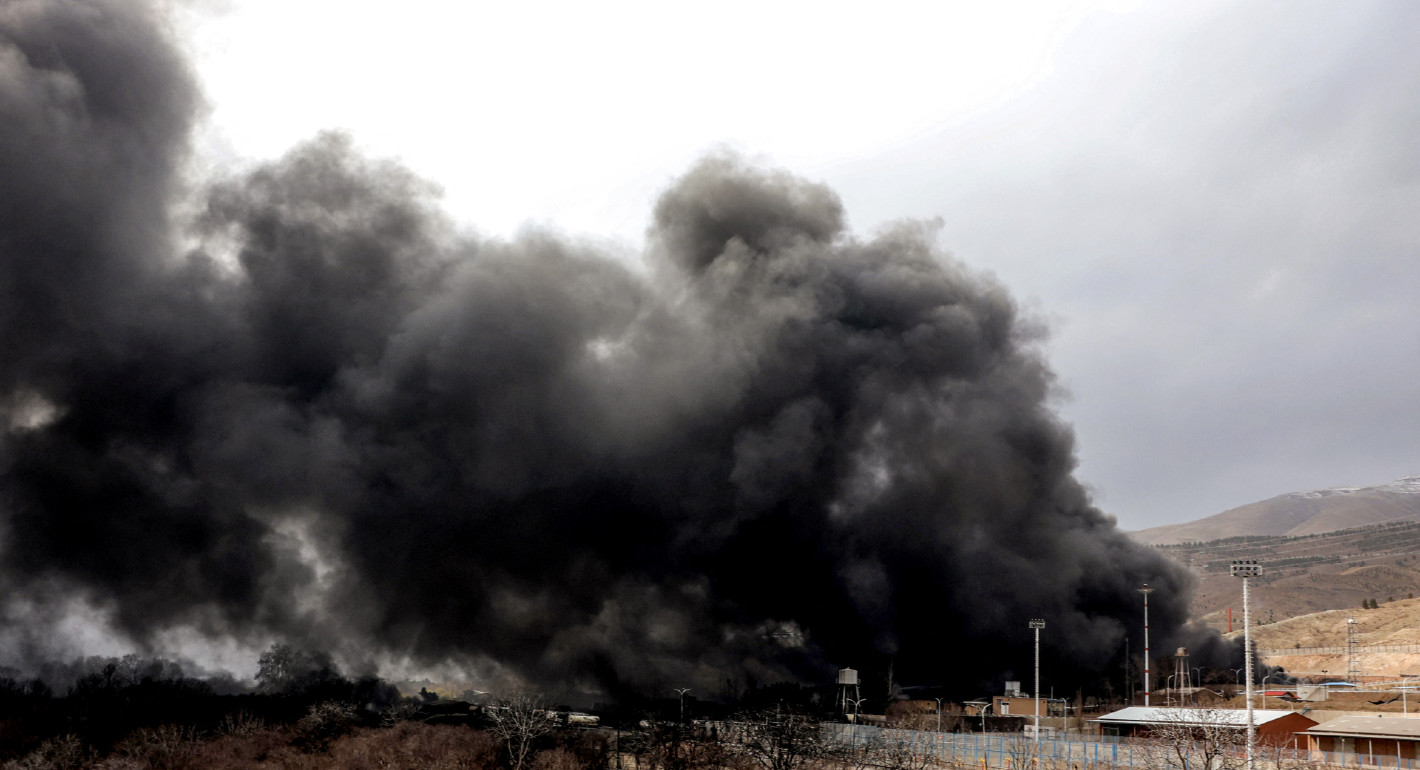
Conflict-linked pollution in West Asia goes beyond the contamination of water resources. On March 7, 2026, airstrikes hit four oil storage and refinery sites in and around Tehran. The strikes resulted in fires that produced a phenomenon referred to as “black rain”: oil mixed with precipitation, impacting a metro area of 9–15 million people. The situation was so bad that the WHO issued a warning about dangerous air pollution following the strikes. The strikes caused air to be contaminated with sulfuric acid and trace metals. This has had direct impacts on public health, and residents reported experiencing headaches and breathing difficulties following the attack. Short-term exposure to black rain can also lead to eye and skin irritation and can exacerbate existing asthma and pulmonary conditions. And because the exact combination of contaminants is not known, the impacts of chronic and long-term exposure to contaminated soil, water, and crops are yet to be determined.
More broadly, the ongoing conflict has led to serious challenges to Iran’s water, sanitation, and hygiene conditions, causing an elevated risk of respiratory infections, diarrhea, and other communicable illnesses, which disproportionately impact women and children as populations are displaced and people overcrowd shelters. More than 3.2 million people in Iran and up to 700,000 in Lebanon are estimated to have been internally displaced since the beginning of the war. In Lebanon, the WHO has pointed to heightened risks of cholera as well as measles, chickenpox, and scabies. And an increase in human displacement due to war has already contributed to a 25 percent gap in essential noncommunicable disease medicines (including insulin).
The ongoing conflict has led to serious challenges to Iran’s water, sanitation, and hygiene conditions, causing an elevated risk of respiratory infections, diarrhea, and other communicable illnesses.
Though not directly related to climate change, the region’s health care facilities have also experienced direct threats, with eighteen verified attacks on health care facilities in Iran and twenty-five in Lebanon since February 28. Additionally, attacks on Iran’s central vaccine production and epidemiological tracking hub have hobbled the country’s ability to produce vaccines and monitor outbreaks. Damage to health care infrastructure is both direct and indirect, with power outages, fuel shortages, and staff displacement disabling medical care even in facilities that have remained out of the line of fire.
An additional public health impact of the ongoing conflict is the psychosocial toll and mental health consequences of the continued war. According to the WHO, in populations exposed to armed conflict, around 10 percent will develop serious mental health challenges and another 10 percent will develop mental health–related, functionally impairing behavioral changes. The impact is even worse on children, who experience disruptions to school, housing, and family stability that all serve as drivers for childhood anxiety, hyperactivity, and other mental health concerns that can persist well beyond the end of conflict.
The impact of the conflict on public health is well documented and further exacerbated by the decline in humanitarian assistance globally. The eastern Mediterranean region was already home to nearly half of all people globally requiring humanitarian assistance before the conflict started. Furthermore, the WHO’s own global logistics hub in Dubai faced disruption early in the conflict due to airspace closure, impacting its ability to distribute medical supplies to more than 1.5 million people across twenty-five countries.
West Asia’s arid conditions, which have worsened as a result of climate change, make it particularly vulnerable to forest and farmland fires. Conflict exacerbates the risk of fires, with Armed Conflict Location & Event Data recording almost 200 incidents of fires caused by attacks from Hezbollah or the Israel Defense Forces in Israel and Lebanon between October 2023 and July 2024. More recent attacks have particularly affected farmland, and the Lebanese Agriculture Ministry reported in late March 2026 that 22 percent of the country’s cultivated land had been damaged in the previous month. This, combined with the worsened global fertilizer crisis caused by the closure of the Strait of Hormuz, could lead to disastrous food insecurity forcing populations to leave their homes. Wildfires in the region have also triggered more displacement in recent years, and this phenomenon can be expected to increase as conflict-related fires become more common.
Extreme climate variability in recent years has exposed the Middle East to increased fire risk occurrences, but 90 percent of fires are ignited as a result of anthropogenic factors like destructive land management practices and military activities. Burning farmland and economically essential crops in fertile hotspots is done for political gain during conflict across the Middle East, and because areas under conflict are less accessible, land management regulations are less enforceable.
Ninety percent of fires are ignited as a result of anthropogenic factors like destructive land management practices and military activities.
In 2019, territory held by the Islamic State in Iraq and Syria experienced an irregular spike in scorched agricultural land following the group’s military defeat. Scorching previous strongholds is a way to reassert territorial ownership. Similarly, after 2015, active fire hotspots in Türkiye’s Dersim province were tied to armed clashes between the Kurdistan Workers’ Party (PKK) and Turkish armed forces. Wildfires in croplands release pollutants that contaminate soil, water, and air, threatening food security; and are likely to spread to nearby forests, which act as natural carbon sinks. Food systems that farmers rely on for self-sufficient livelihood are pressured by the weaponization of environmentally harmful contaminants as a conflict tactic. In summer 2026, Israel has turned to the use of white phosphorus and glyphosate in southern Lebanon to retaliate against Hezbollah’s attack on Israel following Israel’s assassination of Iran’s supreme leader. The displacement of farmers who can no longer work, along with significant chemical exposure, has halted 78 percent of agricultural activity in the region—a national hub for citrus, olive, and tobacco production. Lebanon’s minister of environment has labeled attacks on her country’s forests, agricultural lands, marine ecosystems, water resources, and atmospheric quality an “act of ecocide”: the mass damage, destruction, or loss of ecosystems.
The use of agricultural herbicide and arson in cultivated land—including tear gas, which intensifies the spreading of fire—is also common in Palestine. Palestinian territories have seen an escalation in targeted infrastructure attacks since the beginning of the Iran war. In Gaza, only 1.5 percent of agricultural land remains unharmed.
Damage assessments are already difficult to conduct in remote rural areas. With conflict exacerbating climate impacts, the process of environmental monitoring after fires is made more complicated. Iran’s rural towns of Zanjan and Tabriz struggled with disaster management after fires spread following Israel- and U.S.-led attacks on their military facilities, exposing the local population to highly toxic dioxins and furans. A product of climate events rather than the Iran war, wildfires erupted in July 2026 in Syria and re-erupted across the rural parts of Homs, Lattakia, Hama, Idleb, and Tartous. As a result, 2,000 families were displaced from their homes.
Displacement in conflict-affected areas is tightly linked to degrading climate conditions, which make present habitability and long-term reintegration unfeasible and unattractive. In conflict zones, fire hazards act as a threat multiplier to already fragile conditions relating to food, economics, and human security. Trends of both forcible and voluntary migration among herding communities in rural areas to urban cities are growing across the Middle East, leaving formerly well-sustained farmlands to the careless supervision of military actors who are not incentivized to conduct sustainable fire and environmental management. More importantly, the destruction of farming equipment and vehicles, and in some cases attacks on makeshift encampments, stretches evacuation into long-term displacement. Although many countries have banned harmful practices like crop residue burning, land clearing by fire, and logging, the Middle East must approach climate adaptation issues and emergency response measures in fire management as an integrated, multisectoral strategy that can mitigate climate and public health threats in the shadows of conflict.
As mentioned earlier, emissions from military activity exacerbate the climate crisis, and the Iran war is no exception. In just the first two weeks of the war, an estimated 5 million tonnes of CO₂ were emitted into the atmosphere. This means the war is burning carbon at a faster rate than eighty-four countries combined. Greenhouse gases come from a variety of sources, including the destruction of homes, buildings, and fuel reserves; the fuel consumed in combat operations; and the embodied carbon of military equipment.
Existing infrastructure may be the primary target, but attacks are also wiping out the opportunity to build more resilient societies in the region. In the long term, emissions generated by the conflict will compound with those generated by postwar reconstruction efforts in the region. When the war ends, analysts expect military spending in the region and globally to rise, in the face of an increasingly volatile geopolitical landscape. This will inevitably lead to higher military emissions. For instance, based on the White House’s April 2026 Pentagon budget request of around $1.5 trillion, submitted in the context of the ongoing conflict with Iran, experts estimate that 267 megatonnes more carbon pollution could be sent into the atmosphere. This is fifty-three times more than the estimated CO₂ emissions produced during the first two weeks of the war.
In just the first two weeks of the war, an estimated 5 million tonnes of CO₂ were emitted into the atmosphere.
As the conflict develops, secondary impacts will also lead to an increase in greenhouse gas emissions. Many countries, particularly in Asia, are switching from gas to coal because of the volatility of the liquified natural gas (LNG) market in the wake of the war. LNG had played a key role in the energy security of these economies, particularly following Russia’s full-scale invasion of Ukraine in 2022. However, the Iran war is causing gas cargoes in the Persian Gulf to be delayed, rerouted, or priced out by maritime insurance premiums. The consequence has been countries like India increasing their coal consumption to meet the high demand for energy in the summer, or countries like Thailand, the Philippines, and Vietnam “boosting coal-fired power.”
Ultimately, the war creates a double burden on the climate crisis: more emissions, accelerating climate impacts, and less funding to invest in mitigating them through the transition to renewables or building adaptation and resilience. Conversely, the greenhouse gas emissions generated by military activity throughout the conflict will compound the medium- and long-term climate pressures already bearing down on the region. All of this evidence shows a reinforcing relationship: a climate crisis compounding a war and a war compounding a climate crisis.
The war in Iran is not only impacting environmental and climate stressors in the region. It is also preventing governments from investing in much-needed resilience and adaptation measures that could help address existing challenges. This is happening not long after the so-called great aid recession, with eight of the ten largest humanitarian donors having reduced their funding since 2022. Historically, weakened governance systems have led to revolts and conflicts over water, energy, and food shortages that have triggered exacerbated displacement—disproportionately harming refugees, farmers, and women. While the Gulf has adopted cleaner energy alternatives, the war has exposed the consequences of a policy of water overconsumption and energy-intensive systems (such as desalination plants) now under heightened threat. Furthermore, with remittance streams from foreign workers in Gulf countries facing increased risk, the future of the region’s social contract looks uncertain. So far, the Iran war has also caused an estimated $58 billion in damage to energy infrastructure, and the region’s tourism revenue is declining around $600 million a day, further diminishing Gulf governments’ capacity to invest resources in the adaptation and resilience of their societies.
In the Gulf Cooperation Council sustainable development mega projects are being shelved to make fiscal room for repairing battered energy infrastructure and strengthening defense capabilities. While the economies of Kuwait, Bahrain, and Qatar are more dependent on oil revenues, the United Arab Emirates and Saudi Arabia are not immune to the macroeconomic pressures of a volatile energy market, in addition to the climate stressors that exacerbate resource scarcity. Rising fuel and insurance costs for Gulf shipping carriers, abetted by an unreliable ceasefire, undermine the promise of deals like an Abu Dhabi port group’s $22 million dirham investment to develop Khalifa Port, which houses the world’s three largest shipping lines: CMA CGM, COSCO, and MSC.
At best, these Gulf countries will experience a dip in foreign capital flows and tourism and a spike in risk premiums for investors. Together, these changes may subvert the Gulf’s long-standing image as a prosperous business hub for expats. Along with expanding budget deficits across Bahrain, Qatar, Saudi Arabia, and Kuwait, crackdowns against Shia minorities in Bahrain and Kuwait have increased since the Iran war, further depleting the Gulf’s governance capacity; some are experiencing displacement after having their citizenship revoked. In the long run, a diverse resource market in the Gulf cannot function fully without a diverse labor market to participate in it. On the other hand, resource-dependent, debt-burdened countries like Iraq, Egypt, Lebanon, and Morocco face more structural challenges that complicate the reversal of economic and social devastation. In Iraq, oil infrastructure is under persistent attack, and fuel prices are rapidly rising after a 70 percent slash in electricity imports from Iran, which has deepened preexisting public frustration over unemployment, affordability, and state capacity in managing conflict.
The rerouting of humanitarian aid delivery and the global deprioritization of postconflict reconstruction funds have pushed socioeconomically fragile and resource-poor states into deeper instability.
Supply shocks also limit energy availability used to sustain food supply chains and agroproduction, which involve irrigation, refrigeration, and transportation—processes made more costly by rising temperatures and extreme heat waves plaguing the region in the summer. Historically, food insecurity and inflation were significant stimuli for unrest during the Arab Spring; and underdeveloped, conflict-exposed countries, where farmer populations make large contributions to GDP, suffer disproportionately from the consequences of food insecurity. Yemen serves as the region’s most severe example of food insecurity that is exacerbated by high displacement rates. Countries like Syria and Palestine are affected to similarly acute degrees. The impact of the U.S.-Iran war on food inflation has eroded purchasing power, lowered demand for higher-value agricultural commodities, and raised input and production costs for farmers. These realities negate the labor opportunities that traditionally exist in farming for displaced populations. The seasonal nature of employment in the agricultural sector, which has become increasingly jeopardized by shorter rainfall and increased drought cycles, further alienates displaced and rural households.
Gulf states, which are highly dependent on food imports for staples like soybeans, vegetable oils, and corn, are also primary exporters of ammonia, urea, and sulfur—fertilizers that farmers in Egypt and Morocco heavily rely on for production. Morocco is one of the Gulf’s largest importers of sulfur, a key agricultural fertilizer. Egypt’s protracted battle with inflation and indebtedness to foreign grants and loans (to finance delayed megaprojects after a rise in oil prices) has sharpened social grievances among consumers grappling with poverty. Lebanon represents an even more concerning case of debt accumulation and fragile governance delivery systems that are unable to keep up with proliferating displacement, overcrowding shelters, and spreading climate-induced diseases, caused by Israel’s escalating military incursions in the south. With 33 percent of Lebanon’s GDP dependent on remittances from the Gulf countries, the better-off segments of Lebanon’s population are not spared from livelihood uncertainties and government mistrust.
Lastly, the rerouting of humanitarian aid delivery through longer aviation routes—that originally traveled through the Strait of Hormuz—and the global deprioritization of postconflict reconstruction funds by major donors like the UN Office for the Coordination of Humanitarian Affairs have pushed socioeconomically fragile and resource-poor states into deeper instability. Humanitarian organizations seeking to help displaced Iranians only have access to a third of the funding required to sustain emergency relief efforts. In Lebanon and Palestine, infrastructure damage by Israel has led to immobility and delays across aid carriers, entrapping would-be aid recipients in a state of displacement. Extreme reliance on international aid and the absence of a framework for regional integration and cooperation in response to the Iran war will only compound MENA governments’ struggles in coping with resource insecurity and displacement in a context of mounting conflict and climate stressors.
The Iran war has had immediate consequences for global geopolitics, economic growth, human security, and energy markets. It also has a climate vulnerability dimension. Understanding the environmental and climate fallout of the conflict can help policymakers identify how to minimize its potential consequences. It can also help observers assess the extent to which desalination plants in Iran or cultivated land in Lebanon are being prioritized as common targets of military strategy, against a background of the logic of war increasingly colliding with the logic of climate vulnerability. And at the same time, it can help countries that are concerned about a new migration wave in the Middle East—like the one that followed the Syrian Civil War—think about how to prevent such a wave, or at least prepare for it.
Policymakers must integrate climate into security and military assessments, invest in adaptation and resilience, and prioritize cost-effective interventions.
The Iran conflict has made clear that war and climate change interact in dangerous ways, amplifying negative impacts on societies and economies with both short- and long-term consequences. Policymakers who seek to alleviate these harms should no longer silo their responses to conflict and to climate. The single most important action that could address this threat-multiplying relationship is to cease hostilities and end the conflict permanently. In the meantime, policymakers must integrate climate and environmental vulnerability outputs into security and military assessments, to better understand the impact of conflict on populations, governance, and military capacities. Such integration would require a range of actions, such as analyzing how rapid- and slow-onset events that undermine rural livelihoods or increase water and food insecurity interact with military tactics, or considering how military personnel on the front lines respond to climate impacts. Additionally, to prevent or minimize human suffering, policymakers must invest in adaptation and resilience so that their societies are better equipped to respond to climate shocks, including those exacerbated by conflict. This would lead to more resilient populations, less easily exploited by military tactics that build impact via climate and environmental vulnerabilities. And to address the displacement challenges brought about by both climate and conflict, policymakers should prioritize cost-effective interventions and financial support for climate mobility action, such as disaster preparedness and response or planned relocations.
Finally, policymakers and civil society actors should take advantage of this moment of policy plasticity to localize energy and food systems and increase investment in renewable sources of energy that are less vulnerable to geopolitical impacts. Such energy efficiency investments and increase in renewables in China and Spain, for instance, have made those countries less vulnerable to the energy impacts of the war.
These policies offer opportunities for cost-effective interventions that can support people—especially the most socioeconomically vulnerable populations—as they experience climate impacts, including those exacerbated by conflict. Although the Gulf has struggled with developing a coordinated approach to the climate and energy crises, the war presents a new opportunity for countries in the Gulf and the broader Middle East to strengthen their adaptive resilience through more integrated clean energy and water infrastructures.

Fellow, Sustainability, Climate, and Geopolitics Program
Alejandro Martin Rodriguez is a fellow in the Sustainability, Climate, and Geopolitics Program at the Carnegie Endowment for International Peace. His research focuses on the social dimensions of climate change, and he manages projects on climate mobility, peace, and security.

Joy Arkeh
Research Assistant, Middle East Program
Joy Arkeh is a research assistant in the Middle East Program at the Carnegie Endowment for International Peace, where she focuses on climate change, vulnerability, and governance in the Middle East and North Africa.

Acting Co-Director and Senior Fellow, Middle East Program
Sarah Yerkes is acting co-director and a senior fellow in the Middle East Program at the Carnegie Endowment for International Peace. Her research focuses on democracy and governance, U.S. foreign policy towards the Middle East and North Africa, and political and economic reform in Tunisia.
Carnegie does not take institutional positions on public policy issues; the views represented herein are those of the author(s) and do not necessarily reflect the views of Carnegie, its staff, or its trustees.

The EU can impose sanctions but struggles to enforce them without the United States. With Washington increasingly disinterested in backing European interests, the bloc must now fend for itself.


Nicu Popescu, Tiago Antunes

Rubio’s recent visit brought welcome attention, but more capital requires governance changes that may be a hard sell for regional governments.

Jennifer B. Murtazashvili

America’s foreign-policy objectives have grown more demanding while Americans have demanded greater focus on their own affairs.

Stephen Wertheim

Japan’s long-term security policy is driven by concerns about China, and there is little appetite for (or interest in) pursuing a confrontation with Moscow.

James D.J. Brown

Russia is testing the waters of NATO’s mutual defense clause. What do strikes in Romanian territorial waters mean for the alliance’s posture toward Moscow?

Dimitar Bechev