

Commentary
Maha Yahya
{
  "authors": [
    "Maha Yahya"
  ],
  "type": "legacyinthemedia",
  "centerAffiliationAll": "dc",
  "centers": [
    "Carnegie Endowment for International Peace",
    "Malcolm H. Kerr Carnegie Middle East Center"
  ],
  "collections": [],
  "englishNewsletterAll": "menaTransitions",
  "nonEnglishNewsletterAll": "",
  "primaryCenter": "Malcolm H. Kerr Carnegie Middle East Center",
  "programAffiliation": "MEP",
  "programs": [
    "Middle East"
  ],
  "projects": [],
  "regions": [
    "Maghreb",
    "Tunisia",
    "North Africa"
  ],
  "topics": [
    "Political Reform",
    "Security",
    "Democracy"
  ]
}
Source: Getty
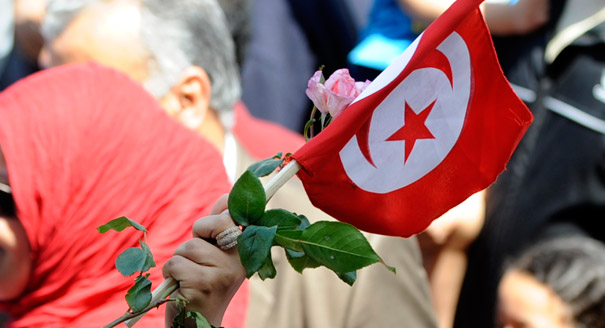
Tunisia may be the exemplar for democratic transition in the Arab world. But if longstanding grievances continue to go unaddressed, worsening societal fractures will derail the country's fragile political transition.
Source: RealClearWorld
Tunisia may be the exemplar for democratic transition in the Arab world, but it has also seen 3,000 of its citizens drawn as recruits to extremist groups. This apparent enigma emerges from the country’s struggles with unemployment and poverty, but also - and perhaps more importantly - from a past of repression, and from the unmet expectations of Tunisians after the fall of Zine El Abidine Ben Ali. If longstanding grievances continue to go unaddressed, worsening societal fractures will derail Tunisia’s fragile political transition.
A prevailing discontent with Tunisia’s economic and political conditions is increasingly palpable, particularly among the youth. Many of those who first took to the streets to protest the Ben Ali regime now resent what they see as their hijacked uprising, and concerns about economic prospects are increasing. The hope that economic reforms would lead to more equitable growth and social justice did not materialize.
Instead, successive post-uprising governments continued with the same socioeconomic policies as Ben Ali and expanded austerity measures.Inflation has increased, and more than 25 percent of Tunisians are poor. Similarly, more than 32 percent of unemployed youth carry university degrees, only enhancing their frustration. More than 64,000 teachers went on strike recently, while a six-week sit-in has brought the country’s premier phosphate mine to a halt. In a recent Pew poll, more than 88 percent of respondents considered the economic situation bad, and only 48 percent believed things will get better. In the words of one youth activist, ‘all we got out of this uprising was inflation.’
This economic frustration is taking place in a context of rising conservatism, plummeting morale, and dwindling belief in the democratic process. The newfound freedom of the post-2011 moment unleashed repressed debates on the role of religion in politics and brought to the surface the simmering polarization between the ‘coastal haves’ and the ‘inland have-nots.’ Parts of the country’s frontiers are no longer under state control, fueling illicit activities and an exponential growth in the informal sector. Multiple polls in the past year show that Tunisians are choosing stability over democracy, believing it will provide better opportunities.
The current economic plan for Tunisia, as presented so far by President Beji Caid Essebsi, purports to do just that. He is promising stability through stronger security measures and greater cooperation with neighboring countries and with the West. He is also pursuing external investments, soft loans, and other measures to implement infrastructure projects and expand viable industries and sectors such as tourism, in an effort to increase employment opportunities.
However, limiting the aim of economic reform to increasing tax proceeds and making the country more investment-friendly - in the hope that this will create more jobs and decrease poverty - is insufficient to limit support for extremist groups.
The self-declared Islamic State is capitalizing on the youth’s growing disenchantment with the political process. Younger Tunisians largely abstained from participating in the last elections. These youth also find themselves ill-equipped to handle newfound political freedoms after the forced suppression of political and religious debate of the Ben Ali era, and they gravitate to actors that provide a voice and offer a solution.
Extremists are also preying on a growing sense of injustice. Flawed accountability measures, and an inability to bring to justice those accused of human rights abuses and deaths, as documented recently by Human Rights Watch, are undermining the role of the state as the protector of individual and collective rights. A security-first response to potential terror activities, including a clampdown on civil society organizations, further undermines this role.
In this context, the large number of extremist-group recruits is not surprising.
To safeguard Tunisia’s political transition, the government - with support from the international community - needs to forge a new development vision and initiate a strategy that aims for political inclusion and social justice, while addressing socioeconomic grievances and the underlying threats to democracy.
This is about much more than piecemeal changes such as increases in public sector wages. Social justice requires a commitment to reforming economic policies in ways that both foster growth and achieve greater equity. This also entails championing societal participation and dialogue in forging new policies; improving the quality of education; and ensuring the independence of the judiciary.
Only if Tunisia’s leaders fortify their commitment to building an inclusive and pluralistic political system, and begin implementing changes that protesters demanded in 2011, can the country’s democracy be preserved and the flow of angry youth to extremist groups be stemmed.

Director, Malcolm H. Kerr Carnegie Middle East Center
Maha Yahya is director of the Malcolm H. Kerr Carnegie Middle East Center, where her research focuses on citizenship, pluralism, and social justice in the aftermath of the Arab uprisings.
Recent Work
Maha Yahya
Maha Yahya
Carnegie does not take institutional positions on public policy issues; the views represented herein are those of the author(s) and do not necessarily reflect the views of Carnegie, its staff, or its trustees.
Reestablishing a dialogue with Moscow is not a goal in its own right. The goal is to guarantee the independence of Ukraine and the peace and security of Europe.
Arkady Moshes
Ukraine’s increasingly confrontational posture on Belarus reflects Kyiv’s effort to shape the emerging regional order in Eastern Europe. Kyiv wants to limit European normalization with Minsk—and any future rapprochement with Russia.

Balázs Jarábik
The ruling elites in contemporary Russia are not a political class, but a community of managers who are not subject to competition or public accountability. The state is becoming an operating apparatus without any internal autonomy.

Alexandra Prokopenko
The Franco-German relationship is on the rocks again. But unlike previous moments of tension, the epochal changes on the world stage require that both step up investment in their bilateral ties.

Rym Momtaz
Pashinyan’s pro-European party has been re-elected with a decisive victory. But the pro-Russian opposition could still slow Armenia’s progress toward peace with Azerbaijan and rapprochement with Europe.
Mikayel Zolyan