

Article
C. Raja Mohan, Darshana M. Baruah
{
  "authors": [
    "C. Raja Mohan"
  ],
  "type": "legacyinthemedia",
  "centerAffiliationAll": "dc",
  "centers": [
    "Carnegie Endowment for International Peace",
    "Carnegie India"
  ],
  "collections": [],
  "englishNewsletterAll": "ctw",
  "nonEnglishNewsletterAll": "",
  "primaryCenter": "Carnegie India",
  "programAffiliation": "SAP",
  "programs": [
    "South Asia"
  ],
  "projects": [],
  "regions": [
    "Asia",
    "South Asia",
    "Afghanistan",
    "North America",
    "United States",
    "East Asia",
    "China"
  ],
  "topics": [
    "Foreign Policy",
    "Security"
  ]
}
Source: Getty
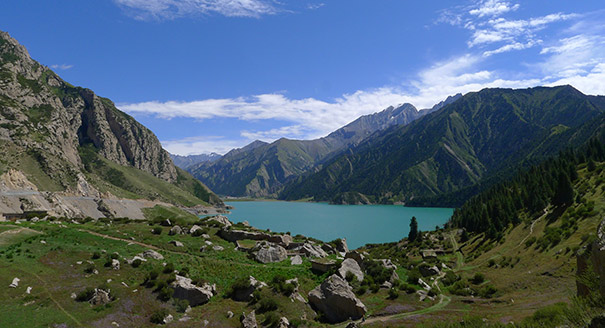
Beijing has begun to see that political stability and moderation in Afghanistan are vital to counter the rise of Islamist extremism and ethnic separatism in its restive far western province, Xinjiang.
Source: Indian Express
Contrary to the initial reports that China might host the second round of the dialogue between the Afghanistan government and the Taliban, the talks will now take place later this week in Pakistan. The first round of the talks were held in Murree, a hill station in Pakistan, earlier this month. Chinese diplomats were present in the room, signalling Beijing’s high stakes in Afghanistan.
In the past, Beijing has kept away from local conflicts by citing the high principle of non-intervention in the internal affairs of sovereign states. Its approach has been changing in recent years. Beijing is now very conscious of its new position as a great power in the international system. China’s national interests, too, have become more expansive and diverse. Its political and military leadership has spoken in recent years about the need to secure its national interests beyond borders. From Sudan to Myanmar, China has stepped gingerly towards the difficult job of peacemaking in the world’s civil wars. Beijing has begun to see that political stability and moderation in Afghanistan are vital to counter the rise of Islamist extremism and ethnic separatism in its restive far western province, Xinjiang.
The US, long castigated by China for meddling in other people’s affairs, has every reason to hand over the Afghan mess to China. Washington may be rebalancing its military forces to the Pacific to counter Beijing’s challenge in East Asia. That has not prevented US-China cooperation in other areas, for example in the Middle East. China has supported over the last few years Washington’s attempt to turn the financial squeeze on Tehran at the United Nations Security Council. It has also backed the US terms for a settlement of the nuclear issue with Iran.
If the foreign policy discourse in New Delhi tends to view relations among great powers in black and white terms, the unfolding dynamic between Washington and Beijing shows many shades of grey depending on the context. If America and China can collaborate and challenge each other simultaneously, India must learn not to limit its partnership with one power either to avoid offending the other or in the name of non-alignment.
The problem in Afghanistan is not China’s growing influence or the American support for it. It is with the widespread belief that Pakistan is willing and capable of getting the Taliban to deliver peace in Afghanistan. Like Washington, Kabul has bet that China’s all-weather partnership with Pakistan could be useful in finding political reconciliation with the Taliban. Kabul also hopes that China’s massive financial resources would help rebuild Afghanistan if and when peace takes hold of the country.
At a time when America is in political retreat and the Western economic footprint is declining in Afghanistan, China has naturally loomed large in Kabul.
If President Hamid Karzai began the outreach to China, his successor, Ashraf Ghani, has intensified it. The Taliban, however, does not appear too enthusiastic about China’s role in Afghanistan, for precisely the reasons that Kabul welcomes it. The Afghan government hopes that China will persuade Pakistan to restrain the Taliban. But restraint is not at the top of the Taliban mind, at a time when Kabul looks rather vulnerable after the US ended its combat role in the country last year. If you are winning on the ground, you certainly don’t want to negotiate. Unsurprisingly, there are deepening divisions within the Taliban leadership on how to approach the negotiations with Kabul. While Pakistan appears to have persuaded some factions in the Taliban to show up at the talks, other groups seem determined to fight.
Meanwhile there is growing anxiety in sections of the Afghan political elite that Ghani has gone too far to befriend Pakistan to secure peace with the Taliban.
They fear that Kabul — under pressure from America, China and Pakistan — might make many more concessions to the Taliban at the negotiating table.
History tells us that Pakistan, like so many others, will find it hard to secure a deal that satisfies everyone in Afghanistan. But the hope that it just might has already increased Islamabad’s near-term leverage with all the major powers, including China, Russia and America. If Delhi lets domestic political passions overwhelm the need for a carefully crafted strategy towards Pakistan, it will find the Afghan dynamic will soon make matters a lot more difficult for India.
This article was originally published in the Indian Express.
Former Nonresident Senior Fellow, Carnegie India
A leading analyst of India’s foreign policy, Mohan is also an expert on South Asian security, great-power relations in Asia, and arms control.
Recent Work

C. Raja Mohan, Darshana M. Baruah


Alexander Gabuev, Paul Haenle, C. Raja Mohan, …
Carnegie does not take institutional positions on public policy issues; the views represented herein are those of the author(s) and do not necessarily reflect the views of Carnegie, its staff, or its trustees.

Despite a new textbook, an influx of Russian teachers and managers, and an end to the teaching of Ukrainian, the Kremlin is unlikely to have “reprogrammed” locals.

Konstantin Skorkin
The acknowledgment has sparked fears of a new arms race with China and Russia.

Chris O’Meara
Smaller powers cannot go it alone, but Canadian history shows that integration with the United States will not always be benign.
Paul Samson

The European Commissioner for Trade is headed to China. But after President Xi’s bridge-building visit to Washington, can a more isolated EU overcome Beijing’s stranglehold on critical raw materials? Who will blink first?

Rym Momtaz, ed.
The summit may be remembered as a fatal blunder, when Washington, Beijing, and the AI industry collectively chose ceremony over action.

Jeffrey Prescott