

Paper
Ashley J. Tellis
{
  "authors": [
    "Ashley J. Tellis"
  ],
  "type": "legacyinthemedia",
  "centerAffiliationAll": "dc",
  "centers": [
    "Carnegie Endowment for International Peace"
  ],
  "collections": [],
  "englishNewsletterAll": "ctw",
  "nonEnglishNewsletterAll": "",
  "primaryCenter": "Carnegie Endowment for International Peace",
  "programAffiliation": "SAP",
  "programs": [
    "South Asia"
  ],
  "projects": [],
  "regions": [
    "North America",
    "United States",
    "South Asia",
    "India"
  ],
  "topics": [
    "Security",
    "Military",
    "Foreign Policy"
  ]
}
Source: Getty
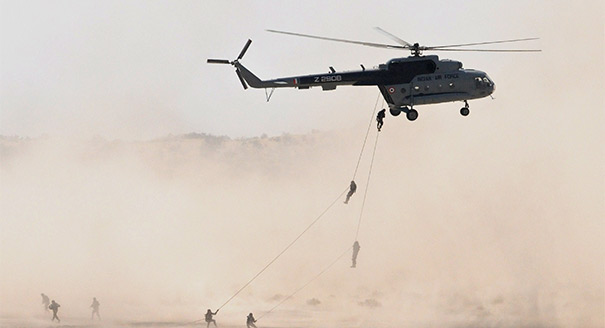
Defense cooperation is the cornerstone of the steadily strengthening bilateral U.S.-Indian relationship.
Source: Force
If there is any single proof of the transformation of US -Indian relations since 2001, burgeoning defence ties would stand out as ‘Exhibit A.’ Since the trying moments after the 1998 Indian nuclear tests — when Indian strategic entities became targets of US sanctions, when Indian weapons systems of US origin lay non-operational because spare parts were denied, and when US -Indian defence trade was minuscule — the flood of interactions that have now become commonplace mark defence cooperation as the cornerstone of the steadily strengthening bilateral relationship.At one level, this metamorphosis should not be surprising. Both the United States and India face common threats: Islamist terrorism, rising Chinese power, continued nuclear proliferation, and new dangers in the global commons. But despite these persistent perils, it required a civil nuclear agreement to dramatically seal the evolving strategic collaboration between Washington and New Delhi. The 18 July 2005 joint statement issued by President George W. Bush and Prime Minister Manmohan Singh did just that: by signalling that the United States would now treat India as a valued geopolitical partner rather than as a singular target of its nonproliferation policy, Bush (and, his successor, Barack Obama) declared— to the consternation of many— that the United States was serious about building a new relationship with India....
The full text of this article was originally published in Force.
Former Senior Fellow
Ashley J. Tellis was a senior fellow at the Carnegie Endowment for International Peace.
Recent Work
Ashley J. Tellis
Ashley J. Tellis
Carnegie does not take institutional positions on public policy issues; the views represented herein are those of the author(s) and do not necessarily reflect the views of Carnegie, its staff, or its trustees.

Are Germany’s economic, industrial, and political struggles becoming a liability for the EU’s ability to rise to the geopolitical moment?

Rym Momtaz, ed.

China’s police training infrastructure construction projects provide benefits to recipient countries, promote China’s image as a major global security provider, and are likely to reinforce alignment between Beijing’s security priorities and those of countries in the Global South.


Cameron Waltz, Sheena Chestnut Greitens, Kim Nguyen, …
AI capabilities are moving fast. Most institutions—including governments—can’t keep up.


Anton Leicht, Scott Singer
The Bureau of Industry and Security needs to adjust its focus and practices to maintain its position as the U.S. government’s primary champion of international technological competition.

Geoffrey Irving
They face an uphill climb, but they could draw on a strategy that other diplomats have used in the past.


Shana Tabak, Alejandro Martin Rodriguez