

In The Media
Lina Khatib
{
  "authors": [
    "Lina Khatib"
  ],
  "type": "legacyinthemedia",
  "centerAffiliationAll": "dc",
  "centers": [
    "Carnegie Endowment for International Peace",
    "Malcolm H. Kerr Carnegie Middle East Center"
  ],
  "collections": [],
  "englishNewsletterAll": "menaTransitions",
  "nonEnglishNewsletterAll": "",
  "primaryCenter": "Malcolm H. Kerr Carnegie Middle East Center",
  "programAffiliation": "MEP",
  "programs": [
    "Middle East"
  ],
  "projects": [],
  "regions": [
    "Levant",
    "Lebanon",
    "Middle East"
  ],
  "topics": [
    "Political Reform"
  ]
}
Source: Getty
The brutal reaction to the ‘You Stink’ protest shows the Lebanese government knows citizens’ frustration goes far beyond an inadequate garbage-disposal system.
Source: Middle East Eye
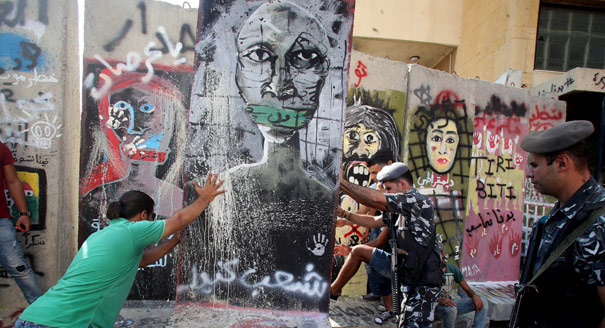
Lebanon at the weekend witnessed some of the most violent government responses to a peaceful demonstration in its recent history, with one person killed and hundreds injured after the police and the army responded to protesters with rubber bullets, tear gas, sonic bombs, and live bullets.
The demonstrations on August 22 and 23 were motivated by the “garbage crisis” that has seen Lebanon overtaken by mountains of refuse on its streets as a result of the lack of a viable governmental plan to address the problem of garbage collection in the country, which meant that garbage has mostly ended up in dump sites.
Those sites were supposed to be a temporary measure, but the government has kept extending their life span seemingly indefinitely at the expense of citizens’ health and environmental safety.Citizens’ frustration with the government’s response grew to wide-ranging criticism of corruption in a country ranked by the World Economic Forum as having the world’s fourth least effective government.
Following a series of social media campaigns, civil society activists took to the streets to call for the fall of the government. The government’s brutal response took the demonstrators by surprise, but it shows that the Arab world continues to witness more of the same hypocrisy among its political class.
The “garbage crisis” in Lebanon is but one example of the political deals that take place behind the scenes there and elsewhere, in which politicians exchange favors at the expense of citizens. In this kind of scenario, services are provided to citizens but this is done in an exploitative way, and citizens are expected to acquiesce.
In Lebanon, people tolerated the political bargaining system through which refuse collection was organized, despite it making garbage processing there among the most expensive in the world, because at least the system meant that garbage was being collected.
The same political bargaining applies to the provision of other basic services, from electricity to water. Citizens were expected to be grateful to the political class for what they got and to turn a blind eye to its open-secret transgressions. This created a self-sustaining status quo that sanctioned corruption and that encouraged people to aspire to appease the political class in order to have their basic needs met.
However, continued inattention to the growing problem of garbage dump sites tested people’s patience, and they began to openly link it to Lebanon’s bigger political picture.
Years after the Lebanese parliament twice extended its own mandate unconstitutionally and after more than a year without a president and with only an impotent caretaker cabinet, citizens mobilized to take a stand against the corrupt status quo and to demand accountability from their leaders.
The protest that started on August 22 is therefore not about rubbish in its literal form; its slogan, “You Stink,” is a metaphor aimed at Lebanese politicians who are complicit in the country’s deterioration.
The response from the government is in turn unconstitutional. Although the constitution guarantees the right to protest, the protesters were met with violence by the Lebanese Internal Security Forces and the army in scenes reminiscent of those of the Arab Spring protests.
The brutality against the peaceful protesters in downtown Beirut is unfortunately not new for the Arab world. It is the same as what citizens all over the region have witnessed almost every time they have mobilized against corruption in authoritarian countries.
Violence and oppression in this context are used not just because the immediate demands of protesters are considered unacceptable by the political class, but also because the protests risk unearthing the corruption of the prevailing political system as a whole—pointing the finger at corrupt political deals in one area may lead to a domino effect of exposes that fundamentally threaten the status quo.
As such, Lebanon’s ruling political class considered the organizers of the “You Stink” campaign as an existential threat. In the usual Arab authoritarian tradition, any response less than sheer brutality would not have been sufficient—the “troublemakers” had to be nipped in the bud before they could expand the scope of their presence and influence.
Similar to what happened in Egypt, government-affiliated thugs on August 23 infiltrated the peaceful protest and attacked protesters and journalists, including a female reporter who was assaulted live on television as she was reporting on the mob activity. The violence gave the security apparatus a “legitimate” pretext to respond with force.
But the response also saw the other familiar trope of exploitation: a number of Lebanese members of parliament and ministers began speaking out in a critique of the status quo through statements supportive of the demonstration, thereby placing themselves outside the system and, with that, attempting to absolve themselves from responsibility for the oppression that was taking place in the public eye.
Such a trope of autocratic leaders masquerading as democrats is also a familiar one in the Arab world. And this makes the events of August 22 and 23 simply another example of the need for a fundamental change in the prevailing political system in the region.
What is becoming clear is that the system may offer promises of reform, but the ruling political class will not act upon them. Reform will not come from above, but through serious strategic mobilization on part of citizens on the ground.
The key lesson to be learned here is that citizens should not accept promises of protection or reform from the corrupt political class that prevails over state institutions. Such promises may placate demands in the short term, but they make citizens vulnerable to exploitation in the long term.
In short, the only way meaningful change can happen is through a restructuring of the whole political system and the replacement of the ruling political class with true democrats who do not put their own political interests above those of the nation.
Former Director, Middle East Center
Khatib was director of the Carnegie Middle East Center in Beirut. Previously, she was the co-founding head of the Program on Arab Reform and Democracy at Stanford University’s Center on Democracy, Development, and the Rule of Law.
Recent Work
Lina Khatib
Lina Khatib
Carnegie does not take institutional positions on public policy issues; the views represented herein are those of the author(s) and do not necessarily reflect the views of Carnegie, its staff, or its trustees.

Before the next wave of EU enlargement takes place, the union needs to grapple with thorny questions of how power is distributed among its members.


Emil Sondaj Hansen, Ditte Brasso Sørensen

The Horn of Africa countries are among those facing a new security calculus.


Andrew Leber, Lesley Anne Warner

The European far right might fail to steer EU policy in the direction Russia wants, but they will create enough chaos inside Europe to benefit the Kremlin.

Dimitar Bechev

As the U.S. stumbles in its war with Iran, we are likely to see an acceleration of its disengagement from the region.

Michael Young

If the Russian-speaking community in Latvia cannot articulate their interests without being seen as disloyal, they could end up embracing a pro-Kremlin agenda.

Sergejs Potapkins