

Paper
James M. Acton, Ankit Panda
{
  "authors": [
    "James M. Acton"
  ],
  "type": "legacyinthemedia",
  "centerAffiliationAll": "dc",
  "centers": [
    "Carnegie Endowment for International Peace",
    "Malcolm H. Kerr Carnegie Middle East Center"
  ],
  "collections": [
    "Iranian Proliferation",
    "U.S. Nuclear Policy"
  ],
  "englishNewsletterAll": "ctw",
  "nonEnglishNewsletterAll": "",
  "primaryCenter": "Carnegie Endowment for International Peace",
  "programAffiliation": "NPP",
  "programs": [
    "Nuclear Policy"
  ],
  "projects": [],
  "regions": [
    "North America",
    "United States",
    "Middle East",
    "Iran"
  ],
  "topics": [
    "Foreign Policy",
    "Nuclear Policy"
  ]
}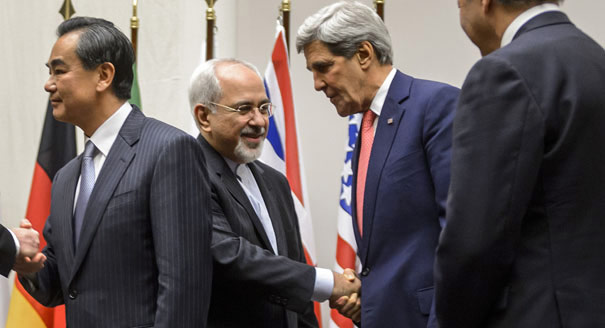
Source: Getty
If Congress prevents the United States from implementing its part of the deal, it would undercut not only Obama in attempting to a secure a better deal with Iran, but also any future president seeking to prevent proliferation through diplomacy.
Source: National Interest
At the crux of the debate over the nuclear deal with Iran is the question of whether there is a better alternative. President Obama has argued that the choice is between the deal and war. His opponents have claimed he could have held out for—and should still press for—an ill-defined “better deal.” Given that some of these critics, by their own admission, opposed the current deal before even reading it, it’s reasonable to wonder whether they really would judge an improved version on its merits. Even so, it remains important to ask what would have happened if the United States had walked away from negotiations, doubled down on sanctions and tried to negotiate a better deal in a year or two.
Given sanctions’ success in forcing Iran to the negotiating table and extracting many concessions, it is undeniable that more pressure might have led to a better agreement. However, even Mark Dubowitz, one of sanctions’ most vocal proponents, has now acknowledged that “more sanctions...are unlikely to thwart the mullahs’ nuclear designs.” To believe otherwise required at least three assumptions to be correct. If even just one had turned out to be wrong—as was eminently possible—suspending diplomacy would have created the serious risk of ending up with a worse agreement or even none at all.Sanctions on Iran proved effective because they enjoyed broad international support. Yet, it was unclear for how long the consensus could have been maintained. President Rouhani’s adept diplomacy coupled with the economic damage inflicted by sanctions on Iran’s trading partners—including many EU states, South Korea, Japan, India, Russia and China—risked undermining the coalition. Indeed, many coalition members were willing to suffer the costs of sanctions only because they believed the United States was working, in good faith, to resolve the crisis diplomatically. By declining to sign a deal that was supported by all of its negotiating partners, the United States would have risked undermining confidence in its leadership and adding to the growing pressure on sanctions.
To be sure, it is unlikely the sanctions regime would have fallen apart rapidly. Washington’s willingness to punish foreign companies that did business with Iran would have remained a powerful enforcement mechanism—but it was not a panacea. Walking away from negotiations carried the risk that, when they resumed (if they ever did), Iran would have been less economically embattled and consequently less willing to bargain.
The interim agreement reached in November 2013 capped some of Iran’s nuclear activities and rolled others back, thus ensuring Tehran could not use negotiations as a way of buying time while getting closer to the Bomb. This agreement had been extended multiple times while negotiations towards a final accord were ongoing. But it was far from clear that, if negotiations had collapsed, Iran would have agreed to another extension—the preferred choice of many of the deal’s critics.
Freed from the constraints of the interim deal, Iran might well have decided to install more centrifuges, enrich to a higher level, stockpile more enriched uranium, and restart work on its plutonium production reactor. Any subsequent negotiations might well have focused on getting Iran to abide by the terms of the interim agreement again; clinching a final deal that was even as good as the current one—let alone better—might have proved impossible.
If negotiations had collapsed there was no guarantee that both Obama and Rouhani would have had the political clout to deliver again later. Looking further forward—after the U.S. presidential election in 2016 and the Iranian election in 2017—the prospects for diplomacy would have become even murkier.
The current willingness and ability of both Tehran and Washington to negotiate is unprecedented. Iran’s clandestine nuclear activities were revealed in 2002. After the invasion of Iraq in 2003, Iran signaled interest in negotiations with the United States. It’s unclear how serious Tehran was, but the United States didn’t test it. (France, Germany and the United Kingdom tried to fill the void but the obviously flawed agreements they negotiated fell apart fairly quickly.)
By 2009, it was the newly elected Obama administration that was seeking negotiations. In October, Iran, under the uncompromising presidency of Mahmoud Ahmadinejad, actually agreed to a modest confidence-building proposal, known as the “fuel swap.” However, Iran backed out after domestic criticism from both the left and right. It was only after Rouhani’s election in 2013 that productive negotiations became possible again.
Considering what would have happened if the United States had walked away from negotiations is no mere academic exercise. All the risks that would have been associated with suspending diplomacy still exist today. In fact, they are much greater.
If Congress now prevents the United States from implementing its part of the deal, the risk that the sanctions regime will collapse is higher—after all, the deal’s other signatories have committed to giving Iran sanctions relief regardless of whether Washington does. Moreover, Congress will also send a clear message that the United States cannot be relied upon to implement nonproliferation agreements negotiated by the president. In doing so, it would undercut not only Obama in attempting to a secure a better deal with Iran, but also any future president seeking to prevent proliferation through diplomacy.
This article was originally published in the National Interest.

Jessica T. Mathews Chair, Co-director, Nuclear Policy Program
Acton holds the Jessica T. Mathews Chair and is co-director of the Nuclear Policy Program at the Carnegie Endowment for International Peace.
Recent Work

James M. Acton, Ankit Panda
James M. Acton
Carnegie does not take institutional positions on public policy issues; the views represented herein are those of the author(s) and do not necessarily reflect the views of Carnegie, its staff, or its trustees.

Trump has promised Belarus a massive potash deal. But Minsk is seeking something greater: restored Western transit and greater room for maneuver from Russia.

Balázs Jarábik

The real test may come after the leaders leave the room.



Sheena Chestnut Greitens, Oriana Skylar Mastro, Yukon Huang, …

The Horn of Africa countries are among those facing a new security calculus.


Andrew Leber, Lesley Anne Warner

The new U.S.–Denmark–Greenland agreement will help Washington exert political, economic, and financial dominance under the guise of security. Yet, it acknowledged Copenhagen’s and Nuuk’s sovereignty on the island.

Marc Pierini

The nuclear relationship between China and the United States is increasingly shaped by widening perception gaps rather than deliberate strategic design.

Tong Zhao