

Article
Dalia Ghanem
{
  "authors": [
    "Dalia Ghanem"
  ],
  "type": "legacyinthemedia",
  "centerAffiliationAll": "dc",
  "centers": [
    "Carnegie Endowment for International Peace",
    "Malcolm H. Kerr Carnegie Middle East Center"
  ],
  "collections": [],
  "englishNewsletterAll": "menaTransitions",
  "nonEnglishNewsletterAll": "",
  "primaryCenter": "Malcolm H. Kerr Carnegie Middle East Center",
  "programAffiliation": "MEP",
  "programs": [
    "Middle East"
  ],
  "projects": [],
  "regions": [
    "Maghreb",
    "Algeria",
    "North Africa"
  ],
  "topics": [
    "Political Reform",
    "Security"
  ]
}
Source: Getty
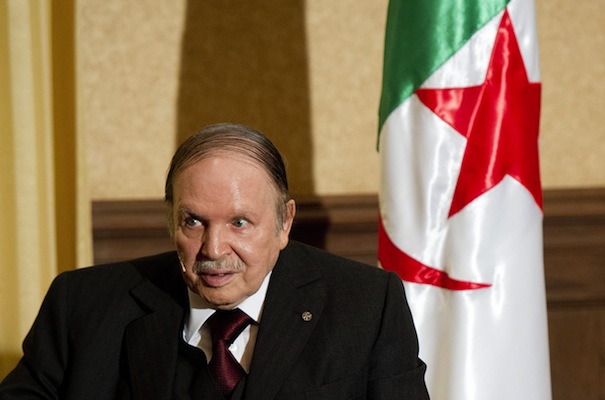
Although Algerian President Abdelaziz Bouteflika has dismissed several top generals, the state's security apparatus remains unshaken.
Source: World Politics Review
On Sept. 13, Algerian President Abdelaziz Bouteflika announced the retirement of Gen. Mohamed “Toufik” Mediene, head of the Department of Intelligence and Security (DRS), days after sacking several top generals who worked under Mediene and weeks after the arrest of a former intelligence chief. Bouteflika’s office claimed that the retirement decision was made “in line with the constitution.” But that muted explanation belied the stunning decision to remove Toufik, as he is widely known in Algeria, who has been the head of Algeria’s state intelligence service for 25 years.
Created in 1958 during Algeria’s War of Independence as the Ministry of Ammunitions and General Liaisons, the DRS soon became the country’s main internal security force, especially after the failed coup attempt led by Chief of Staff Tahar Zbiri in 1967 against Houari Boumediene. Through its networks, the DRS permeated public debates, penetrating the civil service, universities, the police and even the ruling National Liberation Front (FLN). It played a key role in co-opting elites, as well as repressing opponents of the regime. Heading this organization for a quarter of a century, Mediene played an active role among what came to be known as the “Janvieristes,” the generals who canceled the second round of legislative elections in early 1992 in order to avoid an overwhelming victory by the Islamic Salvation Front (FIS), an Islamist political party, setting off a decade-long civil war.
The full article originally appeared in World Politics Review.
Former Senior Resident Scholar, Malcolm H. Kerr Carnegie Middle East Center
Dalia Ghanem was a senior resident scholar at the Malcolm H. Kerr Carnegie Middle East Center in Beirut, where her research focuses on Algeria’s political, economic, social, and security developments. Her research also examines political violence, radicalization, civil-military relationships, transborder dynamics, and gender.
Recent Work
Dalia Ghanem


Frances Z. Brown, Judy Dempsey, Dalia Ghanem, …
Carnegie does not take institutional positions on public policy issues; the views represented herein are those of the author(s) and do not necessarily reflect the views of Carnegie, its staff, or its trustees.
In Egypt’s dense cities, the disappearance of foliage has health implications and punishes daily commuters.

Angie Omar

If the Russian-speaking community in Latvia cannot articulate their interests without being seen as disloyal, they could end up embracing a pro-Kremlin agenda.

Sergejs Potapkins

Are Germany’s economic, industrial, and political struggles becoming a liability for the EU’s ability to rise to the geopolitical moment?

Rym Momtaz, ed.

Russia’s ruling party would have benefited from Putin appearing as its distant patron, but as an active frontman imposing his views on the public, he has done nothing but harm both the party’s election campaign and the ruling system overall.

Andrey Pertsev

China’s police training infrastructure construction projects provide benefits to recipient countries, promote China’s image as a major global security provider, and are likely to reinforce alignment between Beijing’s security priorities and those of countries in the Global South.


Cameron Waltz, Sheena Chestnut Greitens, Kim Nguyen, …