

Article
C. Raja Mohan, Darshana M. Baruah
{
  "authors": [
    "C. Raja Mohan"
  ],
  "type": "legacyinthemedia",
  "centerAffiliationAll": "dc",
  "centers": [
    "Carnegie Endowment for International Peace",
    "Carnegie India"
  ],
  "collections": [],
  "englishNewsletterAll": "ctw",
  "nonEnglishNewsletterAll": "",
  "primaryCenter": "Carnegie India",
  "programAffiliation": "SAP",
  "programs": [
    "South Asia"
  ],
  "projects": [],
  "regions": [
    "South Asia",
    "India",
    "North America",
    "United States"
  ],
  "topics": [
    "Foreign Policy",
    "Security",
    "Military",
    "Global Governance"
  ]
}
Source: Getty
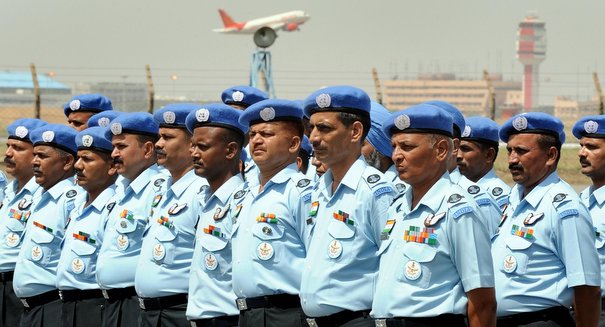
As the world today looks up to India as a net security provider, Delhi needs to recast its peacekeeping strategy by modernizing its decision-making structures, expanding domestic defence capabilities, and strengthening its military diplomacy.
Source: Indian Express
A little noticed agreement unveiled last week by India and the United States marks a long overdue revision of New Delhi’s approach to international peacekeeping operations. At the second round of the India-US strategic and commercial dialogue in Washington, External Affairs Minister Sushma Swaraj and US Secretary of State John Kerry announced that India and the US will jointly train troops of six African nations for peacekeeping duties.
It has indeed taken a long while for India and the US, two big champions of international peacekeeping, to start working together. Better late than never. The United Nations peace operations, which have expanded so rapidly since the end of the Cold War, now face immense challenges.Prime Minister Narendra Modi is joining a host of other world leaders to discuss ways and means of making UN peace operations more effective at a meeting convened by President Barack Obama this week in New York. America has long picked up much of the tab for UN peace operations. This year, out of the $8.2 billion budgeted for these operations, Washington will pay nearly 30 per cent. Cumulatively, India is the biggest troop contributor for these operations. Over the decades, India has sent nearly 1,80,000 peacekeepers to 44 missions.
Delhi and Washington have often talked of working together on peacekeeping. While India’s armed forces and the foreign office recognised the utility of working with America and others on international peace operations, there was little enthusiasm in the defence ministry. As a result, India’s expansive contribution to international peacekeeping seemed to have only one objective — to reinforce India’s campaign for a permanent seat at the UN Security Council.
But over the last few years, many developing countries, especially India’s neighbours, began to contribute in a big way to UN operations. Bangladesh now has the top spot with 9,432 troops deployed in UN peace operations. India stands third with a contribution of 7,794 men and women. Pakistan is close behind India, with about 7,533 soldiers. Nepal, with 5,346 peacekeepers, is among the top 10 contributors.
Meanwhile, China has begun to steal a political march over India in the international discourse on peace operations. Ending its traditional wariness about international peacekeeping, China has moved quickly into the list of top 10 troop contributing countries in recent years. Although the number of Chinese troops currently deployed is modest at 3,079, China has put peacekeeping at the centre of its defence diplomacy and made it a priority military mission for the People’s Liberation Army. These precisely have been the missing elements of India’s approach.
As peacekeeping became a routine activity for India, Delhi was increasingly preoccupied with process-related issues at the UN — the construction and implementation of the mandates for peacekeeping. India’s recent focus has been on gaining a say in the UN decision-making on peace operations that have become increasingly complex.
India is unlikely to advance by organising a trade union of troop contributing countries at the UN General Assembly. Instead, it should expand its strategic cooperation with the US, France, Japan, Australia and other partners to reshape the norms and mechanics of international peace operations. At the same time, India should also seek partnerships with its South Asian neighbours. While the Pakistan army might be reluctant, the security forces of Bangladesh and Nepal may be more open to collaboration with India on peacekeeping, disaster management and humanitarian relief operations.
The first step is to start sharing their expansive experiences in peace operations. Second, South Asian military and civilian policymakers on peacekeeping should be meeting in Delhi, Dhaka and Kathmandu and not just in New York.
At the UN last week, India reaffirmed its commitment to international peace operations. But Delhi must look beyond mere troop contribution to other critical activities, such as training, logistics and operational support. The latest agreement between India and the US on training African troops provides a good basis for this. Military cooperation with the major powers and neighbours is also important for another reason — not all peace operations today are run from the UN. India needs to develop military coalitions that can respond to crisis situations in the Indian Ocean and beyond on short order.
In the end, reforming UN peace operations is only a small part of the answer to the larger questions that India must ask itself about the use of military force. Way back in the 1950s, our first PM, Jawaharlal Nehru, recognised that our armed forces had duties beyond borders in discharging India’s responsibilities as a good global citizen.
As the world today looks up to India as a net security provider, Delhi needs to recast its peacekeeping strategy by modernising its decision-making structures, expanding domestic defence capabilities, and strengthening its military diplomacy.
This article was originally published in the Indian Express.
Former Nonresident Senior Fellow, Carnegie India
A leading analyst of India’s foreign policy, Mohan is also an expert on South Asian security, great-power relations in Asia, and arms control.
Recent Work

C. Raja Mohan, Darshana M. Baruah


Alexander Gabuev, Paul Haenle, C. Raja Mohan, …
Carnegie does not take institutional positions on public policy issues; the views represented herein are those of the author(s) and do not necessarily reflect the views of Carnegie, its staff, or its trustees.

China’s police training infrastructure construction projects provide benefits to recipient countries, promote China’s image as a major global security provider, and are likely to reinforce alignment between Beijing’s security priorities and those of countries in the Global South.


Cameron Waltz, Sheena Chestnut Greitens, Kim Nguyen, …
AI capabilities are moving fast. Most institutions—including governments—can’t keep up.


Anton Leicht, Scott Singer

The Bureau of Industry and Security needs to adjust its focus and practices to maintain its position as the U.S. government’s primary champion of international technological competition.

Geoffrey Irving
They face an uphill climb, but they could draw on a strategy that other diplomats have used in the past.


Shana Tabak, Alejandro Martin Rodriguez

European Commission President Ursula von der Leyen is about to give her annual address on the state of the EU. Here’s what she won’t—but should—say.

Rym Momtaz