

Commentary
A leak of Russian gas price data helps establish that China is paying Russia far less than Central Asian countries and Gazprom’s former European customers.
Sergey Vakulenko
{
  "authors": [
    "Tristan Volpe",
    "Matthew Kroenig"
  ],
  "type": "other",
  "centerAffiliationAll": "dc",
  "centers": [
    "Carnegie Endowment for International Peace"
  ],
  "collections": [],
  "englishNewsletterAll": "ctw",
  "nonEnglishNewsletterAll": "",
  "primaryCenter": "Carnegie Endowment for International Peace",
  "programAffiliation": "NPP",
  "programs": [
    "Nuclear Policy"
  ],
  "projects": [],
  "regions": [],
  "topics": [
    "Security",
    "Nuclear Policy",
    "Global Governance"
  ]
}
Source: Getty
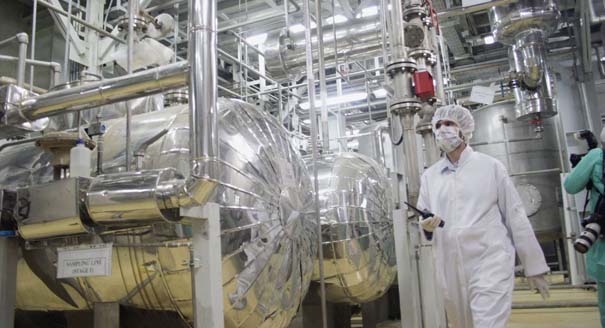
3-D printing could make it easier for states to build nuclear weapons and harder for the international community to detect and stop them.
Source: Washington Quarterly
A revolution in manufacturing is underway that may enable the most sensitive pieces of a nuclear weapons program to be transferred and produced around the globe. In the Additive Manufacturing (AM) process, 3-D printing machines build objects of virtually any shape from digital build files—the essential data telling printers how to construct an object—by laying down successive layers of material.1 Since objects are built from scratch, one can make products in shapes and to standards impossible under any other method, and the digital nature of this automated process takes most of the skill out of fabrication. AM allows the manufacture of better products, with less effort, and at a fraction of the cost of traditional methods. As a result, it is hardly surprising that General Electric, Aerojet Rocketdyne, and the Chinese People’s Liberation Army are already using AM to print sophisticated metal parts for jet engines, rocket propulsion systems, and fighter aircraft, respectively.2
Like many disruptive technologies, however, AM has a dark side. The widespread adoption of AM will make it easier for countries to acquire nuclear weapons, and more difficult for the international community to detect and stop them. If building the bomb is like solving a giant jigsaw puzzle, one of the hardest parts is simply getting all the necessary pieces.3 Attempts to buy or build these items—such as the components of a gas centrifuge—are fraught with obstacles and set off alarm bells to the existence of a covert weapons program. In contrast, with a 3-D printer and the right digital build files, a country can print many of the specialized components for a nuclear program quickly, with little technical skill, and at low cost. Moreover, hiding such a fabrication effort would be much easier than under traditional manufacturing methods, rendering obsolete many of the international community’s tools for spotting illicit nuclear activity. In short, AM may provide a way for countries to print the pieces of the nuclear jigsaw indigenously before anyone notices.Fortunately, the proliferation potential of AM has not yet fully materialized, so the United States can still lead an international effort to prevent an AM-enabled cascade of nuclear weapons proliferation before it is too late. This multifaceted problem demands a strategy that combines the bottom-up efforts of expert working groups and top-down attention from the highest levels of national governments and international organizations. Together, they can work to create new multilateral frameworks, update existing control regimes, and develop technical fixes that will allow the world to reap the benefits of AM while mitigating its proliferation dangers...
This article was originally published in The Washington Quarterly.
1 “3D Printing Scales Up,” The Economist, September 7, 2013, http://www.economist.com/ news/technology-quarterly/21584447-digital-manufacturing-there-lot-hype-around-3dprinting-it-fast.
2 Andrew Zaleski, “GE’s Bestselling Jet Engine Makes 3-D Printing a Core Component,” Fortune, March 5, 2015, http://fortune.com/2015/03/05/ge-engine-3d-printing/; “Aerojet Rocketdyne Successfully Demonstrates 3D Printed Rocket Propulsion System for Satellites,” Reuters, December 15, 2014, http://www.reuters.com/article/2014/12/15/idUSnGNX8FQrs1+1d8+GNW20141215; Brooke Kaelin, “World’s Largest 3-D Printed Titanium Aircraft Part on Display in China,” 3-D Printer World, August 19, 2013, http://www.3dprinterworld.com/article/worlds-largest-3d-printed-titanium-aircraft-partdisplay-china.
3 Matthew Kroenig, Exporting the Bomb: Technology Transfer and the Spread of Nuclear Weapons (Ithaca: Cornell University Press, 2010); David Albright, Peddling Peril: How the Secret Nuclear Trade Arms America’s Enemies (New York: Free Press, 2010).

Former Nonresident Fellow, Nuclear Policy Program
Tristan Volpe was a nonresident fellow at the Carnegie Endowment for International Peace and assistant professor of defense analysis at the Naval Postgraduate School.
Matthew Kroenig
Carnegie does not take institutional positions on public policy issues; the views represented herein are those of the author(s) and do not necessarily reflect the views of Carnegie, its staff, or its trustees.
A leak of Russian gas price data helps establish that China is paying Russia far less than Central Asian countries and Gazprom’s former European customers.

Sergey Vakulenko

Japan’s long-term security policy is driven by concerns about China, and there is little appetite for (or interest in) pursuing a confrontation with Moscow.

James D.J. Brown

Russia is testing the waters of NATO’s mutual defense clause. What do strikes in Romanian territorial waters mean for the alliance’s posture toward Moscow?

Dimitar Bechev

China has showcased its engineering prowess with small modular reactor demonstration projects. But turning these technological achievements into commercial success will be a greater challenge.

Tong Zhao

Why Pakistan, Saudi Arabia, and Turkey are joining forces on regional security.


Alper Coşkun, Amr Hamzawy