The countries in the region are managing the fallout from Iranian strikes in a paradoxical way.
Angie Omar
{
"authors": [
"David Livingston",
"Deborah Gordon",
"Rob Barnett",
"Brandon Barnes",
"Cheryl Wilson"
],
"type": "other",
"centerAffiliationAll": "dc",
"centers": [
"Carnegie Endowment for International Peace"
],
"collections": [],
"englishNewsletterAll": "ctw",
"nonEnglishNewsletterAll": "",
"primaryCenter": "Carnegie Endowment for International Peace",
"programAffiliation": "SCP",
"programs": [
"Sustainability, Climate, and Geopolitics"
],
"projects": [],
"regions": [
"North America",
"United States",
"East Asia",
"China",
"Western Europe"
],
"topics": [
"Climate Change"
]
}Source: Getty
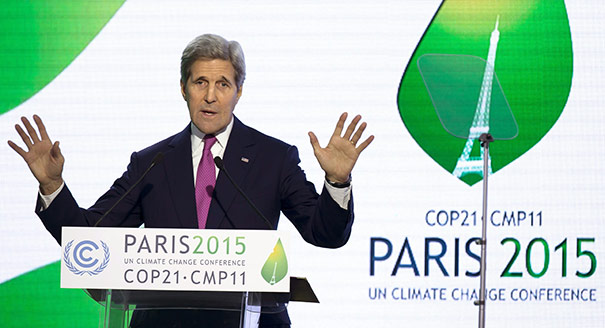
An analysis of the outcomes of the Paris climate talks, as well as the opportunities and challenges ahead for addressing emissions.
Source: Bloomberg Intelligence Webinar
In the run-up to international climate talks being held in Paris, lawmakers from various countries put their chips on the table. Rather than a top down approach, each country offered its unique approach for tackling greenhouse gas emissions. In the United States, for instance, the Clean Power Plan is the cornerstone for cutting emissions from the power sector. And the Chinese government recently announced plans for a cap-and-trade program that will begin in 2017.
After the Paris talks conclude, experts from Bloomberg Intelligence and the Carnegie Endowment came together to discuss:
Former Associate Fellow, Energy and Climate Program
Livingston was an associate fellow in Carnegie’s Energy and Climate Program, where his research focuses on emerging markets, technologies, and risks.
Former Director and Senior Fellow, Energy and Climate Program
Gordon was director of Carnegie’s Energy and Climate Program, where her research focuses on oil and climate change issues in North America and globally.
Rob Barnett
Bloomberg Intelligence
Rob Barnett is a senior energy economist with Bloomberg Government, specializes in energy-sector economics, environmental policy and strategy, and EPA regulations.
Brandon Barnes
Bloomberg Intelligence
Cheryl Wilson
Bloomberg Intelligence
Carnegie does not take institutional positions on public policy issues; the views represented herein are those of the author(s) and do not necessarily reflect the views of Carnegie, its staff, or its trustees.
The countries in the region are managing the fallout from Iranian strikes in a paradoxical way.
Angie Omar
French President Emmanuel Macron has unveiled his country’s new nuclear doctrine. Are the changes he has made enough to reassure France’s European partners in the current geopolitical context?
Rym Momtaz, ed.
The drone strike on the British air base in Akrotiri brings Europe’s proximity to the conflict in Iran into sharp relief. In the fog of war, old tensions in the Eastern Mediterranean risk being reignited, and regional stakeholders must avoid escalation.
Marc Pierini
In an interview, Hassan Mneimneh discusses the ongoing conflict and the myriad miscalculations characterizing it.
Michael Young
In an interview, Nicole Grajewski discusses the military dimension of the U.S. and Israeli attacks on Iran.
Michael Young