
Japan’s revision of its three strategic documents reflects an intention to keep the United States engaged in the region while Japan fills any vacuums of U.S. power to preserve the Indo-Pacific order.
Ryo Sahashi
{
"authors": [
"Marc Lynch",
"Michael Wahid Wahid Hanna",
"Thanassis Cambanis"
],
"type": "legacyinthemedia",
"centerAffiliationAll": "dc",
"centers": [
"Carnegie Endowment for International Peace",
"Malcolm H. Kerr Carnegie Middle East Center"
],
"collections": [
"Arab Awakening"
],
"englishNewsletterAll": "menaTransitions",
"nonEnglishNewsletterAll": "",
"primaryCenter": "Carnegie Endowment for International Peace",
"programAffiliation": "MEP",
"programs": [
"Middle East"
],
"projects": [],
"regions": [
"Middle East",
"North Africa",
"Egypt"
],
"topics": [
"Political Reform",
"Democracy",
"Security"
]
}Source: Getty
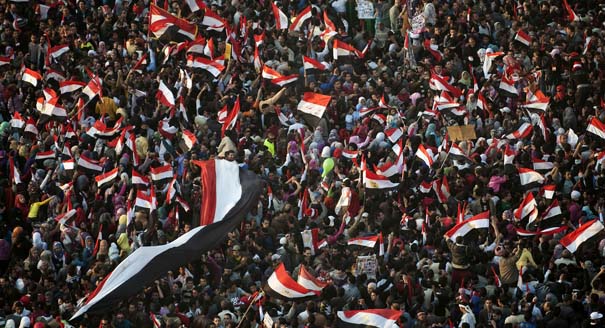
As the anniversary of Egypt’s January 25th revolution approaches, the direction of the country remains uncertain.
Source: Project on Middle East Political Science
Five years after Egypt’s revolution, the country faces challenges on numerous fronts. Looking back at developments since the onset of the Arab Spring and forward toward the country’s future, Marc Lynch discusses Egypt’s state of affairs Michael Wahid Hanna and Thanassis Cambanis.
This podcast originally appeared that the Project on Middle East Political Science.
Former Nonresident Senior Fellow, Middle East Program
Marc Lynch was a nonresident senior fellow in Carnegie’s Middle East Program where his work focuses on the politics of the Arab world.
Michael Wahid Wahid Hanna
Michael Wahid Hanna is a senior fellow at The Century Foundation and a nonresident senior fellow at the Reiss Center on Law and Security at New York University School of Law.
Thanassis Cambanis
is a senior fellow at The Century Foundation.
Carnegie does not take institutional positions on public policy issues; the views represented herein are those of the author(s) and do not necessarily reflect the views of Carnegie, its staff, or its trustees.
Japan’s revision of its three strategic documents reflects an intention to keep the United States engaged in the region while Japan fills any vacuums of U.S. power to preserve the Indo-Pacific order.
Ryo Sahashi
In the discussions made possible by the State Duma election campaign, one question is being asked more and more loudly. “What next?”
Andrey Pertsev
Lee’s tour shows how Seoul is reorganizing its diplomacy away from Pyongyang and toward industrial networks and the geography of the compute economy.
Darcie Draudt-Véjares
Most migrants may have left Ceuta, but the effects may linger.
Alejandro Martin Rodriguez, Sarah Yerkes
Saied’s main accomplishment has been to destroy a decade’s worth of democratic progress.
Sarah Yerkes