

Research
- +5
Alper Coşkun, Fatih Ceylan, Tacan İldem, …
{
  "authors": [
    "Sinan Ülgen"
  ],
  "type": "legacyinthemedia",
  "centerAffiliationAll": "dc",
  "centers": [
    "Carnegie Endowment for International Peace",
    "Carnegie Europe"
  ],
  "collections": [
    "Turkey’s Transformation",
    "Transatlantic Cooperation"
  ],
  "englishNewsletterAll": "ctw",
  "nonEnglishNewsletterAll": "",
  "primaryCenter": "Carnegie Europe",
  "programAffiliation": "EP",
  "programs": [
    "Europe"
  ],
  "projects": [],
  "regions": [
    "Europe",
    "North America",
    "Türkiye",
    "Middle East",
    "Iran"
  ],
  "topics": [
    "Foreign Policy"
  ]
}
Source: Getty
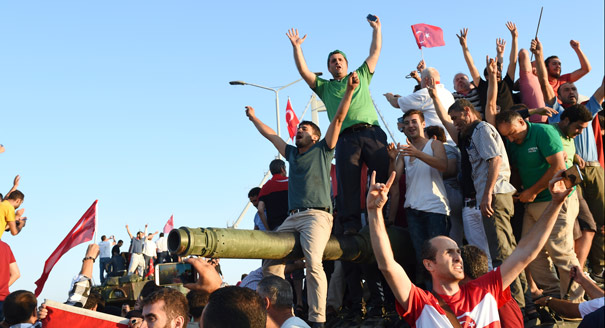
The attempted coup in Turkey will have far-ranging implications for the country’s international role. The Turkish-U.S. relationship in particular is headed for considerable turbulence.
Source: Project Syndicate
A military coup against an elected government typically unleashes a flood of analysis about the country’s future direction following the break in democratic rule. But failed coups can be just as consequential. The botched attempt by elements of the Turkish military to overthrow President Recep Tayyip Erdoğan will have far-ranging implications for Turkey’s foreign relations and regional role. Turkey’s relationship with the United States, in particular, is headed for considerable turbulence.
The coup attempt heralds a new and uneasy phase in the Turkey-US relationship, because Turkish authorities have linked it to Fethullah Gülen, an Islamic preacher based near Philadelphia since 1999 but with a core group of followers in Turkey.
Gülen was previously charged with establishing a parallel state structure primarily within the police, the judiciary, and the military. More recently, the Turkish authorities classified the Gülen movement as a terrorist organization – a label given new meaning by the failed coup. But, despite the growing evidence concerning Gülen and his followers, the impression in Ankara is that the US has so far refused to constrain the activities of his network, which includes a range of schools and many civil-society organizations.This network allows the Gülen movement to engage in substantial fundraising, which the authorities claim sustains the nefarious operations of its affiliates in Turkey. As a result, Gülen’s continued residence in Pennsylvania has become not only a contentious issue in the bilateral relationship, but also an important source of rising anti-Americanism in Turkey.
The failed coup is set to compound this trend. In the post-coup era, the US will come under significant pressure to reconsider its laissez-faire attitude toward Gülen. The Turkish side already has signaled that it will initiate a formal request for Gülen’s extradition.
The coup has therefore brought a new urgency to the need for the two NATO allies to settle this important dispute. A failure to find common ground under these changed circumstances would weaken prospects for cooperation at many levels. The effectiveness of the joint fight against the Islamic State (ISIS), which relies heavily on air strikes originating from the Incirlik airbase in southern Turkey, would doubtless be jeopardized. More broadly, a breach in this key bilateral relationship would weaken NATO cohesion in its policy toward Russia, with Turkey seeking to move beyond the confrontational framework set out at the Alliance’s recent Warsaw summit.
The consequences of the failed coup are also likely to affect Turkey’s relationship with Europe. In March, Turkey and the European Union agreed on an ambitious package of measures designed to stem the flow of refugees to Europe. But, while the arrangement has been a clear success, it remains politically vulnerable. For Turkey, the biggest prize was the EU’s commitment to lifting visa restrictions on Turkish citizens traveling to the Schengen Area, a move scheduled for June. Instead, visa liberalization was postponed until October, owing to Turkey’s refusal to comply with a few remaining conditions.
At the core of the diplomatic impasse is the EU’s demand that Turkey amend its anti-terror legislation to ensure that it reflects more closely the norms established by the European Court of Human Rights. The aim is to limit the legislation’s implementation to genuine terror cases and prevent its use as a tool to restrain freedom of expression. But the post-putsch environment will reduce the government’s willingness to amend Turkey’s anti-terror framework.
As a result, a diplomatic crisis by October is likely, with Turkey claiming that the EU has failed to honor its commitments. The entire refugee package, under which Turkey continues to host more than 2.8 million Syrian refugees, could then come under threat, with consequences for the flow of asylum-seekers.
Finally, the botched coup will have repercussions on Turkey’s ability to contribute to regional security. The Turkish military will now undergo a painful process of purging its Gülenist elements, and morale and cohesion will inevitably be affected at a time when the armed forces play an instrumental role in Turkey’s efforts to combat Kurdish separatists and ISIS terrorism and in strengthening Turkey’s border controls, which has helped to impede the flow of foreign jihadists to ISIS-controlled territory in Syria. And weakened trust in the wake of the coup attempt will make interagency cooperation between the military, the police, and the intelligence services particularly problematic.
Just like successful coups, failed coups can have a major impact on countries’ foreign and security policies. Turkey’s botched putsch has already heightened the likelihood that critical milestones soon will be reached in the country’s relationship with the US and Europe.

Senior Fellow, Carnegie Europe
Sinan Ülgen is a senior fellow at Carnegie Europe in Brussels, where his research focuses on Turkish foreign policy, transatlantic relations, international trade, economic security, and digital policy.
Recent Work

Alper Coşkun, Fatih Ceylan, Tacan İldem, …
Carnegie does not take institutional positions on public policy issues; the views represented herein are those of the author(s) and do not necessarily reflect the views of Carnegie, its staff, or its trustees.

The domestic impacts of how long it is taking to end the war in Ukraine have pushed the French electorate to the political extremes and compromised the country’s diplomatic capacity.

Rym Momtaz
Soft power on its own is insufficient to meet U.S. national security needs, but hard power also has its limits. Soft power allows for more effective and efficient use of hard power than hard power alone, as it encourages cooperation and compliance which deters the need for hard power.

Sarah Yerkes
A deep dive into the policy ecosystems behind battery development in China, South Korea, Japan, the European Union (including some of its member states), the United States, Canada, and India.



Milo McBride, Herbert Crowther, Darcie Draudt-Véjares, …

In an interview, Ian Lustick and Eli Clifton discuss their new book on why a prominent ally has so much influence in America.

Michael Young

Germany, India, and other middle powers can’t build frontier AI alone, and they risk being cut off if they depend on the United States or China. The way through is to build the capacity for a frontier sprint while hoping never to use it.


Anton Leicht, Sam Winter-Levy