

Article
C. Raja Mohan, Darshana M. Baruah
{
  "authors": [
    "C. Raja Mohan"
  ],
  "type": "legacyinthemedia",
  "centerAffiliationAll": "",
  "centers": [
    "Carnegie Endowment for International Peace",
    "Carnegie India"
  ],
  "collections": [],
  "englishNewsletterAll": "",
  "nonEnglishNewsletterAll": "",
  "primaryCenter": "Carnegie India",
  "programAffiliation": "",
  "programs": [],
  "projects": [],
  "regions": [
    "North America",
    "United States"
  ],
  "topics": [
    "Foreign Policy"
  ]
}
Source: Getty
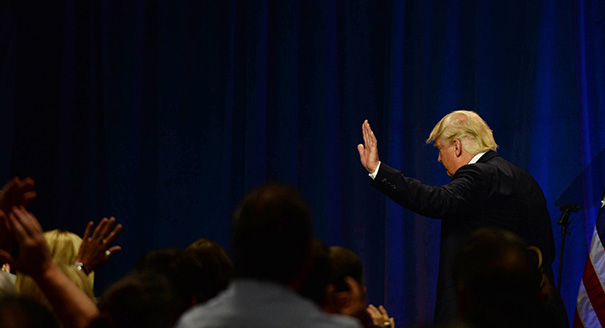
Donald Trump has sent shock waves around the world by distancing himself from most of the things that the Republican Party has stood for in recent years.
Source: Indian Express
Attitudes to war and peace have long been an easy, if simplistic, way to differentiate between America’s two main political parties. Democrats are supposed to be the peace party and the Republicans trigger-happy. This year though, there is a strange political inversion.
Donald Trump has sent shock waves around the world by distancing himself from most of the things that the Republican Party has stood for in recent years. His Democratic rival, Hillary Clinton, is now being celebrated across the political aisle as the wise and experienced torchbearer of the American foreign policy establishment.
This twist in the tale might well hold the key to understanding the evolution of US foreign policy in the coming years. Although there always is much variation within and across administrations, the Republicans, in general, have stood for free trade, military alliances in Eurasia, and the use of force to defend American interests. Trump has upturned that default orientation.With a strong base of trade unions and liberal elites, the Democrats are ambivalent about free trade and beset by self-doubt on using force.
Unlike the Republicans, they also tend to be more supportive of international institutions. In the post Cold War era, the Republican emphasis on unilateralism stood in contrast to the Democratic commitment to multilateralism. If the Democrats emphasised international legitimacy for the use of force, the Republicans underlined the supremacy of self-interest.
In most recent elections campaigns, Democrats had to make sure that they were not branded as national security wimps by Republicans.
This time around, though, Trump is attacking Clinton’s war instincts. He insists that US interventionist policies in the Middle East have brought ruination to the region and terrorism to America’s homeland.
Recoiling in disbelief, many leading members of the Republican foreign policy establishment have denounced Trump’s worldview and defected to the Clinton campaign that has welcomed them with open arms. That Clinton might be more hawkish on the use of force than President Obama comes through in most of the recent assessments of the outgoing president’s foreign policy. Clinton, who served as the secretary of state in Obama’s first term, had, according to these reports, sought a more forceful policy in the Middle East than the president.
Given the costs of distancing herself too much from Obama’s legacy, Clinton is unlikely to advertise that fact. She is also conscious of the strong anti-interventionist sentiment in the Democratic party. During the 2008 election campaign, for example, Obama had mounted a strong critique against Clinton for supporting President George W. Bush’s war in Iraq. Throughout this year, Bernie Sanders, Clinton’s rival for the presidential nomination, rallied the massive anti-war sentiment in the party.
Equally interesting is the presumption that Russia and China will be happier to see Trump in the White House than Clinton. The Democrats, who scoffed at the Republican candidates John McCain (2008) and Mitt Romney (2012) for talking up the Russian threat, are eager today to brand Trump as the “Siberian candidate” for the White House.
Over the weekend, Clinton accused Trump of “absolute allegiance” to Russian policy goals. Dismissing these charges, Trump has affirmed his conviction that a deal with Russia, including potential cooperation against extremism and terrorism, is worth exploring for it might vastly enhance America’s room for global manoeuvre.
China is a far more complicated case. Beijing sees Clinton as the architect of America’s strategic “pivot to Asia” in the first term of the Obama administration and worries that she might embark on a vigorous containment of China. Beijing, of course, has even bigger concerns about Trump’s threat to unravel the complex economic interdependence with America by imposing steep tariffs on Chinese goods and demanding fundamental changes in China’s commercial policies.
The Chinese leaders probably bet that the seemingly anarchic Trump will weaken the West as a whole in the name of putting “America First”. They also suspect Trump will be incapable of mounting a sustained offensive against Beijing that Clinton could. But Beijing also fears Trump’s potential to upturn Asia’s geopolitical landscape by encouraging Japan to go nuclear.
That brings us to the most radical departure that Trump might bring to US foreign policy — recasting America’s alliances in Europe and Asia. Trump insists that the allies must do more if they want to enjoy American protection. Clinton, in contrast, is seen as having a steady hand that will nurture and lead US alliances.
Whether they like her policies or not, most countries in the world would like to see Hillary Clinton win this election. They know her and have dealt with the people she is most likely to appoint to various senior positions in the government. Few in the world chancelleries would like to cope with the strategic chaos that Trump promises to unleash.
Yet it might be wise for America’s interlocutors to prepare for significant changes in US foreign policy, irrespective of who wins the election. For the current domestic turbulence at home and a fluid international environment could easily push Washington in unexpected directions.
Former Nonresident Senior Fellow, Carnegie India
A leading analyst of India’s foreign policy, Mohan is also an expert on South Asian security, great-power relations in Asia, and arms control.
Recent Work

C. Raja Mohan, Darshana M. Baruah


Alexander Gabuev, Paul Haenle, C. Raja Mohan, …
Carnegie does not take institutional positions on public policy issues; the views represented herein are those of the author(s) and do not necessarily reflect the views of Carnegie, its staff, or its trustees.

Ahead of a tough winter for Ukraine, Donald Trump’s swing back toward Russia bodes ill. But instead of panicking, Kyiv’s European allies are focusing on action.

Rym Momtaz

Without a ceasefire with Ukraine on attacking each other’s energy infrastructure—to which the Kremlin is unlikely to agree—the diesel agreement between Putin and Trump is largely for show, rather than representing a genuine increase in the volumes of Russian diesel on the global market.

Sergey Vakulenko
Despite its flop at the box office, the film raises important questions for the climate community to answer.

Leonardo Martinez-Diaz

Funding Ukraine remains a priority for European leaders. As Russia’s war of aggression heads into another winter, two feasible options to mobilize support for Kyiv should be fast-tracked.


Vladyslav Rashkovan, Gregory P. Wilson
In an interview, Rozina Ali discusses her new book on the rise and manifestations of Islamophobia in the United States.

Michael Young