

Q&A
Matt Ferchen
{
  "authors": [
    "Matt Ferchen"
  ],
  "type": "legacyinthemedia",
  "centerAffiliationAll": "",
  "centers": [
    "Carnegie Endowment for International Peace",
    "Carnegie China"
  ],
  "collections": [
    "China and the Developing World",
    "China’s Foreign Relations"
  ],
  "englishNewsletterAll": "",
  "nonEnglishNewsletterAll": "",
  "primaryCenter": "Carnegie China",
  "programAffiliation": "",
  "programs": [],
  "projects": [],
  "regions": [
    "North America",
    "South America",
    "East Asia",
    "China"
  ],
  "topics": [
    "Economy"
  ]
}
Source: Getty
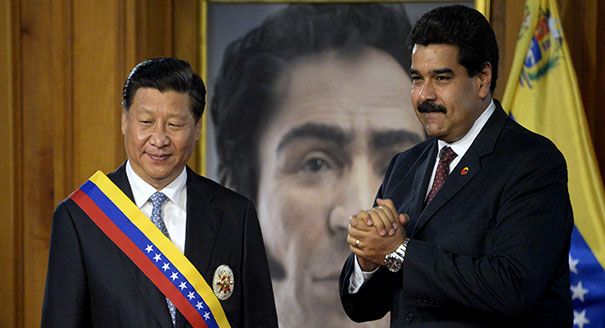
Venezuela’s political instability is causing China to reevaluate its financial investments in the country, the loss of which would be devastating to the South American nation’s fragile economy.
Source: Latin America Advisor
Inter-American Dialogue: Unrepaid loans and rising levels of insecurity in Venezuela may mean that the country cannot receive additional significant loans or investment from China in the near future, the Wall Street Journal reported on September 11. How important a lifeline is Chinese financing to Venezuela, and what will happen to Venezuela if China holds off on additional financing to the country? What other financing options exist for Venezuela, whose economy is expected to contract 10 percent this year, according to the International Monetary Fund? Would China maintain its interest in providing financing to Venezuela’s government if President Nicolás Maduro is forced from power and the opposition takes control of the presidency?
Matt Ferchen: For almost a decade now, China has been Venezuela’s most important foreign financial partner. Even before the end of the commodity boom and the crushing drop in oil prices, Venezuela’s Chavista government had come to rely on regularly renewed tranches of Chinese loans for oil. But as the price of oil and PDVSA’s own productivity have plummeted, it has become increasingly burdensome for Venezuela to service these loans. The September 11 Wall Street Journal article said little we haven’t known for quite some time: that Chinese foreign policy and bank officials are deeply concerned about the situation in Venezuela and are reticent to dig themselves an even deeper financial hole in a country descending ever further into economic and political chaos. Without further Chinese financing, Venezuela, and in particular PDVSA, will be under even greater budgetary strain. However, there is little indication that Maduro and his government will veer from their self-destructive policies. But even if a new leader or government in Venezuela comes in and begins to address the country’s many economic and political dysfunctions, it makes little sense for China to continue with its government-to-government financing of long-term oil purchases. This model did little, if anything, to guarantee China’s own energy security, nor did it benefit the people of Venezuela. Instead, the China-Venezuela deals and similar Chinese commodities-for-loans arrangements with countries in the rest of South America and Africa have saddled many of the debtor nations with unsustainable sovereign loan burdens and left promises of ‘South-South’ development unfulfilled.

Former Nonresident Scholar, Carnegie-Tsinghua Center for Global Policy
Ferchen specializes in China’s political-economic relations with emerging economies. At the Carnegie–Tsinghua Center for Global Policy, he ran a program on China’s economic and political relations with the developing world, including Latin America.
Recent Work
Matt Ferchen
Matt Ferchen, Anarkalee Perera
Carnegie does not take institutional positions on public policy issues; the views represented herein are those of the author(s) and do not necessarily reflect the views of Carnegie, its staff, or its trustees.
It should address the shortcomings of previous crisis communication efforts and adapt to the demands of frontier AI.

Lucy Luo

China’s police training infrastructure construction projects provide benefits to recipient countries, promote China’s image as a major global security provider, and are likely to reinforce alignment between Beijing’s security priorities and those of countries in the Global South.


Cameron Waltz, Sheena Chestnut Greitens, Kim Nguyen, …
AI capabilities are moving fast. Most institutions—including governments—can’t keep up.


Anton Leicht, Scott Singer

The Bureau of Industry and Security needs to adjust its focus and practices to maintain its position as the U.S. government’s primary champion of international technological competition.

Geoffrey Irving

Depleted financial reserves and a shrinking tax base mean it is no longer possible to simultaneously deliver high defense spending, price stability, and economic growth.

Alexandra Prokopenko