

Commentary
Sarah Chayes
{
  "authors": [
    "Sarah Chayes"
  ],
  "type": "legacyinthemedia",
  "centerAffiliationAll": "dc",
  "centers": [
    "Carnegie Endowment for International Peace"
  ],
  "collections": [],
  "englishNewsletterAll": "democracy",
  "nonEnglishNewsletterAll": "",
  "primaryCenter": "Carnegie Endowment for International Peace",
  "programAffiliation": "DCG",
  "programs": [
    "Democracy, Conflict, and Governance"
  ],
  "projects": [],
  "regions": [
    "South Asia",
    "Afghanistan"
  ],
  "topics": [
    "Security",
    "Military"
  ]
}
Source: Getty
Who we empower and how our local allies treat the greater population may determine the outcome of the U.S. fight against violent extremism.
Source: Los Angeles Times
In the decade I lived and worked in Afghanistan, from 2002 through 2011, I listened almost daily to people’s frustration at their government’s corrupt and demeaning behavior, and U.S. officials’ refusal to curb it.
“The Afghan government is your face,” Nurallah told me. He’s a former police officer who worked in the cooperative I founded in Kandahar. “If it’s pretty or ugly, it’s your face.”
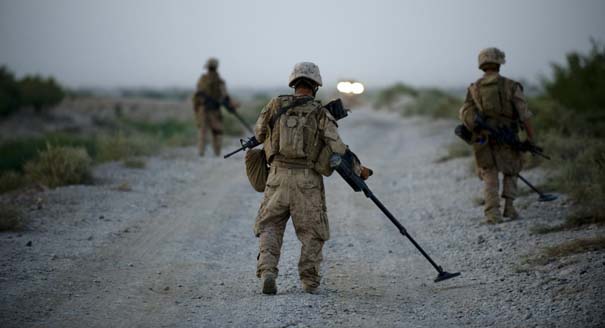
In 2010, around when Nurallah made that comment, a U.S. Marine major named Jason Brezler was dealing with a corrupt Afghan National Police commander called Sarwar Jan in neighboring Helmand Province. Brezler perfectly grasped Nurallah’s point. The abuse of power so prevalent among Afghan officials — which appeared to locals to be perpetrated with U.S. connivance — was a danger to his mission to defeat the Taliban.
A 2009 assessment of the war emphasized that Afghans’ “crisis in confidence” in their government threatened U.S. objectives.
Brezler got Sarwar Jan removed from power, or at least sent away from his privileged position on the U.S. base. Three years later, however, he heard Sarwar Jan was back in the Marine fold. Brezler, by then a Brooklyn firefighter and a reservist, dispatched a warning the moment he found out. It went unheeded. Seventeen days later, a boy Sarwar Jan had been using for sex shot four Marines, killing three.
Brezler should be honored by the Marine Corps for his foresight. Instead the Corps plans to discharge him because the file he emailed to substantiate his concerns, and had saved on his computer, was classified. A hearing is scheduled in U.S. District Court for Oct. 14.
Brezler, who immediately reported his violation of classification rules, has argued that he was trying to save lives. His lawyer, Mark Bowe, plans to draw a comparison to the treatment of Hillary Clinton, who also kept sensitive information on a private server.
I hope Brezler prevails. And not just in court. His way of thinking must be adopted as the U.S. considers how to partner with foreign forces in its continuing fight against extremists, including Islamic State.
“The police in many cases was a destabilizing force,” Brezler told NPR recently. They were “driving more folks into the arms of the Taliban.” Capt. Dan Quinn — a special operations officer disciplined for punching out a similarly abusive Afghan police commander — put it this way to the New York Times: “We were putting people into power who would do things that were worse than the Taliban did.” It is little wonder the Taliban kept (and still keeps) gaining recruits. Or, in the case of Sarwar Jan, that a humiliated and physically violated teenager lashed out, turning a Kalashnikov on Marines who seemed to be protecting and enabling his tormentor.
Brezler was deployed during a brief period of maximum U.S. recognition that good governance was crucial to bringing peace to Afghanistan. A 2009 assessment of the war emphasized that Afghans’ “crisis in confidence” in their government threatened U.S. objectives, and that fostering “responsive and accountable government” should “be on a par with, and integral to, delivering security.” Among other measures, U.S. and U.K. officials supported two major anti-corruption investigations.
But those efforts were halfhearted and short-lived. By 2011, Afghan government corruption was no longer a serious U.S. priority. The dominant attitude reasserted itself among U.S. officials that corruption was just part of Afghan culture, and should be left alone – even when it extended to the grotesquely complicated combination of abuse and favoritism that characterized the practice in which adult, usually powerful, men keep prepubescent boys as servants and for sex. The New York Times has documented the difficulty some officers encountered trying to challenge the laissez-faire approach.
The presumption about culture that underlies that approach is false. As Brezler told NPR, residents were “absolutely elated” when Sarwar Jan was sent away from the base in 2010. “We could probably have had a parade the next day through the bazaar,” he remembered. That same year, the commander of a provincial reconstruction team on the other side of the country enjoyed a similarly enthusiastic response — and a reduction in Taliban control in his province — when he stopped channeling development money to a corrupt governor. I never heard an Afghan dismiss corruption as if nobody minded.
Just because a behavior is common, in other words, doesn't mean it's accepted. (Would it be fair to deduce from the Catholic Church's problems that the faithful are by nature pedophiliac?)
Arguably, Brezler should have chosen a different way to detail his concerns about Sarwar Jan. But it was the failure to act on his information that threatened U.S. national security, not his transmission of it. With the combination of insight and initiative he demonstrated, Brezler should be training Marines, not being drummed out of the Corps. His reflex was one that, if replicated, would have led to very different outcomes in our wars in Afghanistan and Iraq.
Brezler’s insight remains crucial to the U.S. fight against violent extremism. Who we empower in that fight and how our local allies treat the population may determine its outcome. That the Marine Corps insists on punishing Brezler demonstrates that its leadership has not yet learned the lesson.
This article was originally published by the Los Angeles Times.
Former Senior Fellow, Democracy, Conflict, and Governance Program
Sarah Chayes is internationally recognized for her innovative thinking on corruption and its implications. Her work explores how severe corruption can help prompt such crises as terrorism, revolutions and their violent aftermaths, and environmental degradation.
Recent Work
Sarah Chayes
Carnegie does not take institutional positions on public policy issues; the views represented herein are those of the author(s) and do not necessarily reflect the views of Carnegie, its staff, or its trustees.

The books, podcasts, and films that explain the world it made.

Andrew Leber

With the growth in points of friction between the great powers, organizations like the SCO will continue to play a role in the strategic adaptation of the smaller powers caught between them.

Temur Umarov
Amid celebrations of bilateral ties was a deeper focus on stability in the Middle East.

Amr Hamzawy

Moscow is testing Europe’s defenses with drone incursions and could decide to use drones against the continent on a much larger scale once the war in Ukraine pauses. European countries will need Kyiv to help them prepare for such a possibility.
Pavlo Zvenyhorodskyi

European states control several Overseas Countries and Territories around the world that carry strategic, economic, and environmental weight. As great powers challenge the rules-based order, defending them is a geopolitical imperative for Europe.

Marc Pierini