

Article
Carole Nakhle
{
  "authors": [
    "Carole Nakhle"
  ],
  "type": "legacyinthemedia",
  "centerAffiliationAll": "dc",
  "centers": [
    "Carnegie Endowment for International Peace",
    "Malcolm H. Kerr Carnegie Middle East Center"
  ],
  "collections": [],
  "englishNewsletterAll": "menaTransitions",
  "nonEnglishNewsletterAll": "",
  "primaryCenter": "Malcolm H. Kerr Carnegie Middle East Center",
  "programAffiliation": "MEP",
  "programs": [
    "Middle East"
  ],
  "projects": [],
  "regions": [
    "Iran",
    "Middle East"
  ],
  "topics": [
    "Political Reform",
    "Economy"
  ]
}
Source: Getty
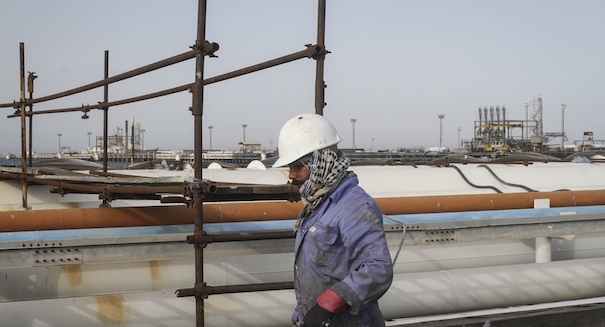
Iran has some of the world’s largest oil and gas fields and its oil sector is, once again, occupying centre stage in the global media
Source: Oil Review Middle East
The Iranian oil sector is, once again, occupying centre stage in the global media. The impression generated is of a big bonanza awaiting zealous international oil and gas investors as the country offers a new type of agreement – the Iran Petroleum Contract (IPC) which, we are told, is more investment-friendly than its predecessor, the buyback. Meanwhile, voices from Tehran are calling upon companies to rush to gain a foothold in the country to avoid losing out in this new gold rush.
This new gold rush. It would be hard to overstate Iran’s oil and gas potential. Iran has world-class assets, including some of the world’s largest oil and gas fields. According to the BP Statistical Review (2016), the Islamic Republic sits on the world’s largest proven gas reserves (1,200 trillion cubic feet, more than 18 per cent of the global total) and the fourth-largest proven oil reserves (158 billion barrels, more than nine per cent of the total) after Venezuela, Saudi Arabia, and Canada. However, as members of this list like Venezuela demonstrate, the presence of significant reserves below ground is not a prerequisite for successful exploitation. Above-ground factors weigh as much as geological and technical risk.Based on its “Sixth National Development Plan”, which covers the period from March 2016 to March 2021, Iran will need to attract around US$200bn in foreign investment into the country’s oil, gas and petrochemical industries. This is not pocket money.
Iran also hopes to further increase its oil production to 4.8mn bpd by 2021, more than a 5mn bpd or a 30 per cent increase in volumes over a five-year period, if condensates are included.
As of today, the country is edging closer towards its pre-sanctions level of 3.8mn bpd, with production expanding gradually. At 3.7mn bpd, Iran is OPEC’s third-largest oil producer, after Saudi Arabia and Iraq. When OPEC attempted to reach agreement on capping production in 2016, Iran has held firm and argued it will not consider any production cuts (or “freeze”) before reaching its pre-sanctions production level of 3.8mn bpd. This wish seems to have been granted at the organisation’s informal meeting in Algeria in September.
But Iran’s stated ambitions go beyond achieving pre-sanctions levels. Its vice president, Eshaq Jahangiri, was quoted as saying that Iran needs to regain the share of the global oil market which it lost because of international sanctions. In 2015, Iran accounted for four per cent of the world’s oil supply, down from five per cent in 2015. Similarly, its share within OPEC fell from 12 per cent in 2011 to nine per cent in 2015, while Saudi Arabia, Iraq and other GCC producers expanded their share. For Iran to restore a five per cent market share in today’s global oil market would require it to increase production to more than 4.8mn bpd.
A significant ramp-up of production by any player would obviously put downward pressure on today’s already depressed oil market, and it would undermine the effectiveness of OPEC’s strategy of setting a floor under prices and gradually reverse their decline.
Iran needs capital and modern technology to sustain higher production levels, regardless of what exactly those targets are, and it has pinned its hopes in this regard on its newly revamped oil contract, the IPC. Details of the new contracts are yet to be revealed. However, the general headlines and official statements point toward more lenient terms for investors compared to the previous Buybacks, starting with longer contract duration (25 years compared to seven years) and a fee per barrel which is no longer fixed but linked to profitability instead.
These are major steps in the right direction. However, a few observations are worth keeping in mind.
First, the comparison of the IPC with previous Buybacks is of limited value. Any rational investor will compare what Iran offers today with what is offered elsewhere in the world today, not with what Iran has offered in the past. Oil companies with an international portfolio will allocate their limited resources to countries with the best risk-reward balance. During low oil price periods, these companies can afford to become more selective. Meanwhile, countries intending to attract investment will relax contractual terms, further thereby further intensifying competition. Iran, like everyone else, will have to be internationally competitive.
Second, in oil as in any contract, the devil is in the detail. What has been revealed about the IPC appears appealing, but contracts are negotiable, negotiations can be tough and no contract with a foreign entity has been concluded yet. Iran is also divided on the extent to which to involve international companies. Moderates recognise the contribution these companies can make. But hard-line conservatives have a point: they argue that the sanctions have forced Iran to develop local skills and expertise in the oil and gas industry independently from foreign participation, and that the contribution of international companies will therefore be limited.
It is this polarised perspective that has caused the finalisation of the IPC to be delayed, and that has motivated policy shifts and tougher contract terms. And this polarisation continues to raise concerns because presidential elections are looming, with no guarantee of a re-election of the moderate Hassan Rouhani, who was in favour of energy sector reform.
Finally, there are large potential problems around contract implementation, prominent among them the fear of political intervention. For instance, although Iran has committed to allocate contracts based on competitive bidding processes, individual Iranian officials were quoted with statements to the effect that Chinese companies had been allowed enough investment in Iran and that it was time to offer opportunities to other companies. In principle, competitive bidding should not be based on a company’s nationality but on its expertise and capabilities. Next, any foreign investor to operate in Iran’s oil and gas sector has to partner with a local company (something not part of the original IPC discussions). Iran has already shortlisted a number of local companies to this effect. In particular as long as US sanctions are still on the table, international companies ought to be cautious about their local partner.
What Iran has to offer, in terms of field size as well as development and production cost, is confined to a limited number of countries indeed. This does not make it ‘easy’. There is no such a thing as ‘easy oil’ to begin with. Iran is blessed by geology but is technically challenging. Its recovery rates are low, at 20- 25 per cent – less than half the average rates of its neighbours (in Saudi Arabia’s largest field the recovery rate can be as high as 60 per cent).
Furthermore, above-ground political risks are considerable and uncertainties abound. Not all of them can be catered for by contractual terms. For example, although nuclear-related sanctions have been lifted, ‘snap back’ provisions allow for their reintroduction in case of Iranian noncompliance. Other US sanctions still apply, which limit access to international banking services.
Assessing accurately how to locate, time and quantify a potential investment in Iran’s oil and gas reserves requires knowledge and analytical skills of the highest quality, stretching over a range of disciplines and expertise. It requires careful planning, confidence and strong nerves. The signal to the world’s oil investors ought to be: proceed slowly and with extreme caution.
This article was originally published in Oil Review Middle East.
Former Nonresident Scholar, Middle East Center
Nakhle was a nonresident scholar at Carnegie Middle East Center, specializing in international petroleum contracts and fiscal regimes for the oil and gas industry, world oil and gas market developments, energy policy, and oil and gas revenue management.
Recent Work
Carole Nakhle
Carole Nakhle
Carnegie does not take institutional positions on public policy issues; the views represented herein are those of the author(s) and do not necessarily reflect the views of Carnegie, its staff, or its trustees.

The Bureau of Industry and Security needs to adjust its focus and practices to maintain its position as the U.S. government’s primary champion of international technological competition.

Geoffrey Irving

Depleted financial reserves and a shrinking tax base mean it is no longer possible to simultaneously deliver high defense spending, price stability, and economic growth.

Alexandra Prokopenko
Understanding the climatic pain points is necessary for policymakers hoping to minimize the war’s negative environmental consequences.



Alejandro Martin Rodriguez, Joy Arkeh, Sarah Yerkes

Huawei pushed hard to enter the Egyptian data centers market, until the Americans made a better offer.

Angie Omar

The books, podcasts, and films that explain the world it made.

Andrew Leber