

Paper
Christopher S. Chivvis, Rohan Mukherjee, Milan Vaishnav
{
  "authors": [
    "Milan Vaishnav"
  ],
  "type": "legacyinthemedia",
  "centerAffiliationAll": "dc",
  "centers": [
    "Carnegie Endowment for International Peace",
    "Carnegie India"
  ],
  "collections": [],
  "englishNewsletterAll": "ctw",
  "nonEnglishNewsletterAll": "",
  "primaryCenter": "Carnegie Endowment for International Peace",
  "programAffiliation": "SAP",
  "programs": [
    "South Asia"
  ],
  "projects": [],
  "regions": [
    "South Asia",
    "India"
  ],
  "topics": [
    "Political Reform",
    "Democracy"
  ]
}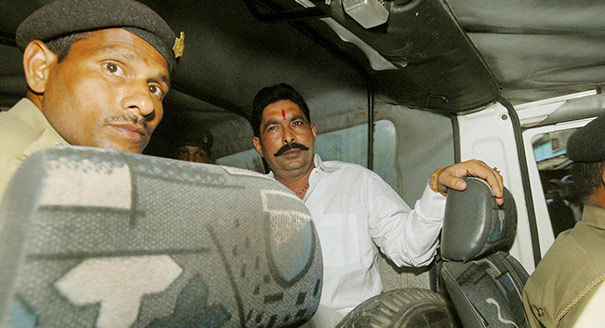
Source: Getty
Despite public knowledge of the crimes he has committed, Anant Singh is a popular politician in India.
Source: Livemint
“Anant Singh is not a murderer. He merely manages murder,” the man said flatly and without a trace of irony. The person who spoke these words was a well-educated engineer, a friend of an acquaintance of mine, and we were sitting in his stately ancestral home on the banks of the Ganges River in central Bihar, sipping our third cup of homemade sickly sweet chai while discussing the local political scene. I had sought out the engineer to chat about a local politician, Anant Singh, a three-time MLA from Mokama, a surprisingly lush constituency in the poverty-stricken easternmost reaches of Patna district. Singh was one of the area’s most well-known politicians, not least because of the length of his rap sheet.
The engineer’s family had long known Anant Singh and was connected to the political party he was affiliated with, the ruling Janata Dal (United). The engineer’s remark about Singh lingered in the air, much like a word cloud from a newspaper cartoon. I paused for a second, not knowing whether the man was joking or serious. It was clear from the expression on his face it was the latter.
Anant Singh is an unlikely poster child for electoral success in a flourishing democracy. He is fond of wearing sunglasses, a cigarette perched on his lips, his body adorned in all white, occasionally gussied up with a leather jacket. If he were not in politics, Singh could have had an alternate career as a cinematic villain—his practised bad boy look was straight out of central casting.
In addition to his official designation as an elected representative of this poor, rural constituency, Singh doubles as something of a local godfather, or dada. Singh rose to political prominence on the back of his older brother, Dilip, who emerged as a Bhumihar gang leader in the region in the mid-1980s. Dilip parlayed his muscle power into political power, eventually entering state politics and winning the Mokama seat in 1990. Anant, who commenced his criminal career as Dilip’s enforcer, ultimately took over the political reins of the family. When I arrived at the engineer’s house in the fall of 2010, Singh was days away from winning his fourth consecutive election.
Over the years, Singh has been implicated in dozens of criminal cases, and many of his alleged criminal acts, widely reported in the press, have been carried out in a brazenly public manner.
The circumstances surrounding Anant Singh’s first (alleged) murder are something of a local legend. Anant’s eldest brother, Birachi, was a mukhia (village headman) and a prominent landlord. Several villagers told me that a sympathizer of Naxalite rebels, who were carrying out targeted assassinations of upper-caste landlords, killed Birachi before taking refuge on a boat in the middle of the Ganges. Anant supposedly tracked his brother’s killer for months. When he eventually learned of the man’s location, Anant swam across the river and is said to have murdered the man. With such a history of high-profile transgressions, videos circulating on YouTube of Singh drunkenly dancing while brandishing an AK-47 seem downright tame in comparison.
On the morning I set out to visit Mokama, The Times of India published a prominent story on page two of its Patna edition titled, “Anant’s Sarkar (government) in Mokama.” The profile described Singh as a dada who wielded more influence in his constituency than the actual government. Indeed, his constituents rarely call Singh by his given name; instead they refer to him as chhote sarkar (little lord) for his dominance over the constituency. The reporter who penned the piece mixed in anecdotes about Singh’s feared personality with talk of improved safety and better access to services under his watch. Residents told me that Singh could often be found holding court at his durbar, ready to take a call on everyday disputes that arose between citizens, hear complaints about the police, or initiate action against “miscreants.”
Though dozens of cases have been lodged against Anant, police and prosecutors have yet to obtain a single conviction. Cases against Anant have languished for years, during which time judges have passed away, law enforcement officials have been transferred, and evidence has gone missing. But Singh’s alleged criminal acts are not his only attributes that have gained notoriety; the lawmaker’s idiosyncrasies and penchant for extravagance are also widely discussed. In the thick of the Hindi heartland, Singh speaks little Hindi, preferring instead the local Magahi dialect; he keeps a python as a house pet as well as an elephant trained to shake hands; and he raises expensive horses tasked with pulling an antique buggy in which Singh often rides.
But perhaps the most surprising fact about Anant Singh is that his political patron is a man who burnishes a reputation as one of India’s cleanest politicians: the reformist chief minister of Bihar, Nitish Kumar. Kumar swept into office in 2005 with promises of cleaning up one of the country’s poorest, most corrupt, and socially fractured states. Between 2005 and 2010, when Kumar’s ruling alliance won a resounding re-election, Kumar made great strides, against all odds, in doing exactly that. So why would Kumar risk his reputation by giving Anant Singh a party ticket and then campaign tirelessly on his behalf?
The short answer is that Anant Singh was simply too powerful for the chief minister to rebuff him. Kumar embraced Singh because he believed that any candidate allied with Anant would have a strong advantage, especially among the upper castes, a constituency not intrinsically supportive of Nitish Kumar or his party. Thus, Kumar brought Singh within the JD(U) fold back in 2005. And when Anant won that election, rumour has it that he brought Kumar to his constituency and weighed him in gold. Once asked why he had embraced known criminals like Singh, Kumar bluntly retorted, “There are certain compulsions of politics.”
In 2015, Anant Singh was arrested on murder and kidnapping charges. This time, the so-called compulsions of politics forced Nitish Kumar to cut Singh loose, in a move largely interpreted as a sop to Kumar’s longtime rival turned newfound partner, Lalu Prasad Yadav.
Lodged in jail and forced to contest polls as an independent, Singh instructed his wife Neelam to campaign on his behalf. Day in and day out, she sought votes in her incarcerated husband’s name, who she dubbed a “rare diamond.” When all the votes were counted, Singh handily won re-election without once setting foot on the campaign trail. “We were on a weak wicket as chhote sarkar was behind bars, but people stayed with us in even these tough times,” Neelam explained to the press. “We have shown Nitish and Lalu that they may have won Bihar but chhote sarkar is still a force to reckon with.”
This excerpt from When Crime Pays was originally published in Livemint.

Director and Senior Fellow, South Asia Program
Milan Vaishnav is a senior fellow and director of the South Asia Program and the host of the Grand Tamasha podcast at the Carnegie Endowment for International Peace. His primary research focus is the political economy of India, and he examines issues such as corruption and governance, state capacity, federalism, and electoral behavior. He also conducts research on the Indian diaspora.
Recent Work

Christopher S. Chivvis, Rohan Mukherjee, Milan Vaishnav



Sophia Besch, Eric Ciaramella, Steve Feldstein, …
Carnegie does not take institutional positions on public policy issues; the views represented herein are those of the author(s) and do not necessarily reflect the views of Carnegie, its staff, or its trustees.

China’s political future will be shaped between now and next October. As the Communist Party enters its intense “campaign season” to prepare for a major political transition in 2027, reading Beijing's actions and responses may become more difficult as domestic politics weigh on its behavior more than usual.

Damien Ma

Despite public disputes over trade and immigration, the strategic partnership’s foundations remain sturdy.

Sameer Lalwani

Putin’s conservative staffing policies and search for ever greater control have cemented parliament’s transformation into a bureaucratic appendage of the executive branch.

Andrey Pertsev

Ex-president Gurbanguly Berdimuhamedov remains interested in politics, but his son Serdar, Turkmenistan’s current president, is becoming increasingly independent and willing to break with his father’s legacy. If their covert rivalry goes too far, both risk losing power.

Galiya Ibragimova

A notable degree of participative democracy has firmly arrived in Europe. But to have more far-reaching impact, democratic deliberation needs to move into a radically new phase.

Richard Youngs