Introduction
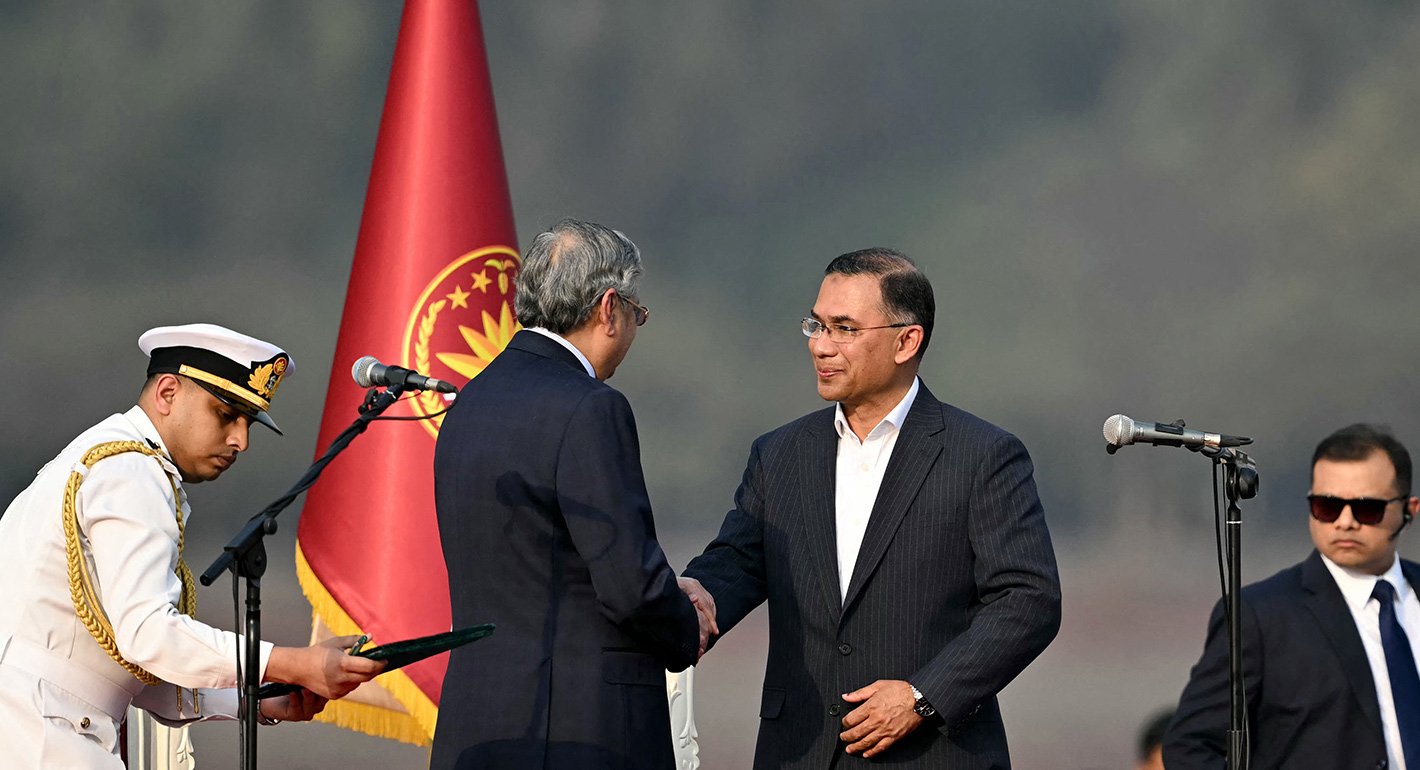
“I have a plan for the people of my country,” Tarique Rahman announced to a large, jubilant crowd on Christmas Day 2025. His seventeen-year exile had come to an end. Less than two months later, Rahman’s Bangladesh Nationalist Party (BNP) won a decisive victory in February’s general election. The BNP won 209 of 300 seats, the Bangladesh Jamaat-e-Islami (BJI) followed with 68 seats, and the new student-led National Citizens Party (NCP) secured 6 seats. The vote was the first credible election Bangladesh has convened in nearly two decades. The last such elections, held in 2008, led to the rise of former prime minister Sheikh Hasina’s Awami League (AL). Once ensconced in power, Hasina consolidated power through increasingly authoritarian means, holding office until her ouster following a public uprising in July–August 2024.
Beyond their credibility, the February elections saw 68 percent voting in favor of a referendum on the July Charter, a set of constitutional, electoral, and administrative reforms named after the summer uprising and introduced by the interim government led by Nobel laureate Professor Muhammad Yunus. From establishing prime ministerial term limits and replacing the first-past-the-post electoral system with proportional representation and a bicameral parliament to relaxing anti-defection laws, the July Charter is designed to prevent the overcentralization of power. Coupled with the BNP’s return, the BJI’s revival, and the NCP’s emergence, the Bangladeshi electorate has signaled an abiding interest in participatory politics, political reform, economic stability, and democracy.
Yet the revolutionary promise of such historic moments—Bangladesh’s 2024 uprising has been called the “Monsoon Revolution”—frequently collides with the reality of entrenched political economies. Bangladesh is no different. The interim government’s success in stabilizing the economy and holding credible elections, alongside Rahman’s largely uncontested elevation as prime minister, suggests a stable social contract. This is a significant shift from the Hasina years, when she frequently targeted opponents and dissidents. But the return to power of an established party led by the son of BNP founder Ziaur Rahman and former prime minister Khaleda Zia—who died five days after Rahman’s return from exile—carries an unmistakable note of continuity. Can Rahman, whose party returned to power operating within the existing structures of Bangladesh’s political economy, deliver serious reforms?
The Road to Rupture
Tensions had been building across the economy, the electoral system, and the army in the months before the uprising. The January 2024 elections were marked by a nationwide wave of protests by BNP and BJI supporters, resulting in the arrests of over 20,000 people on the eve of the vote. Hasina banned the BJI, and the BNP boycotted the elections, calling them procedurally unfair.
Even though Hasina returned to power that month, the violence surrounding the process created a pressure-cooker situation. Bereft of an opposition, the elections were widely viewed as compromised; the economy, suffering from the lingering aftershocks of the COVID-19 pandemic, the Russia-Ukraine war, and chronic corruption, was in accelerating decline; and the army warily watched these developments.
It was in this context that Hasina announced 30 percent job quotas for the descendants of the “freedom fighters” who had fought in the country’s 1971 war of liberation, through which the country gained independence from Pakistan. This move was a clear signal that the government planned to favor those directly tied to the AL. In a country where the state plays a significant role in job creation, this announcement alarmed the nearly 18 million young people who were either unemployed or underemployed, and for whom public-sector employment represented one of the few reliable paths to economic security. Though it was eventually rescinded under intense pressure, the job quota was the final straw that triggered widespread student protests in July–August 2024. These protests escalated into a mass uprising when Hasina ordered a crackdown, and over 1,400 people were killed by the AL’s armed cadre, the police, the border guards, and the army.
On August 4, 2024, Bangladesh army chief General Waker-uz-Zaman convened his senior officers and made a consequential decision: The army would not fire on the protesters and would instead facilitate Hasina’s exile. This was immediately followed by the decision to allow Yunus—then living abroad, facing multiple politically motivated criminal charges—to return and lead the country.
The eighteen months that followed set the tone for Bangladesh’s transition. Yunus, in his role as chief adviser to the interim government, laid the groundwork for structural reform. Apart from promising a range of reforms that included bringing Hasina to justice, the interim government’s most consequential actions were concentrated in two areas: the economy and electoral politics. While Yunus’s economic team succeeded in stabilizing an economy in freefall, their political measures proved more contentious. Under pressure from student leaders serving in the interim government and aligned with the BJI, Yunus lit a long fuse by barring the AL from reentering politics.
The interim government’s most consequential actions were concentrated in two areas: the economy and electoral politics.
The interim period reshaped the economy, elections, and the army, though each tells a different story about what it achieved, and what it left unresolved.
Economy: Stabilization Without Transformation
Bangladesh’s economy has demonstrated resilience despite external shocks and internal turmoil. This is no small feat for an economy that relies on two revenue streams: readymade garment (RMG) exports, which constitute over 80 percent of Bangladesh’s total exports, and remittances from a diaspora that numbers more than 13 million.
The downward spiral began with the onset of the Covid pandemic and was further compounded by the Russia-Ukraine war’s impact on global food and energy prices. Both shocks, in turn, were made significantly worse by the Hasina regime’s systemic corruption.
In 2023, Hasina approved $17 billion worth of loans from public banks for the S Alam Group and Beximco. It later emerged that most of this money had either been laundered abroad or defaulted on, threatening a complete breakdown of Bangladesh’s financial and banking system. Hasina’s loyalists, including members of parliament and business owners, engaged in price-fixing of essentials such as eggs, grains, and cooking oil, which fueled food inflation. The 2024 protests brought into stark relief what had become undeniable: Bangladesh had experienced jobless growth, and its so-called macro-economic miracle had benefited a small coterie of Hasina-linked oligarchs.
On the eve of Hasina’s ouster in August 2024, the Bangladeshi economy, according to contemporaneous assessments, had come to a “screeching halt” amid curfews, internet blackouts, and the quota protests. The country lost an estimated $10 billion over the month of unrest; the garment industry alone shed $150 million per day. Bangladesh’s foreign exchange reserves fell to $20 billion—enough to cover just three months of imports. Headline inflation reached nearly 12 percent, with food inflation hitting 14 percent.
Such was the dismal state of the economy when Yunus assumed office as chief adviser. Rather than reaching for quick fixes, the interim government undertook a sweeping restructuring of Bangladesh’s financial sector. It dissolved the boards of eleven major banks, seven of which were under the control of the S Alam group, and launched an asset recovery program. The 2025 Bank Resolution Ordinance allowed the central bank to merge or take over failing banks to protect household deposits. Ahsan H. Mansur, the newly appointed governor of the central bank and a former International Monetary Fund (IMF) economist, abandoned the artificial peg of the country’s currency and moved the exchange rate to a market-based float, generating a remittance surge of roughly 60 percent within months. This shift also reduced the risk of under-invoicing and money laundering.
On December 1, 2024, the interim government issued a white paper on the economy intended to offer a transparent account of the impact of economic mismanagement, corruption, and cronyism under Hasina. The document revealed that the Hasina regime plundered $234 billion and heavily inflated infrastructure costs over a fifteen-year period. This triggered the cancellation or suspension of several infrastructure projects to conserve scarce foreign exchange reserves. Yunus also used his reputation and network to unlock a $4.7 billion IMF loan and secure an additional $3 billion from the World Bank and the Asian Development Bank. In addition, the interim government mediated an eighteen-point agreement between garment factory owners and workers to address issues such as minimum wage and industrial safety, thereby preventing the departure of global retail brands such as H&M and Zara.
In February 2026, when the elections were held, Bangladesh’s foreign exchange reserves stood at $30 billion, GDP was forecast to grow at 4.7 percent, and inflation hovered around 9 percent. This stabilization of a deeply distressed economy stands as one of the most significant achievements of the interim government. It allowed the BNP government under Rahman to hit the ground running, rather than contend with acute economic turmoil on the first day in office. This stability also allowed Rahman to navigate the severe economic headwinds emanating from the latest conflict between the United States and Iran—triggered by the U.S.-Israeli strikes that began in late February—with greater confidence than would have been possible otherwise.
Elections: Free and Fair, But Not Inclusive
The 2026 elections were deemed free and fair, but they were certainly not inclusive. By barring the AL from participating, the interim government laid the groundwork for a future political crisis. While this is not quite déjà vu, the AL’s exclusion represents continuity with a past in which opposition parties were not permitted a level playing field.
Ever since its founding in 1971, Bangladesh has held thirteen national parliamentary elections. Of these, only the 1991, June 1996, 2001, 2008, and 2026 elections are considered to have been credible, or free of malpractice and coercion. The polls held in 2014, 2018, and 2024, under Hasina’s tenure, are considered to have been highly problematic. These elections were widely documented to have involved large-scale voter fraud and systematic targeting of the opposition. Hasina banned the BJI, arrested most of its leaders, and sent some to the gallows on charges of terrorism and crimes committed during the 1971 liberation war, directing their cases to the International Crimes Tribunal (ICT). Senior BNP leaders were also arrested, exiled, and coerced or co-opted into silence.
These actions, which prevented an entire generation of Bangladeshi youth from exercising their franchise, culminated in the July–August 2024 violence. In November 2025, the interim government used the same ICT, once abused by Hasina, to sentence her in absentia to death. The sentence has not been enforced since Hasina remains in exile in India. The interim government cited the AL’s crimes as justification for preventing the party from contesting the 2026 elections.
For now, this issue does not seem to pose an immediate problem. Given the scale and recency of Hasina’s excesses and her ongoing exile—both highly sensitive subjects in Bangladeshi politics—the AL’s revival does not appear imminent. But its exclusion, even if on credible legal grounds, structurally echoes previous electoral crises. The AL still retains pockets of support across Bangladesh and will remain linked to its leadership of the country’s liberation struggle. Even if the Hasina family’s political career has ended, the AL has the potential to reemerge in time with new leadership. The mechanics, circumstances, timeframe, and triggers of the AL’s eventual revival are open to speculation, but the possibility that the BNP’s political fortunes will wane, and that the BJI might not fill that vacuum, is likely to create the conditions necessary for the AL to chart its comeback ahead of the next election in 2031.
The other friction point was over the timing of the 2026 elections. In the early months after Hasina’s ouster, Yunus sought a full four-to-five-year mandate to implement reforms. The army and the BNP both found this position unacceptable. Yunus believed that such a timeframe was necessary for meaningful reforms, whereas students—who launched the NCP in February 2025—and the BJI found it expedient. The longer the wait for elections, the more it risked undermining the BNP’s popularity, and the more time it gave the BJI and NCP to expand their electoral bases.
For the army, a longer electoral timeline meant that it would need to remain responsible for law and order and perform magisterial functions longer than it wished. Public anger against the police, which had come to be seen as no more than Hasina’s personal force, had pushed it out of action for several weeks after the 2024 unrest before it gradually resumed normal duties. The longer the army remained on the streets, the more pressure was generated within its ranks, whose members did not want to perform policing duties.
The Army: Calculated Restraint
By staying out of politics during the 2026 elections, the Bangladeshi army underlined its professionalism and commitment to maintaining systemic stability—an important milestone in this relatively young South Asian country’s democratic trajectory. Bangladesh has had a long history of army rule, including twenty-nine recorded coup attempts and mutinies since 1971, and four successful takeovers in August and November 1975, 1982, and 2007.
General Waker-uz-Zaman’s decision to refrain from firing on protesters in the summer of 2024, despite direct orders from Hasina, marked a “quiet coup” in itself.
For some observers, General Waker-uz-Zaman’s decision to refrain from firing on protesters in the summer of 2024, despite direct orders from Hasina, marked a “quiet coup” in itself. Arguably, the conditions in which Bangladesh found itself in July–August 2024 were ripe for a military coup. Waker-uz-Zaman had imposed a nationwide curfew, oversaw the formation of the interim government, and was granted executive magistracy powers by Yunus in September 2024. But having experienced the costs of military rule in the past, Waker-uz-Zaman pressed for an early civilian transition and early elections and moved to curtail Yunus’s hope for a longer-term interim arrangement.
The Limits of the New Order
Three pressures will define Rahman’s first term: the BNP’s ambivalent relationship with the July Charter, the economic shock of the U.S.-Iran war, and the long shadow of Bangladesh’s ties with India. Viewed together, they reveal the extent to which the old order survived the revolution that brought the new one to power.
The BNP and the July Charter
With the military back in the barracks, Bangladesh has an opportunity to convert this moment of political change into institutional reform. For this, the BNP needs to accept and implement the July Charter—but early signs indicate a different reality.
The BNP objected to certain aspects of the July Charter even before the elections. The charter proposed distributing seats in the upper house based on the proportion of votes won. The BNP countered that such a distribution should be based on the proportion of seats won in the lower house. Furthermore, the charter sought to strip the prime minister of the sole power to appoint heads of independent bodies such as the Human Rights Commission, the Anti-Corruption Commission, the Ombudsman, and the Public Service Commission. The BNP argued that such procedures should be established by ordinary legislation rather than enshrined as constitutional requirements.
In addition, it opposed the charter’s recommendation that the heads of future caretaker governments—responsible for the conduct of free and fair elections—should be appointed by a consensus-based selection committee. The BNP argued that if the committee could not reach a consensus, a parliamentary majority should decide this critical appointment.
Such defiance of the July Charter is meant to secure the BNP’s political dominance for years to come. Since coming to power, the BNP has not just rejected those aspects of the charter that it was opposed to from the outset but is also reviewing or scrapping provisions it had previously championed. A separate secretariat for the Supreme Court is one such example. The BNP had previously backed this measure as a means of insulating the judiciary from executive interference on procedural and administrative matters. Now, the BNP is shelving it to maintain leverage over the judiciary.
Ironically, the one interim government-era ordinance the BNP has decided to retain is the suspension of the AL from active politics. In fact, it has formalized the ban, making it nearly impossible for the party to reenter mainstream politics. Having constrained the political space in which the AL operates, the BNP is hoping to absorb the AL’s residual cadres and leaders into its own ranks.
Even if these are short-term measures to strengthen the BNP’s grip, they indicate the BNP’s drive toward long-term dominance. Rahman seeks to maintain control over the courts and the bureaucracy, while preserving a balanced civil-military relationship. Another controversial move by the BNP government was to inauspiciously remove Mansur as governor of the central bank. Instead, in a departure from the tradition of appointing senior bankers, economists, or career civil servants to the sensitive post, it appointed a politically loyal corporate accountant. If these moves become a repeated pattern, Bangladesh could find itself back where it stood in 2009–2011, when Hasina began to consolidate power and target the opposition. That pattern would project political stability in the near-term but steadily erode democratic gains over time.
For now, the BJI and NCP’s responses to these steps are muted. Both parties are focused on expanding their electoral bases and national appeal as newly prominent opposition parties, rather than spending hard-won political capital on legislative fights. But if the BNP begins to impose political costs and restrictions on the BJI and NCP, this will likely catalyze active political mobilization along conservative, Islamist lines.
The Gulf War Shock
The U.S.-Iran war began within days of Rahman becoming prime minister, and its management is drawing out a crisis that poses the most immediate risk to Rahman’s government. Rising oil prices and the closure of the Strait of Hormuz are forcing Dhaka to pivot away from the Gulf for its fertilizer supplies, focusing instead on Vietnam, Malaysia, and Brunei to avoid total crop failure. The higher freight costs are expected to drive up the price of rice by eight to ten percent later this year. If fertilizer stocks are not replenished by July, when the rice cultivation season begins, Bangladesh could see a ten percent drop in rice yields. The situation is acute enough that the government shut down several fertilizer factories in March 2026 to conserve dwindling gas reserves for electricity; liquified natural gas (LNG) accounts for 25 percent of the country’s electricity. The drop in LNG supplies from the Gulf has reduced textile production to between 30 to 60 percent of capacity. For a country finding its feet economically, the pressure on its foreign exchange reserves is immense.
For a country finding its feet economically, the pressure on Bangladesh’s foreign exchange reserves is immense.
Paradoxically, despite rising economic pressure on Dhaka, this war could deepen the BNP’s domestic centralizing tendencies. Even though Rahman has a full electoral term ahead, he wants to guarantee reelection for another five years. Here, the fact that the AL is banned, that neither the BJI nor the NCP has the experience to govern, and that the BNP alone holds both a parliamentary majority and the governance experience needed to manage these pressures reinforces its dominance.
If the BNP can navigate the energy and fertilizer shocks without fully depleting the country’s foreign exchange reserves, it might sustain its popularity. But if it fails, and economic pressure feeds political discontent, the BNP has the incentive to reach for more aggressive tactics. Having been out of power for seventeen years, the party will certainly go to great lengths not to lose it within a single term. The accumulating risks of political miscalculation, though currently limited, will grow over time.
New Delhi, New Relationship
The BNP’s foreign policy broadly resembles that of Hasina, a revealing parallel. It is broadening ties with China and rebuilding strong political relations with India; but, unlike Hasina, it is also normalizing ties with Pakistan and maintaining good relations with the West.
By improving ties with New Delhi, the BNP is reversing its previous stance, when it objected to the closeness between Hasina and India. India over-invested in Hasina during 2009–2024, and many in Bangladesh perceived India as an enabler of a civilian autocrat. The BNP’s engagement with Narendra Modi’s ruling Bharatiya Janata Party (BJP) during the interim government period allowed the BNP and the BJP to build understanding at the party-political level. Such party-to-party understanding enabled an improvement of bilateral ties between the two states after the February elections. This is significant given the breakdown of ties and trust between India and Bangladesh following the events of the summer of 2024, when India’s steadfast support for Hasina triggered a political backlash.
Ironically, for now, the BNP-BJP relationship is developing along lines that recall the AL’s ties with the Indian National Congress (INC)—that is, one of mutual trust and familiarity. In fact, the BNP wants to emulate the BJP’s model from India, where the BJP has maintained single-party dominance since 2014 by keeping the opposition weak and divided. This explains the appointment of Dinesh Trivedi, a BJP leader from West Bengal, as India’s high commissioner to Dhaka. Even if it is highly unlikely to do so, New Delhi has clarified that it is reviewing Dhaka’s request to extradite Hasina. The BNP and the BJP want to reduce the space for political misunderstanding between the two countries and ensure jointly that the BJI remains a mainstream but contained political force in Bangladesh. From an ideological standpoint, the BNP’s conservative secularism—which affirms the rights of the Bangladeshi Hindu minority—offers a credible point of connection for the BJP’s Hindu nationalism.
It is this BNP-BJP understanding that prevented anti-Bangladeshi rhetoric during the Assam and West Bengal elections in April 2026 from disrupting ties again. The BJP earned an unprecedented win in West Bengal and retained its stronghold in Assam. It now either leads or is a party to government in all Indian states bordering Bangladesh, barring Mizoram. Whether a party-to-party understanding can resolve long-standing bilateral issues—such as border killings, interstate connectivity, river water–sharing, and Dhaka’s $7.86 billion trade deficit with India—remains to be seen. But these domestic and international indicators show that Bangladesh’s momentum away from Hasina’s authoritarianism has met an equally powerful gravitational pull back toward its structural core.
Conclusion
The July 2024 unrest did not alter the fundamental characteristics of Bangladesh’s political economy; these characteristics reasserted themselves within weeks of the BNP’s return to power. The Yunus-led interim government, in that respect, was an anomaly: an unelected civilian outsider attempting to reform a country with support from technocrats drawn from the development sector. The February 2026 elections brought Bangladesh back to its familiar politico-economic equilibrium.
It is possible, even probable, that economic disruptions stemming from the U.S.-Iran war will trigger public protests in the coming months. For Rahman, this is an early test: his government must demonstrate that its political capital can be converted into tangible economic relief for ordinary citizens. How the new prime minister navigates this pressure will shape not just the BNP’s political fortunes but the broader question of whether Bangladesh’s new administration can manage external shocks—or whether it will become a casualty of them.