

Paper
Constantino Xavier
{
  "authors": [
    "Constantino Xavier"
  ],
  "type": "legacyinthemedia",
  "centerAffiliationAll": "dc",
  "centers": [
    "Carnegie Endowment for International Peace",
    "Carnegie India"
  ],
  "collections": [],
  "englishNewsletterAll": "ctw",
  "nonEnglishNewsletterAll": "",
  "primaryCenter": "Carnegie India",
  "programAffiliation": "SAP",
  "programs": [
    "South Asia"
  ],
  "projects": [],
  "regions": [
    "South Asia",
    "India",
    "Western Europe"
  ],
  "topics": [
    "Foreign Policy"
  ]
}
Source: Getty
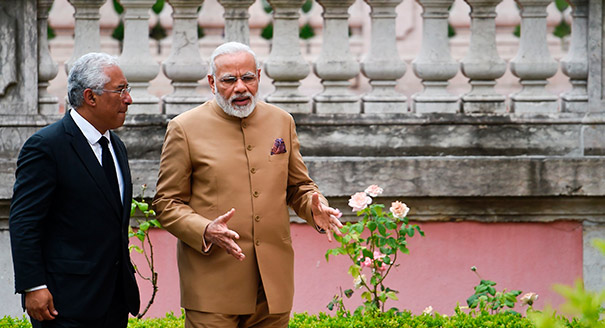
Modi’s visit to the city where the first era of globalization began, five centuries ago, symbolically reflects India’s efforts to push forward, seeking to reclaim spaces it has been absent from for too long.
Source: Indian Express
When Narendra Modi lands in Lisbon for the first-ever bilateral visit of an Indian Prime Minister to Portugal, he will symbolically mark the beginning of a new era in Indo-Portuguese relations. Back in 1961, when he was 11 years old, the formidable little island of Diu — less than 500 km away from his native Vadnagar — which had remained in Portuguese possession since 1535, was annexed by the Indian military. Over the preceding centuries, it had served as a powerful reminder of the long history and global openness that connects both countries.
As they left Lisbon’s Belem dock in search of a new sea route to India in the 15th century, eventually crossing the Cape of Good Hope, Portuguese sailors unleashed the first wave of globalisation with an unprecedented flow of goods, people and ideas.
Lisbon’s formula was its determination to explore the unknown, turn its peripheral location on the Atlantic into an advantage, and transform its scientific and technological innovation into superior navigational, administrative and military skills towards the creation of a colonial empire.
Certainly, today’s India seeks to play the role of a leading power, stretch the frontiers of innovation and explore new domains – but without the rapacious element that came with empire. The tables of history have, therefore, turned. While Vasco da Gama engaged India with trinkets and cannons, Modi brings a confident India to Portugal, ready to strike collaborative deals and explore comparative advantages. This explains the visit’s expected focus on science and technology, with emphasis on collaborative research to foster innovation in the nano-technologies, space and ocean domains.
Besides reciprocating January’s weeklong visit by Portuguese Prime Minister Antonio Costa, the convenience of a stopover on the way to Washington, or the bromance both leaders established in Delhi over a Cristiano Ronaldo jersey, Modi’s Lisbon detour is also driven by three strategic factors. These reflect a confident India, focused on reaching new shores by engaging Europe, balancing China, and leveraging the diaspora.
First, the visit comes in the context of Modi’s European outreach effort, especially in order to balance Beijing’s formidable Western offensive. As one of Beijing’s few strategic partners on the Atlantic, Portugal hosts one of the highest levels of Chinese per capita investments in energy, telecommunication and infrastructure sectors. During the recent Belt and Road summit, Beijing reportedly identified Portugal, together with Hungary and Greece, as one of the most vulnerable to its pressures to opt out of a joint EU statement. While much emphasis has been put on China’s inroads into Eastern and Central Europe through the 16+1 mechanism, Beijing is now also seeking to establish a similar framework for the Mediterranean to link its continental connectivity plans to the Atlantic and Africa.
Modi’s visit to Portugal marks a symbolic response to China, as President Xi Jinping has yet failed to make an appearance in Lisbon. It also seeks greater Indo-European engagement in Africa, in cooperation with “like-minded” states, whether the US, the European Union, Japan or Brazil. Akin to the Indo-Pacific space taking shape towards the East, the Portugal connection could be laying the ground for a complementary Indo-Atlantic space that reflects India’s reorientation towards West.
Second, as New Delhi seeks to expand its presence in Africa and Latin America, it could also seek to leverage Lisbon’s influence and expertise in those regions, particularly in its former colonies. The Portuguese-speaking world includes nine states on four continents, including Brazil, Mozambique and Timor-Leste. This “lusophone” sphere offers significant scope for trilateral alignments, whether in terms of joint investments, development assistance, or security cooperation, and fits with New Delhi’s emphasis on inclusive partnerships with small states and middle powers in niche sectors.
For example, in contrast with China’s preferred bilateral approach to the Portuguese-speaking countries, through its Macau Forum, New Delhi is instead considering to join the CPLP, the community of Portuguese-speaking nations, as an associate member.
Finally, having made the diaspora one of his key foreign policy priorities, Modi will find fertile ground in Portugal, where one of Europe’s largest communities of Indian origin has taken much pride in seeing Costa elected as the West’s first leader of Indian-origin Minister. While the Portuguese Premier had never evoked his subcontinental heritage before reaching the top, last January Modi astutely played the diaspora card to welcome him as a prodigal son back to the motherland. The fact that Costa decided to play along by flaunting his PIO card at the Pravasi Bharatiya Divas further attests to the strategic nature of India’s new diaspora policy, seeking to leverage its historical connections and overseas communities as an asset to build bridges and increase influence abroad.
Modi’s visit to the city where the first era of globalisation began, five centuries ago, symbolically reflects India’s efforts to push forward, seeking to reclaim spaces it has been absent from for too long. It now remains to be seen whether he will be able to follow up the love he is taking to Lisbon with deliverables.
This article was originally published in the Indian Express.
Former Fellow, Carnegie India
Constantino Xavier was a fellow at Carnegie India, based in New Delhi. His research focus is on India’s foreign policy, with emphasis on relations with its neighboring countries and South Asian regional security.
Recent Work
Constantino Xavier
Constantino Xavier
Carnegie does not take institutional positions on public policy issues; the views represented herein are those of the author(s) and do not necessarily reflect the views of Carnegie, its staff, or its trustees.

It should address the shortcomings of previous crisis communication efforts and adapt to the demands of frontier AI.

Lucy Luo
Washington’s decision to support some UN functions while letting others wither is pulling the organization apart at the seams.

Stewart Patrick, Theodore Zaritsky

Are Germany’s economic, industrial, and political struggles becoming a liability for the EU’s ability to rise to the geopolitical moment?

Rym Momtaz, ed.

China’s police training infrastructure construction projects provide benefits to recipient countries, promote China’s image as a major global security provider, and are likely to reinforce alignment between Beijing’s security priorities and those of countries in the Global South.


Cameron Waltz, Sheena Chestnut Greitens, Kim Nguyen, …

The Bureau of Industry and Security needs to adjust its focus and practices to maintain its position as the U.S. government’s primary champion of international technological competition.

Geoffrey Irving