

Q&A
Matt Ferchen
{
  "authors": [
    "Matt Ferchen"
  ],
  "type": "legacyinthemedia",
  "centerAffiliationAll": "",
  "centers": [
    "Carnegie Endowment for International Peace",
    "Carnegie China"
  ],
  "collections": [
    "Belt and Road Initiative"
  ],
  "englishNewsletterAll": "",
  "nonEnglishNewsletterAll": "",
  "primaryCenter": "Carnegie China",
  "programAffiliation": "",
  "programs": [],
  "projects": [],
  "regions": [
    "East Asia",
    "China"
  ],
  "topics": [
    "Economy",
    "Global Governance"
  ]
}
Source: Getty
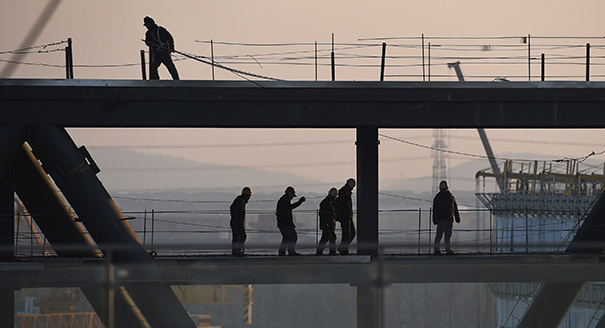
As the Belt and Road Initiative moves forward, countries and local communities more directly in the initiative’s path could learn from Latin American countries’ labor practices.
Source: ChinaFile
ChinaFile: China’s Belt and Road Initiative is a $1 trillion plan to deepen economic relations between itself and up to 60 other countries worldwide through large investments in infrastructure, construction, and other projects. Many commentators have considered the significance of the Belt and Road from a political, economic, or even environmental perspective. This discussion, conceived and led by Aaron Halegua, considers a largely neglected topic: What are the initiative’s implications for labor in China and the target countries? To what extent do China’s investments create jobs for local workers versus Chinese workers? Are the projects positively impacting labor conditions in participating countries or driving down labor standards? Does it matter whether the Chinese investor is state owned? And how do the answers to these questions vary across jurisdictions?
Matt Ferchen: To date, trade has played a much larger role than investment in China-Latin America commercial relations, and simply due to geography, Latin America remains largely tangential to the Belt and Road. Nonetheless, going forward more Chinese investment projects in the Americas are likely to be placed under the Belt and Road umbrella.
One sector in South America that has seen significant Chinese investment is mining, particularly in Peru and Ecuador. In those countries, the labor impact of these projects has varied. In a longstanding negative example, labor conditions at the Shougang-Hierro Peru iron mine in Peru gave rise to local protests as far back as the 1990s, when I first did research on the project. Labor tensions existed almost from day one of Shougang’s management of Hierro Peru, largely due to underinvestment, including in worker safety, but also because the Fujimori government of the day threatened to replace Peruvian with Chinese workers. Tensions with the union have continued to linger, most recently because of the company’s use of temporary contract workers.
Yet other Chinese mining investments in Peru, for example by Chinalco (China Aluminum Corporation), have a much more positive track record regarding labor relations and environmental impact. Perhaps learning from Shougang’s negative example, Chinalco did not bring in Chinese workers and guaranteed local employees both quality housing and a minimum compensation level.
It is notable that these labor-related concerns are almost entirely focused on local workers, not Chinese labor. A key reason for this is because a number of China’s main commercial partners in South America have strict laws, sometimes including constitutional restrictions, against importing foreign labor. So, for example, even though China is the top importer of Chile’s main export, copper, Chinese direct investment in that sector has been negligible and the number of Chinese laborers in Chile therefore minimal. The same phenomenon exists in other countries, such as Colombia, with strong legal and regulatory systems, including governing the contract bidding process. If in neighboring Venezuela Chinese loans and investments have been largely obscured from public oversight, in Colombia Chinese investments have been much more open to public and media scrutiny, with the result that many extractive industry deals have been scuppered.
The primary exception to this trend is the Caribbean, where host countries (like many in Africa) are much more likely to be offered, and to accept, a package involving Chinese finance, materials, and labor. In the contentious Baha Mar casino deal in the Bahamas, a country with double-digit unemployment, the China Export-Import Bank provided $2.4 billion in financing to a state-owned construction firm that brought in 4,100 Chinese workers—some of whom later staged protests in a dispute over their wages.
So despite its geographic distance from China, and the tenuous connection to the Belt and Road, the experience of Latin America may offer some important lessons. It may sometimes be best for the host country to just say no to projects that do not fit local legal, economic, or social conditions. For approved projects, it’s of paramount importance that host governments and communities monitor and regulate the practices of foreign firms, Chinese or otherwise, including their labor practices. As the Belt and Road goes forward, other countries and local communities more directly in the initiative’s pathway could do worse than learning from some of their Latin American counterparts in this regard.

Former Nonresident Scholar, Carnegie-Tsinghua Center for Global Policy
Ferchen specializes in China’s political-economic relations with emerging economies. At the Carnegie–Tsinghua Center for Global Policy, he ran a program on China’s economic and political relations with the developing world, including Latin America.
Recent Work
Matt Ferchen
Matt Ferchen, Anarkalee Perera
Carnegie does not take institutional positions on public policy issues; the views represented herein are those of the author(s) and do not necessarily reflect the views of Carnegie, its staff, or its trustees.
Tehran’s attacks are reshaping the security situation in the Middle East—and forcing the region’s clock to tick backward once again.

Amr Hamzawy

Only collective security can protect fragile economic models.

Andrew Leber
In a volatile Middle East, the Omani port of Duqm offers stability, neutrality, and opportunity. Could this hidden port become the ultimate safe harbor for global trade?
Giorgio Cafiero, Samuel Ramani

South Korea’s rapid demographic transition previews governance challenges many advanced and middle-income economies will face. This paper argues that aging is not only a care issue but a structural governance challenge—reshaping welfare, productivity, and fiscal sustainability, and reorganizing responsibilities across the state, private sector, and society.

Darcie Draudt-Véjares
Arguing that Chinese policy is hung on alliances—with imputations of obligation—misses the point.

Evan A. Feigenbaum