

Article
C. Raja Mohan, Darshana M. Baruah
{
  "authors": [
    "C. Raja Mohan"
  ],
  "type": "legacyinthemedia",
  "centerAffiliationAll": "dc",
  "centers": [
    "Carnegie Endowment for International Peace",
    "Carnegie India"
  ],
  "collections": [],
  "englishNewsletterAll": "ctw",
  "nonEnglishNewsletterAll": "",
  "primaryCenter": "Carnegie India",
  "programAffiliation": "SAP",
  "programs": [
    "South Asia"
  ],
  "projects": [],
  "regions": [
    "Asia",
    "South Asia",
    "India",
    "East Asia",
    "China"
  ],
  "topics": [
    "Foreign Policy"
  ]
}
Source: Getty
India might be quite open to a substantive dialogue with China on the Belt and Road Initiative if Xi is prepared to address New Delhi’s concerns on sovereignty and sustainability.
Source: Indian Express
At the annual Boao forum in Hainan this week, Chinese leader Xi Jinping is expected to present himself as the new champion of globalisation and castigate the unilateral economic actions of US President Donald Trump. While demonstrating his readiness to confront Trump measure for measure on trade, Xi is likely to signal some flexibility on key issues raised by the US. These include concerns over-restrictive approaches to trade and investment, limited market access, and theft of intellectual property. The most likely message from Boao is that Xi is ready either for a deal on his own terms or escalation.
Earlier this year, Premier Li Keqiang had promised that China will open its door wider to foreign investment as part of Beijing’s new phase in economic liberalisation. In 1978, Deng Xiaoping had launched China on the path of reform and opening up that turned it into an economic and political superpower. At Boao, Xi has an opportunity to make good on that promise. Xi is also expected to showcase his signature political move launched five years ago, the Belt and Road Initiative, as a great contribution to global public goods.
Concerned about a trade war between China and America, most leading world capitals will play close attention to what Xi has to offer in Boao. India is no exception. Delhi, however, will be more on the side of sceptics when it comes to Beijing’s claims for global economic leadership. Not without reason.
For one, Delhi has struggled hard to cope with the massive trade deficit in favour of Beijing. Currently, at nearly $52 billion, it accounted for nearly 45 per cent of India’s total trade deficit last year. Despite Delhi’s repeated efforts to seek Chinese cooperation in reducing the trade deficit, it has run into a wall in Beijing. At least until now. For another, Delhi has been deeply troubled by Xi’s Belt and Road Initiative. Last May, Delhi refused to attend Xi’s Belt and Road Forum, despite considerable persuasion from Beijing. India argued that that the China-Pakistan Economic Corridor (CPEC), the flagship project of the BRI, violates India’s sovereignty in Kashmir. It added that the BRI projects are pushing recipient countries into indebtedness, do not transfer skills or technology and are environmentally unsustainable.
Last week, Delhi rejected reports that its position on the BRI has changed and reiterated the criticisms articulated last year. Meanwhile, Chinese projects are likely to continue in India’s neighbourhood. Reports this week from Beijing say China is planning to extend the CPEC to Afghanistan. Meanwhile, Maldives, Nepal, Myanmar and Sri Lanka are eagerly pursuing potential BRI projects.
On its part, Delhi is stepping up its effort to promote connectivity with the neighbours. Recent Indian advances include the Chabahar port project in Iran and the agreement last week on building a rail link to Kathmandu. India is also in discussion with Japan and the US to pool resources and coordinate approaches to sustainable infrastructure development in the Indo-Pacific. Yet, both Delhi and Beijing have an incentive to reduce their differences on the BRI and find ways to work together on at least a limited agenda of connectivity. On its part, Delhi has said it is open to consultations with China on the development of regional trans-border infrastructure. Beijing, in turn, has apparently floated a number of new proposals for Delhi’s consideration.
These include extension of the CPEC to India, promoting connectivity across the Himalayas in J&K, Nepal, Sikkim and other places. If it has the will, China should not find it too hard to address India’s concerns on sovereignty on Kashmir. Beijing can easily return, publicly, to its formulations in the early 1960s on the disputed nature of the state between Delhi and Islamabad, agree to deal with the two parts of Kashmir on the same legal basis, and join India developmental projects in Kashmir and across the Great Himalayas.
India’s broader concerns on the BRI could also be amenable to resolution if Delhi and Beijing move from the abstract discussion of the BRI as a single grand initiative, to specific connectivity projects. In any such negotiation, all dimensions of the project — from fiscal to environmental — would be jointly finalised by Delhi and Beijing.
As both Delhi and Beijing push for mega trans-border connectivity around the Subcontinent, the viability of the projects would significantly improve if there is cooperation between India and China. Consider the fact that financing for China’s hydroelectric projects in Nepal would be lot easier if the power plants are linked to North Indian markets. Similarly, the proposed Indian and Chinese rail lines in Nepal would be more efficient if they are part of sensible trade and transit agreements between Delhi, Kathmandu and Beijing.
The Subcontinent’s geography and the size of India’s market make it plain that many BRI projects will be hugely successful if India is part of them. Persistent competition and conflict between India and China on regional connectivity would make many projects of both countries less efficient. Political distrust between Delhi and Beijing, which has sharpened in the last two years, would seem to make a reconciliation on the BRI near impossible.
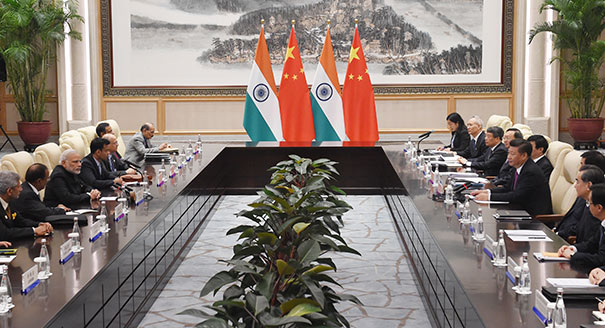
But quite clearly, there are ways around the impasse. Xi might be eager to cut a deal with Trump on trade issues. But it is not clear if he is ready for a deal with Prime Minister Narendra Modi. The NDA government might be quite open to a substantive dialogue with China on BRI if Xi is prepared to address Delhi’s concerns on sovereignty and sustainability.
This article was originally published in the Indian Express.
Former Nonresident Senior Fellow, Carnegie India
A leading analyst of India’s foreign policy, Mohan is also an expert on South Asian security, great-power relations in Asia, and arms control.
Recent Work

C. Raja Mohan, Darshana M. Baruah


Alexander Gabuev, Paul Haenle, C. Raja Mohan, …
Carnegie does not take institutional positions on public policy issues; the views represented herein are those of the author(s) and do not necessarily reflect the views of Carnegie, its staff, or its trustees.

It should address the shortcomings of previous crisis communication efforts and adapt to the demands of frontier AI.

Lucy Luo

Washington’s decision to support some UN functions while letting others wither is pulling the organization apart at the seams.

Stewart Patrick, Theodore Zaritsky

Are Germany’s economic, industrial, and political struggles becoming a liability for the EU’s ability to rise to the geopolitical moment?

Rym Momtaz, ed.

China’s police training infrastructure construction projects provide benefits to recipient countries, promote China’s image as a major global security provider, and are likely to reinforce alignment between Beijing’s security priorities and those of countries in the Global South.


Cameron Waltz, Sheena Chestnut Greitens, Kim Nguyen, …
AI capabilities are moving fast. Most institutions—including governments—can’t keep up.


Anton Leicht, Scott Singer