

Commentary
Trump has promised Belarus a massive potash deal. But Minsk is seeking something greater: restored Western transit and greater room for maneuver from Russia.
Balázs Jarábik
{
  "authors": [
    "Frances Z. Brown",
    "Mara Karlin"
  ],
  "type": "legacyinthemedia",
  "centerAffiliationAll": "dc",
  "centers": [
    "Carnegie Endowment for International Peace",
    "Malcolm H. Kerr Carnegie Middle East Center"
  ],
  "collections": [
    "Violence and Conflict"
  ],
  "englishNewsletterAll": "democracy",
  "nonEnglishNewsletterAll": "",
  "primaryCenter": "Carnegie Endowment for International Peace",
  "programAffiliation": "DCG",
  "programs": [
    "Democracy, Conflict, and Governance"
  ],
  "projects": [],
  "regions": [
    "North America",
    "United States",
    "Middle East",
    "Türkiye",
    "Iraq",
    "Lebanon",
    "Syria",
    "Levant"
  ],
  "topics": [
    "Political Reform",
    "Democracy"
  ]
}
Source: Getty
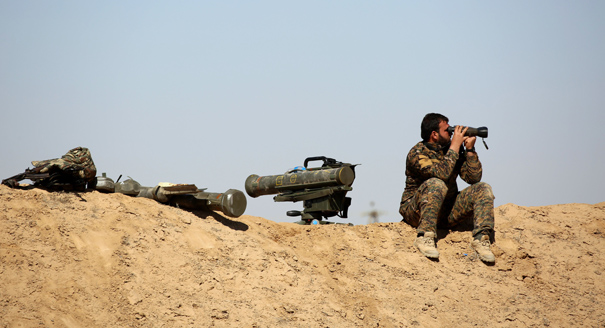
The Trump administration appears committed to working "by-with-through" local partners in the Middle East. Doing so effectively requires a clear political strategy and continued diplomatic engagement in the region.
Source: Foreign Affairs
What does an “America first” national security strategy look like in action? The White House provided a hint in April, when news broke that National Security Adviser John Bolton had asked Arab nations, including Egypt and possibly Saudi Arabia, to supply ground forces to replace U.S. troops in Syria. (This came only weeks after U.S. President Donald Trump announced his desire to “bring our troops back home.”) Although details are scarce, Bolton’s new initiative appears to mirror a broader talking point coming from the Trump administration: rather than putting American lives at risk, the United States will work “by, with, and through” local forces to achieve its national security objectives.
Champions of the by-with-through model argue that it is a better (and cheaper) means of fighting wars and winning the peace than sending U.S. troops into harm’s way. Testifying before Congress in March, General Joseph Votel of U.S. Central Command explained that “working ‘by, with, and through’ our allies and partners allows us to multiply the effect of relatively modest commitments,” ensuring that the Middle East “never again requires a mass deployment of U.S. forces.” For Trump, this sounds like the ultimate deal: working with local partners will enable the United States to get more of its desired security outcomes for less of its blood and treasure.
Working with local partners is not a new model: the administrations of George W. Bush and Barack Obama both relied heavily on local partners to fight the “war on terror,” whether through major efforts to develop national armies and police forces in Iraq and Afghanistan or through more limited partnerships across Africa, Asia, and the Middle East. Today, however, it has assumed a new centrality as Trump seeks to wind down U.S. military commitments abroad. Votel has said that the by-with-through model now underpins U.S. campaigns in Afghanistan, Egypt, Iraq, Lebanon, Syria, and Yemen. Defense Secretary James Mattis cited it on a recent visit to U.S. military allies in the Pacific. General Raymond Thomas, commander of U.S. Special Operations Command, testified to Congress that “by, with, and through” is the “primary approach” to achieving his command’s objectives. And General Thomas Waldhauser, commander of U.S. Africa Command, cites it as a central tenet of U.S. operations on the continent.

Vice President for Studies
Dr. Frances Z. Brown is a vice president for studies at the Carnegie Endowment for International Peace. Brown served on the White House National Security Council (NSC) staff over the past three presidential administrations. Her research focuses on U.S. foreign policy, Africa, the Middle East, and governance.
Mara Karlin
Brookings Institution
Carnegie does not take institutional positions on public policy issues; the views represented herein are those of the author(s) and do not necessarily reflect the views of Carnegie, its staff, or its trustees.

Trump has promised Belarus a massive potash deal. But Minsk is seeking something greater: restored Western transit and greater room for maneuver from Russia.

Balázs Jarábik

Before the next wave of EU enlargement takes place, the union needs to grapple with thorny questions of how power is distributed among its members.


Emil Sondaj Hansen, Ditte Brasso Sørensen

The real test may come after the leaders leave the room.



Sheena Chestnut Greitens, Oriana Skylar Mastro, Yukon Huang, …

The Horn of Africa countries are among those facing a new security calculus.


Andrew Leber, Lesley Anne Warner

The European far right might fail to steer EU policy in the direction Russia wants, but they will create enough chaos inside Europe to benefit the Kremlin.

Dimitar Bechev