

Paper
Erik Brattberg, Tomáš Valášek
{
  "authors": [
    "Tomáš Valášek"
  ],
  "type": "legacyinthemedia",
  "centerAffiliationAll": "dc",
  "centers": [
    "Carnegie Endowment for International Peace",
    "Carnegie Europe"
  ],
  "collections": [
    "Transatlantic Cooperation",
    "European Defense in a New Transatlantic Context"
  ],
  "englishNewsletterAll": "ctw",
  "nonEnglishNewsletterAll": "",
  "primaryCenter": "Carnegie Europe",
  "programAffiliation": "EP",
  "programs": [
    "Europe"
  ],
  "projects": [],
  "regions": [
    "Russia",
    "Europe",
    "North America",
    "United States",
    "Western Europe",
    "Iran"
  ],
  "topics": [
    "Security",
    "Foreign Policy"
  ]
}
Source: Getty
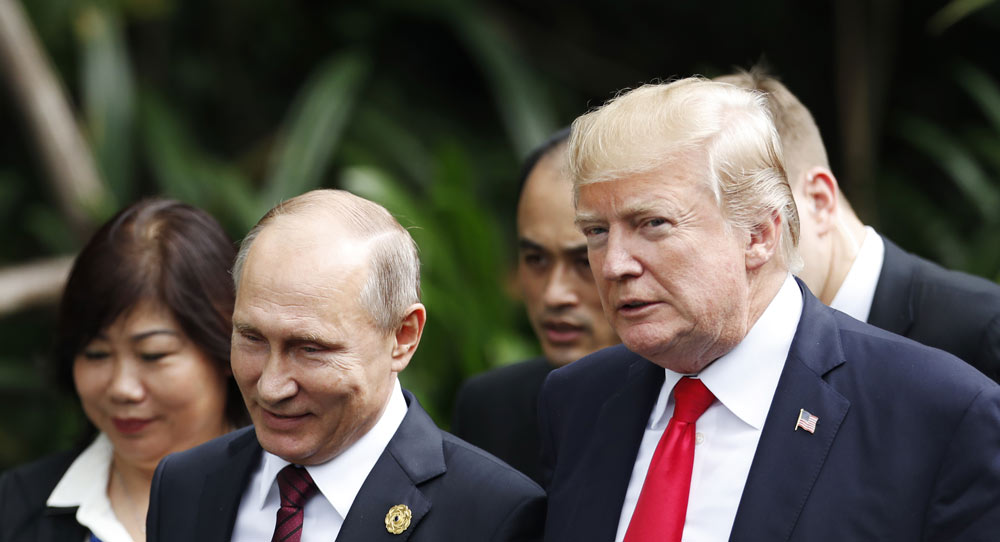
U.S. President Donald Trump may undo any progress NATO leaders achieve at the 2018 NATO summit when he meets with Russian President Vladimir Putin in Helsinki.
Source: Politico Europe
Spare a thought for NATO officials and diplomats. They have spent the last six months preparing a summit that could be rendered irrelevant in a matter of days. It’s not that the meeting — focused on new measures to reinforce Europe in a crisis — is unimportant. The fear is that U.S. President Donald Trump will undo any progress NATO leaders achieve in Brussels this week when he meets with Russian President Vladimir Putin just four days later.
So far, the defense-centered core of the Western alliance has proven strikingly sturdy, even as U.S.-European collaboration has collapsed on other issues, such as climate change, trade and Iran. The Trump administration pleasantly surprised many across the Atlantic by nearly doubling the Obama-era program to fund U.S. military presence in Europe. Almost 1,000 Americans in uniform are now deployed in Poland. By most accounts, the alliance’s ability to discourage Moscow from testing NATO’s resolve has never been better.But not all is well. For the past decade, U.S. officials have been warning the Europeans to start spending more on their own defense. The U.S. now spends $3 for each $1 that the remaining 28 European members plus Canada spend together. This prompted the former American secretary of defense, Robert Gates, to warn back in 2011 that when Congress wakes up to that reality, NATO will face a “dim if not dismal future.”
This crisis, however, was on its way to a resolution of sorts in recent years. Europe is now the region with the fastest growing real-term defense spending, according to the International Institute for Strategic Studies in London. The countries of Central and Northern Europe in particular were spooked by Russia’s aggression into raising budgets as much as 40 percent year-on-year. Not all allies will be spending 2 percent of their GDP on defense, as agreed in 2014, but then again all governments have a habit of making promises they do not intend to keep. This one has actually proven more consequential than other such “commitments” made in the past — most notably on development aid and climate change.
Of course, none of this is guaranteed to make a difference to the White House. Trump brings two new uncertainties into NATO politics. He doesn’t appear to share Europe’s sense of urgency on keeping Russia in check through a significant allied military presence. And even if he did, it’s unlikely that he would consider it to be America’s problem.
The president has said on a number of occasions that he considers all alliances a burden on the United States — it’s a position he’s held unaltered for decades. That raises the possibility that the debate on defense spending is a red herring. In the end, it may not matter whether the allies carry their weight in NATO or not. That would put Europe in somewhat of a lose-lose situation.
The Polish government, probably suspecting as much, has floated an interesting proposal: In addition to spending 2 percent on defense, which it already does, it has offered to pay as much as $2 billion to cover the cost of stationing U.S. forces there. In effect, they have turned the tables on the U.S. president, taking the thorny issue of money out of the equation and testing Trump’s commitment to European stability itself.
The Polish proposal, and all NATO policies, assume that the U.S. president considers military presence of any kind, whether American or not, as a key to maintaining peace in Europe. The summit with Putin will test that theory, and it may very well turn out that he does not.
Trump will want to strike a deal of some kind when he meets Putin in Finland next week. It is safe to assume that’s the whole point of the meeting — to show the U.S. president breaking through where others have tried and failed. European capitals are understandably worried about the possibility of the U.S. reducing military activities — and possibly troop numbers — in Europe, in a move similar to what Trump did on the Korean peninsula following his summit with Kim Jong Un.
If so, we enter uncharted territory. Such a move would reduce the fear in Russia — whether irrational or not — that NATO is planning an offensive. But its positive effects would be limited. European countries would continue their military exercises because they remain concerned, for good reason, about Russia’s expansionist agenda and do not want to be caught unprepared. NATO’s eastern border will remain tense. Without the backstop of U.S. firepower, it would likely become a more dangerous place, as Russia would be emboldened by its heightened odds of prevailing in a conflict, and thus less likely to exercise restraint.
Indications are that the Trump-Putin deal will focus on nuclear arms control, noninterference in elections and the Middle East — not NATO. But the Donald Trump of 2018 is not the Donald Trump of 2017: He is even less constrained by what the establishment thinks and far more willing to shake up the status quo, consequences be damned. We should not assume the status quo will carry on indefinitely. Given Trump’s views on NATO, and the back-to-back opportunities this week and next to make good on them, the hard-working NATO folks are right to worry.
Former Director, Carnegie Europe
Valášek was director of Carnegie Europe and a senior fellow, where his research focused on security and defense, transatlantic relations, and Europe’s Eastern neighborhood.
Recent Work
Erik Brattberg, Tomáš Valášek
Tomáš Valášek
Carnegie does not take institutional positions on public policy issues; the views represented herein are those of the author(s) and do not necessarily reflect the views of Carnegie, its staff, or its trustees.

It should address the shortcomings of previous crisis communication efforts and adapt to the demands of frontier AI.

Lucy Luo

If the Russian-speaking community in Latvia cannot articulate their interests without being seen as disloyal, they could end up embracing a pro-Kremlin agenda.

Sergejs Potapkins

Washington’s decision to support some UN functions while letting others wither is pulling the organization apart at the seams.

Stewart Patrick, Theodore Zaritsky

While there are notable demographic, economic, and geographic divides over AI, there is also substantial alignment between Republicans and Democrats.



Ian Klaus, Mark Baldassare, Rachel George, …

Are Germany’s economic, industrial, and political struggles becoming a liability for the EU’s ability to rise to the geopolitical moment?

Rym Momtaz, ed.