

Commentary
Rubio’s recent visit brought welcome attention, but more capital requires governance changes that may be a hard sell for regional governments.
Jennifer B. Murtazashvili
{
  "authors": [
    "Olga Romanova"
  ],
  "type": "commentary",
  "centerAffiliationAll": "",
  "centers": [
    "Carnegie Endowment for International Peace",
    "Carnegie Russia Eurasia Center"
  ],
  "collections": [
    "Inside Russia"
  ],
  "englishNewsletterAll": "",
  "nonEnglishNewsletterAll": "",
  "primaryCenter": "Carnegie Russia Eurasia Center",
  "programAffiliation": "",
  "programs": [],
  "projects": [],
  "regions": [],
  "topics": [
    "Economy"
  ]
}
Source: Getty
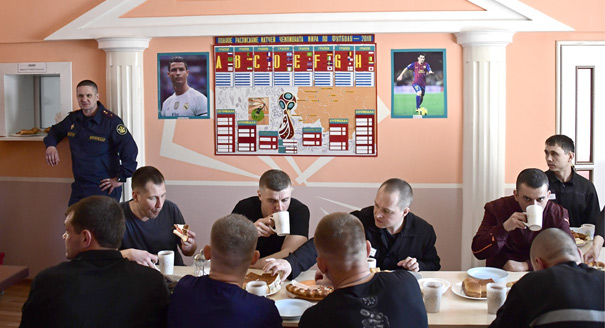
In Russia’s prisons, elite inmates obtain special conditions both through monetary payments and rendering services—guaranteeing order, cutting deals with the administration, and even paying for improvements in the facilities. For its part, the Russian prison system is more concerned with keeping this corruption out of the public eye than actually preventing it.
No one knows who first came up with the idea of immersing a person in filth, cold, hunger, and humiliation to transform him into a responsible citizen and a peaceful member of society. But that is the Russian approach to prison.
An ordinary person—whether truly guilty or not—is transported to hell, away from normal living conditions. Now he can never be alone. The light is never off. Communication with loved ones is interrupted. The person is endlessly humiliated.
The prison inmate finds himself in an extremely closed community, where he loses his individuality and, at best, gains one functional characteristic: “an activist,” “a crime lord,” “an outcast,” or “a cash cow”—an individual used as a reliable source of shadow financing.
However, while everyone is simply trying to survive in this dehumanizing hell, some inmates can cut deals for bearable living conditions, special treatment, and even VIP services. Naturally, money plays an important role here, but it isn’t everything. Underworld ties, economics, and politics are also key. But who can make these deals?
Generally, it’s serious people negotiating about serious things. A respected crime boss, supported by negotiators from the outside, can make practically any deal with the prison warden. He can build a detached cottage with a vegetable garden in a secluded section of the penal colony and live there. He can also have a gardener, a cook, and house aides—services rendered by other inmates. That’s exactly what I saw at Talitsy prison in Russia’s Ivanovo region.
He can also buy a certificate of disability to relax in the medical unit. Or he can move into a separate room for extended visits and receive prostitutes there, which is also quite common.
In the most intense negotiations, both sides can showcase their abilities. For instance, the prison warden can place one of the “inside” negotiators in punitive confinement. And the negotiator can then have the punishment unit burnt to the ground. Thus, apart from money, one needs convincing “arguments” to secure special status. The warden demonstrates how he can make the crime boss’s life difficult, while the crime boss shows how he will react.
An inmate can also obtain special treatment by providing special services. The warden doesn’t want prisoners filing complaints, writing to the Prosecutor’s Office, or doing anything that would cause inspectors to drop by. He can guarantee peace and quiet by making a deal with prison gang leaders who command authority in the underworld. They will then oversee the inner workings of the prison and ensure that no one writes a grievance letter—or else!
Of course, the prison administration will need to reciprocate by providing inmate leaders with uninterrupted access to mobile communications, drugs, alcohol, and card games. If they want black caviar, crabs, and girls, the only thing they will need to do is pay for them. As long as the partnership is reliable and effective, it will work.
In a recent corruption and extortion case at one large pretrial detention facility, a member of a well-known criminal group extorted money, apartments, and assets from other inmates. The detention facility employees took part in the scheme by making the inmates’ lives unbearable. The extortionist, in turn, provided a service to the employees: he maintained order and prohibited drug trafficking. He also dealt with those who complained. In exchange, he was allowed to continue his extortion and could live comfortably while remaining in detention.
Once they land in prison, wealthy inmates with no connections in the underworld are well aware of their situation. In most cases, they have already gone through pretrial detention, where the prosecution often secretly requests the detainee be kept in unbearable conditions. The goal is to extract relevant testimony in exchange for better living arrangements.
Sometimes, the detention facility administration independently imposes pressure to get the inmates to negotiate for better conditions through their lawyers. A good four-person cell in a Moscow detention facility goes for at least a million rubles (around $15,000) a month per detainee.
What does a VIP cell look like? There’s actually nothing special about it. It’s a non-smoking room with a good TV and a fridge, fresh linens, an enclosed washroom, and a chance for frequent walks. Inmates can also order food from the outside (something permitted by detention facility rules but rarely allowed); they can receive parcels with virtually no restrictions; and they have easier access to their lawyers. And, of course, they are allowed cell phones (but that’s the least expensive item on the prohibited service list, so many other inmates have them, too).
After trial, wealthy detainees can also have their lawyers negotiate a (paid) transfer to a good penal colony. The lawyers know that such negotiations are pointless—any prison can offer acceptable living conditions for cash—but they don’t argue with their clients, taking their cut from these deals. Such a transfer costs at least 150,000 rubles (around $2,500). The upper limit depends on the voracious appetites of Federal Penitentiary Service officials.
In pretrial or short-term detention facilities, these agreements are not always honored. After all, the inmate will soon leave for good, and the administration can simply forget about him. But as long as he is in the prison system, he will eternally carry the status of “cash cow.”
Such “cash cows” are generally affluent individuals—often, bankers or entrepreneurs—with connections on the outside, but no status in the criminal world. The pretrial detention center warden transfers the “cash cow” to a prison as a friendly gift to the warden there. Then, he is thrown to the mercy of professional extortionists from among the prison gangs. He is forced to build new barracks, pay for road construction, build cottages for the prison administration, and transfer work orders from his businesses to prison production facilities.
Such “cash cows” have no leverage in the underworld, and cannot stage a prison riot or even an individual protest without facing retribution from the crime bosses. At the same time, Federal Penitentiary Service officials treat them with some care; after all, Moscow lawyers visit them and the prisons don’t want additional trouble.
No matter how much money a “cash cow” has, he is unlikely to secure an early release. He may be promised that, he may even pay for it, but, in the end, someone will derail this plan by writing a negative character reference or issuing a censure. Why would the administration want to lose manufacturing contracts and money for new barracks and repairs?
Of course, there are also cases like that of Defense Ministry official Yevgeniya Vasilyeva, who managed to secure an early release from the prison where she was serving time on corruption charges. But this generally happens when the inmate has access to administrative resources in addition to financial means. Children of high-ranking regional government officials or of business people with connections in the government can enjoy this privilege. For instance, the son of a well-known Ivanovo businessman and regional legislator was sent to a penal colony near the city, but was rarely seen there after being furloughed right upon arrival.
However, money and connections are useless in high-profile cases with political overtones. There will be no special conditions for former Kirov regional governor Nikita Belykh or former economy minister Alexei Ulyukayev, both imprisoned on corruption charges. Nor will they be subject to much abuse. These inmates will be closely watched and visited by attorneys and family members, which protects them from mistreatment behind bars. The same applies to political prisoners who are officially recognized by human rights organizations like Memorial.
While special conditions exist for some wealthy and well-connected inmates, Federal Penitentiary Service officials are highly concerned about confidentiality. Thus, when photos leaked online showing criminal gang member and murderer Vyacheslav Tsepovyaz feasting on caviar and crabs in prison, the Service’s response was telling. It said that supplementary meals are allowed in prison, but it is illegal to photograph and publish this.
The system is more worried about news of corruption getting out than about the corruption itself. That is why the Federal Penitentiary Service is so furiously resisting public oversight. Because while a penitentiary system is supposed to correct flaws in human nature, that isn’t the purpose of Russia’s system. Rather, it is intended to enforce punishments.
Olga Romanova
Carnegie does not take institutional positions on public policy issues; the views represented herein are those of the author(s) and do not necessarily reflect the views of Carnegie, its staff, or its trustees.

Rubio’s recent visit brought welcome attention, but more capital requires governance changes that may be a hard sell for regional governments.

Jennifer B. Murtazashvili

China has showcased its engineering prowess with small modular reactor demonstration projects. But turning these technological achievements into commercial success will be a greater challenge.

Tong Zhao

Despite public disputes over trade and immigration, the strategic partnership’s foundations remain sturdy.

Sameer Lalwani

With its public finances in shambles, the far right polling at 35 percent ahead of the 2027 presidential election, and a growing protest movement, is France’s crisis a threat to the EU’s geopolitical awakening?

Rym Momtaz, ed.

Russian strikes are weakening the economy sustaining Ukraine’s war effort. Closing the growing funding gap will require more European support and politically contentious reforms in Kyiv.

Balázs Jarábik