

Commentary
It should address the shortcomings of previous crisis communication efforts and adapt to the demands of frontier AI.
Lucy Luo
{
  "authors": [
    "Sarah Yerkes",
    "Shannon McKeown"
  ],
  "type": "commentary",
  "centerAffiliationAll": "dc",
  "centers": [
    "Carnegie Endowment for International Peace",
    "Malcolm H. Kerr Carnegie Middle East Center"
  ],
  "collections": [],
  "englishNewsletterAll": "menaTransitions",
  "nonEnglishNewsletterAll": "",
  "primaryCenter": "Carnegie Endowment for International Peace",
  "programAffiliation": "MEP",
  "programs": [
    "Middle East"
  ],
  "projects": [
    "Tunisia Monitor"
  ],
  "regions": [
    "North America",
    "United States",
    "North Africa",
    "Tunisia",
    "Maghreb"
  ],
  "topics": [
    "Political Reform",
    "Democracy"
  ]
}
Source: Getty
There’s an un-American way to make the pink wave permanent.
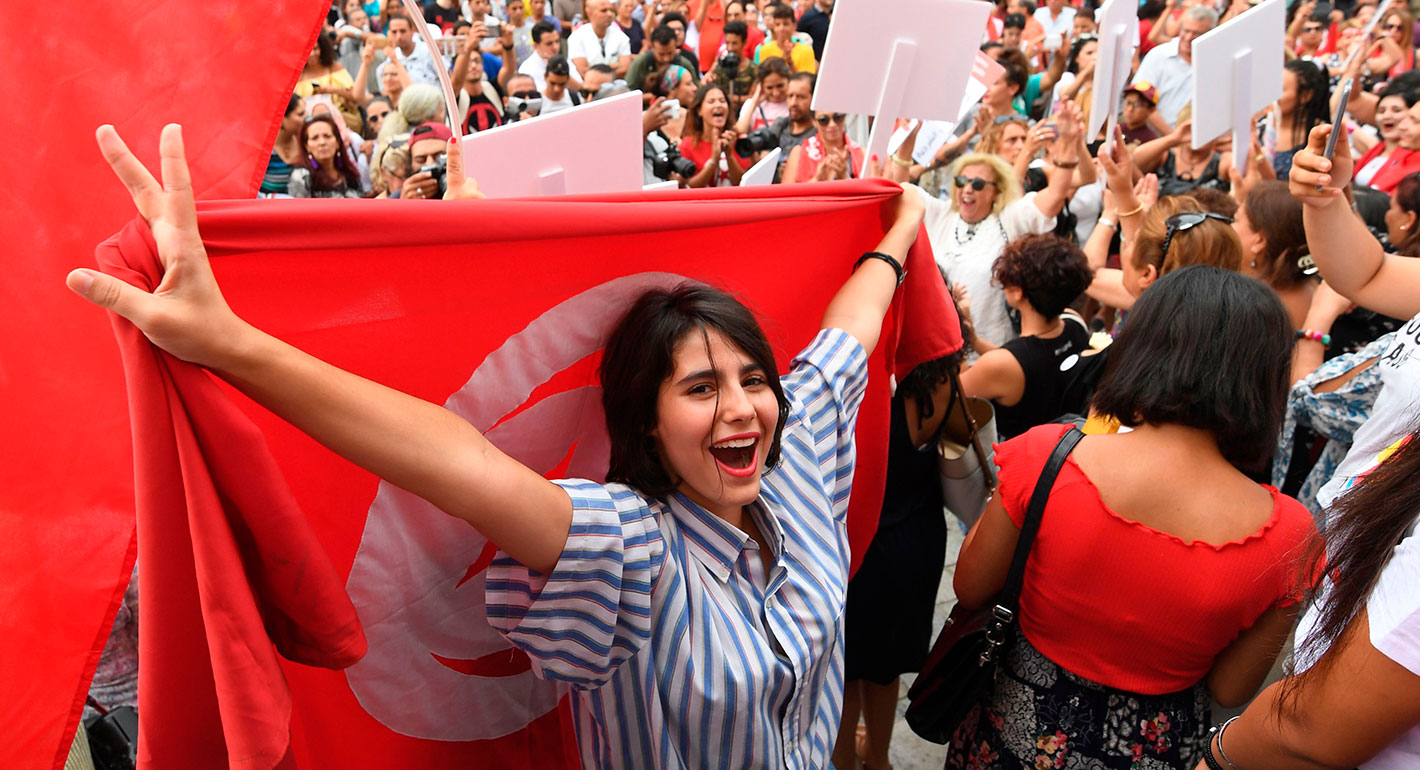
An unprecedented number of women—especially women of color—are headed to the U.S. Congress in January. In what has been called another Year of the Woman, a historic 272 out of 964 candidates for Congress and governorships across the country were women. But even with this wave, women will make up only 21 percent of Congress in 2019 (and hold only about a quarter of the seats in state legislatures). These numbers pale in comparison to the world’s newest democracy, Tunisia, where 36 percent of parliamentarians and nearly half of elected local officials are women.
Why has a country that ratified its first democratic constitution just four years ago elected more women than the world’s oldest democracy? In two words: gender quotas.
Tunisia’s success is due to a combination of top-down and bottom-up measures. Women’s progress in the U.S. midterm elections is due primarily to grassroots efforts by women to push back against the Trump agenda, starting with the Women’s March in January 2017.
Tunisia is famous in the Arab world for its stance on women’s equality. It is home to one of the most progressive gender parity laws in the world. This law requires political parties to alternate the members of their candidate lists between men and women, and to have half of their lists headed by a woman. These measures are a natural progression from the 2014 Tunisian Constitution, which declares that men and women “have equal rights and duties and are equal before the law without any discrimination.”
Gender quotas are effective in part because they force the voters to choose female candidates when they might otherwise not. Gender quotas produce higher numbers of elected women, which, over time, means that the electorate does not see female political participation as anything out of the ordinary. Without quotas, there is a stark difference. In Tunisia’s mayoral races, which lack a gender quota, only one-fifth of seats were won by women this year, compared to nearly half in the municipal elections. This not only gives potential female candidates a larger pool of role models, it should also lead to longer-term shifts in what people think about women holding political office.
This has borne out in Tunisia. According to a 2018 Afrobarometer survey, 67 percent of Tunisians agreed with the statement that “women should have the same chance of being elected to political office as men,” up from 58 percent in 2013. In the United States, where the number of elected women remains low, societal attitudes toward women’s political participation have not kept up with the uptick in female candidates. A June 2018 Pew poll found that only 48 percent of Americans believe there should be an equal number of women and men in elected office.
Quotas are the first step to both providing opportunities for female candidates and getting the public used to the idea of women in office. But they are not enough to fully empower women. Tunisia may have made progress at the ballot box, but its women continue to experience discrimination within the political establishment and pushback from some members of the public. Despite a high number of women in parliament, women hold only three of the twenty-nine cabinet positions. As the first woman elected mayor of Tunis, Souad Abderrahim, recently said, “Changing the masculine mentality of the people is our biggest challenge. The negative reactions to my election are a proof of this.”
Cultural shifts can take generations. So while society catches on, government must step up to support female elected officials and candidates—through media training, access to fundraising networks, and overall capacity building. It is unlikely that the United States will adopt gender quotas anytime soon, as the concept goes against the U.S. national ethos of free will. But Congress could do more to empower its newly elected female members (as well as longtime female incumbents). Political parties can also play an important role in nurturing the next generation of female candidates, and can institute their own internal gender quotas to help boost the number of women who run.
Tunisia’s constitutional protection for women’s equal rights and its forward-thinking electoral laws came about due to a combination of female elected officials and a powerful civil society (labor unions, nongovernmental organizations, etc.) who demanded gender equality. External political pressure from civil society through protest and public outcry forced government officials to pay attention. As a result, Tunisia not only wrote electoral gender quotas into law but also passed a landmark law prohibiting violence against women in 2017. Recently, the cabinet approved a new law that would provide equal inheritance for men and women.
In the United States, groups like She Should Run encourage and support female candidates for elected office. This is a good start. But without the government’s help to guarantee higher levels of female representation, the so-called Year of the Woman will be simply one year in time. It remains to be seen if these elected women are placed into leadership positions by their parties or sidelined. The real test will be whether women can maintain this energized fervor in the coming elections.
Sarah Yerkes is a fellow at the Carnegie Endowment for International Peace, where she runs the Tunisia Monitor project.
Shannon McKeown is an intern with the Tunisia Monitor project at the Carnegie Endowment for International Peace.

Acting Co-Director and Senior Fellow, Middle East Program
Sarah Yerkes is acting co-director and a senior fellow in Carnegie’s Middle East Program, where her research focuses on Tunisia’s political, economic, and security developments as well as state-society relations in the Middle East and North Africa.
Shannon McKeown
Shannon McKeown is an intern with the Tunisia Monitor project at the Carnegie Endowment for International Peace.
Carnegie does not take institutional positions on public policy issues; the views represented herein are those of the author(s) and do not necessarily reflect the views of Carnegie, its staff, or its trustees.

It should address the shortcomings of previous crisis communication efforts and adapt to the demands of frontier AI.

Lucy Luo

If the Russian-speaking community in Latvia cannot articulate their interests without being seen as disloyal, they could end up embracing a pro-Kremlin agenda.

Sergejs Potapkins

Washington’s decision to support some UN functions while letting others wither is pulling the organization apart at the seams.

Stewart Patrick, Theodore Zaritsky

While there are notable demographic, economic, and geographic divides over AI, there is also substantial alignment between Republicans and Democrats.


Ian Klaus, Mark Baldassare, Rachel George, …

Russia’s ruling party would have benefited from Putin appearing as its distant patron, but as an active frontman imposing his views on the public, he has done nothing but harm both the party’s election campaign and the ruling system overall.

Andrey Pertsev