

Article
Zaha Hassan
{
  "authors": [
    "Zaha Hassan"
  ],
  "type": "commentary",
  "centerAffiliationAll": "dc",
  "centers": [
    "Carnegie Endowment for International Peace"
  ],
  "collections": [],
  "englishNewsletterAll": "menaTransitions",
  "nonEnglishNewsletterAll": "",
  "primaryCenter": "Carnegie Endowment for International Peace",
  "programAffiliation": "MEP",
  "programs": [
    "Middle East"
  ],
  "projects": [],
  "regions": [
    "North America",
    "United States",
    "Middle East",
    "Israel",
    "Palestine",
    "Levant"
  ],
  "topics": [
    "Political Reform",
    "Security",
    "Foreign Policy",
    "Global Governance"
  ]
}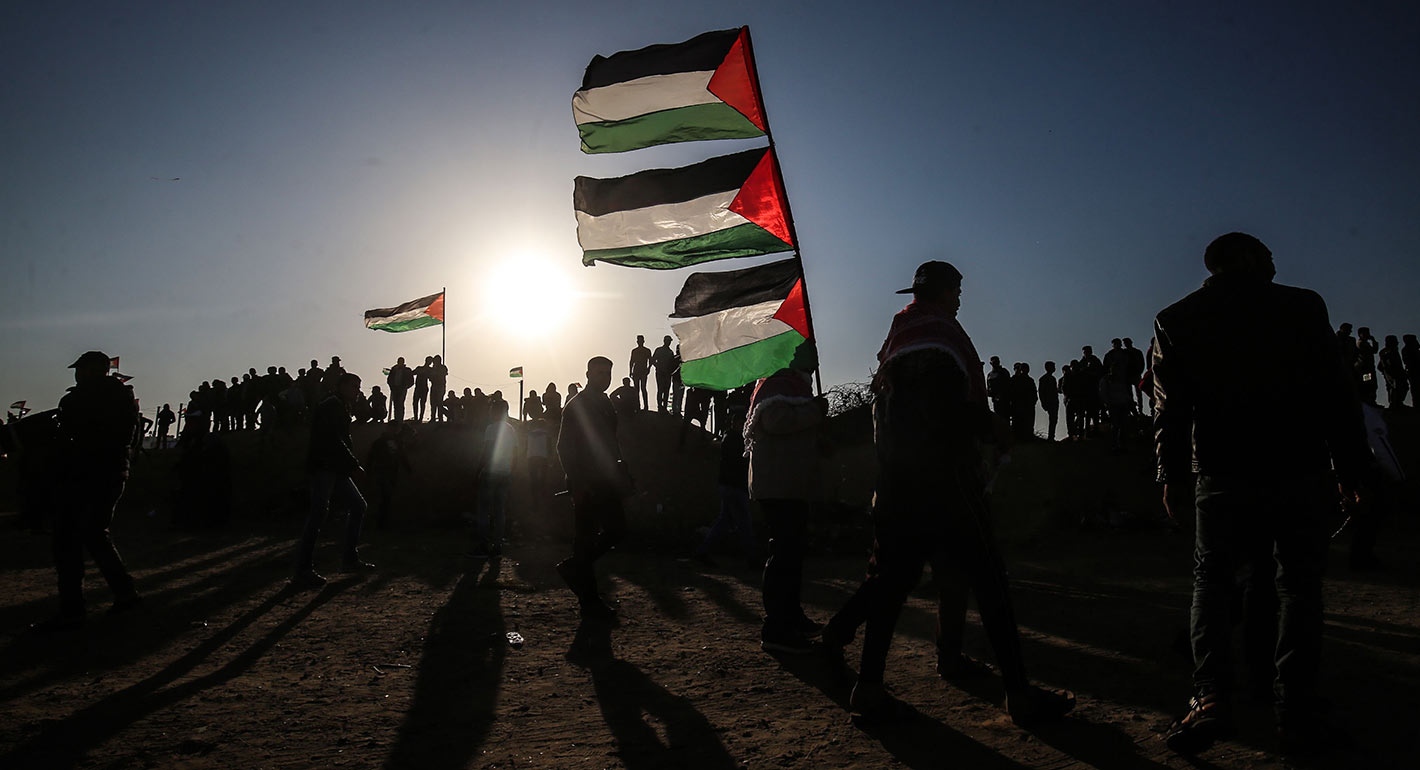
Source: Getty
Far from being an unbiased mediator in the conflict between Israelis and Palestinians, the United States has been part of the problem. Now it is time for other countries to step in.
Israelis have spoken: regardless of what the coalition government looks like following the 2019 Knesset elections, a negotiated two-state solution to the Israeli-Palestinian conflict is over. Forty-two percent of Israelis support at least partial annexation of the West Bank, and almost 70 percent accept that Palestinians will be disenfranchised and confined on isolated patches of land linked only by a segregated road system.
The Trump administration will speak soon, too. The release of a new peace plan is likely to greenlight Israeli actions. Washington’s recent recognition of the occupied Syrian Golan Heights as Israeli sovereign territory—the Trump administration called it a legitimate spoil of war from the same Arab-Israeli conflict that resulted in the Israeli occupation of the Palestinian territories—all but guarantees the United States will accept Israel’s annexation of the West Bank. In doing so, the United States will attempt to remove questions of territory, along with Jerusalem and refugee return, from the list of issues waiting to be resolved by Israelis and Palestinians.
The international community must finally abandon its “wait and see” approach to the Trump administration’s Mideast peacemaking efforts and begin building a truly multilateral mechanism to support Palestinian rights and end Israel’s occupation of Arab lands. Failure to act now will transform a resolvable conflict into a conflagration affecting the entire region. The alliance between Likud—a party predicated on the idea of a Greater Israel—and ultranationalist parties like Jewish Power, which promotes Jewish supremacy and the ethnic cleansing of Palestinians, guarantees a serious escalation in violence. Add to this the growing intercommunal tensions in Jerusalem, and religious extremism will have found its mother’s milk.
Administration officials will likely downplay the ramifications of U.S. recognition of Israeli sovereignty over the West Bank. When Washington recognized Israeli sovereignty over the Golan Heights, officials argued that no one ever really expected Israel to return the territory. In fact, U.S. administrations, both Democrat and Republican, have similarly told Palestinians during the course of the quarter century of negotiations that they should not expect Israel to withdraw from all of the West Bank, and have instead called on them to concede large tracts of land where Israel has built tens of thousands of settler homes. Successive U.S. administrations have not understood that constructing policy on a foundation of war crimes and flagrant violations of international law does not facilitate a durable peace—it guarantees perpetual conflict.
Contrary to what many experts have said, Trump’s recognition of Israeli sovereignty over the West Bank is not an affront to decades of U.S. policy—it is the fulfillment of it. Where previous administrations used fine surgical tools to extract Palestinian concessions, the Trump administration has favored a sledgehammer. After all, it was not Trump who first tried to put the squeeze on the right of Palestinian refugees to return to their homes inside Israel; it was president Bill Clinton and his call for limiting repatriation. And it wasn’t Trump who first tried to put the U.S. seal of approval on a “united Jerusalem” as the capital of Israel, to the exclusion of Palestinian claims; again, it was Clinton and the U.S. Congress that passed the Jerusalem Embassy Act in 1995, at the height of peace talks. And it will not be Trump who first attempts to gift Palestinian land to Israel; that distinction also goes to Clinton, whose innocuous-sounding parameter that “what is Jewish should remain Jewish” legitimized Israeli confiscation of Palestinian property in Jerusalem.
Yet Republican and Democrat presidents alike have also made overtures to the Palestinian cause. President George W. Bush first called for an independent Palestinian state, and president Barack Obama spoke out passionately about Palestinian rights and the inhumanity of perpetual Israeli occupation. This contradiction between what administrations say and what they do only underscores how much the U.S.-Israel special relationship and domestic political considerations can undermine more sensible US policy.
From the very start of the U.S.-mediated peace negotiations, Palestinians—the occupied people—were told that Israeli withdrawal from settlements would be too painful and too politically costly for their occupier. The pain of Palestinians, who have seen their homes destroyed and hundreds of thousands of community-sustaining olive trees uprooted to make way for Israeli settlements, was a less compelling trauma to U.S. mediators. The call for Palestinians to recognize Israel—the state responsible for dispossessing and expelling most of them in 1948—as a Jewish state, negating Palestinian indigeneity, has been especially problematic. Besides being ahistorical, recognition of Israel as a Jewish state—while more than 20 percent of the population is Palestinian and before Israel has even declared its borders—legitimates Israel’s discriminatory treatment of non-Jewish citizens and encourages the same settlement expansion that U.S. administrations have vocally opposed. To say that Washington has not been an honest broker is an understatement; the United States is part of reason the conflict has endured.
While U.S. involvement has yielded no solution to the Israeli-Palestinian conflict, it is also true that a solution will be impossible without U.S. involvement. But this does not mean that nothing can be done. Rather, it means that a new multilateral initiative must be launched with the more limited objective of putting up guardrails around U.S. normalization of Israeli illegal actions, so that norms and the rule of law are not permanently impacted to the detriment of everyone.
The international community, starting with the permanent members of the Security Council (China, France, Russia, and the UK, also known as the P4), should stand firmly against any attempt by the Trump administration to undermine international law and Palestinian rights. Working closely with the Arab League and the European Union, the P4 should act to dis-incentivize the presence and expansion of Israeli settlements in the West Bank and the extension of Israeli sovereignty. This multilateral initiative should monitor Israel’s settlement enterprise and provide regular reports to the High Contracting Parties to the Fourth Geneva Convention and other relevant international judicial bodies concerned with violations of humanitarian law, while encouraging other states to do the same. Most importantly, the initiative should prioritize support for Palestinian resiliency and steadfastness on the land by repurposing the international donor coordinating body known as the Ad Hoc Liaison Committee. Rather than funding large-scale infrastructure projects that require Israeli approval, the donor community should support smaller, community-based projects that can sustain Palestinians until there is a possibility for a durable resolution to the conflict.
This is may sound like a tall order for an international community that has been deferential to the U.S. monopoly over Israeli-Palestinian peacemaking for decades. However, the costs of standing on the sidelines now are much too high. It is not solely about Israelis and Palestinians anymore. Allowing the legal framework for peaceful resolution of international disputes and post–World War II institutions to unravel with the Mideast conflict is more than the world should abide.
Senior Fellow, Middle East Program
Zaha Hassan is a human rights lawyer and a senior fellow at the Carnegie Endowment for International Peace.
Recent Work
Zaha Hassan
Zaha Hassan, Charles H. Johnson
Carnegie does not take institutional positions on public policy issues; the views represented herein are those of the author(s) and do not necessarily reflect the views of Carnegie, its staff, or its trustees.

Amid celebrations of bilateral ties was a deeper focus on stability in the Middle East.

Amr Hamzawy

Canadian Prime Minister Mark Carney has twice inspired praise for standing up to U.S. President Donald Trump: at the 2026 World Economic Forum in Davos and on Canada-U.S. trade negotiations. Is Carney showing a third way better than the EU has in dealing with the Trump administration?

Rym Momtaz, ed.

Moscow is testing Europe’s defenses with drone incursions and could decide to use drones against the continent on a much larger scale once the war in Ukraine pauses. European countries will need Kyiv to help them prepare for such a possibility.

Pavlo Zvenyhorodskyi

Middle Eastern states should welcome an accelerated U.S. disengagement from their region.

Michael Young
Xi, Putin, and other regional leaders are back-slapping in Bishkek, but the SCO has yet to answer the most serious questions about continental Asia's economic future.

Evan A. Feigenbaum