

Research
- +6
Yasmine Farouk, Nathan J. Brown, Maysaa Shuja Al-Deen, …
{
  "authors": [
    "Michele Dunne"
  ],
  "type": "commentary",
  "centerAffiliationAll": "",
  "centers": [
    "Carnegie Endowment for International Peace",
    "Malcolm H. Kerr Carnegie Middle East Center"
  ],
  "collections": [],
  "englishNewsletterAll": "",
  "nonEnglishNewsletterAll": "",
  "primaryCenter": "Carnegie Endowment for International Peace",
  "programAffiliation": "",
  "programs": [],
  "projects": [],
  "regions": [
    "North Africa",
    "Egypt"
  ],
  "topics": [
    "Political Reform"
  ]
}
Source: Getty
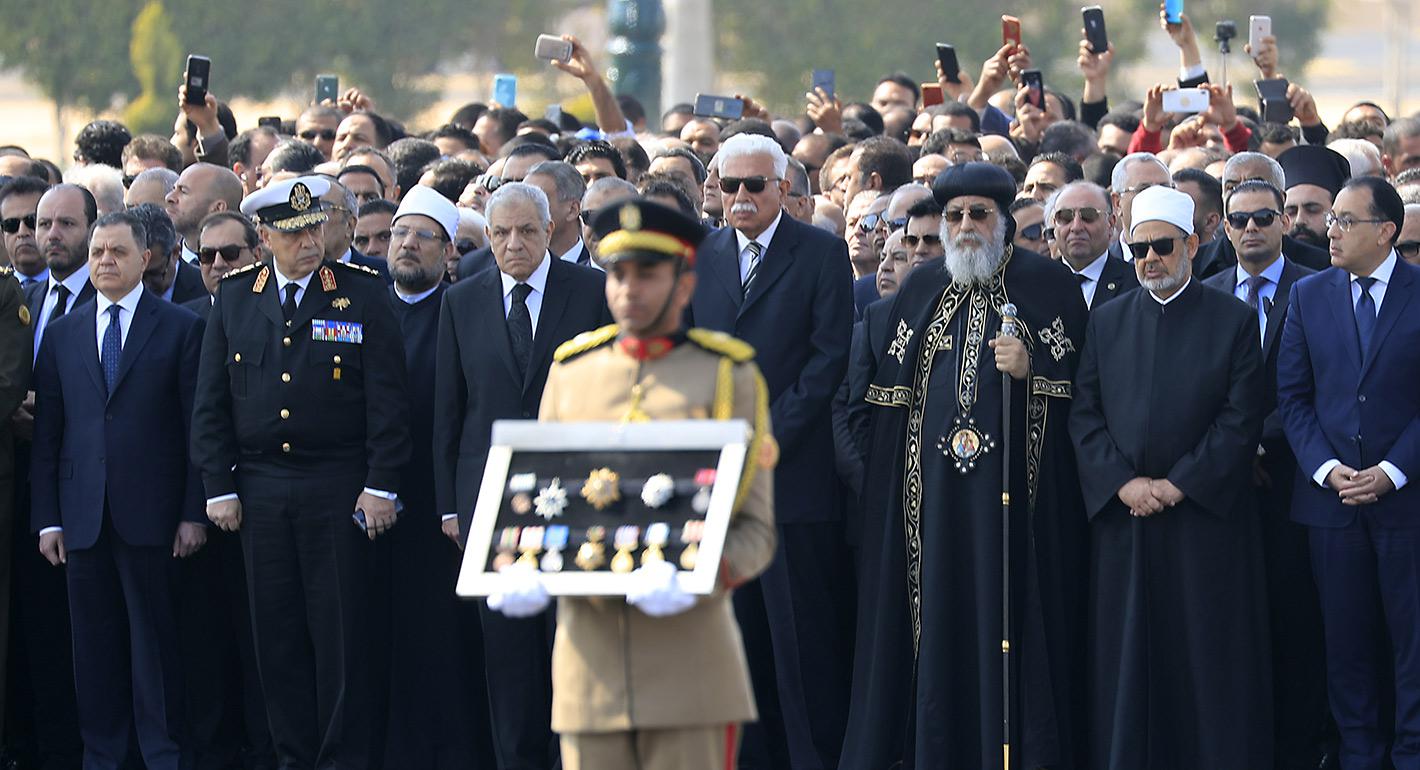
Mubarak’s presidency left a complex legacy in Egypt, but public sentiment has warmed in the years since he was deposed during the Arab Spring.
Former Egyptian president Hosni Mubarak’s death on February 25, at age ninety-one, provoked diverse reflections from Egyptians on the legacy of his thirty years in power as well as comparisons with President Abdel Fattah el-Sisi. While few Egyptians have forgotten the repression, stagnation, and corruption that characterized much of the Mubarak era—ending with his removal in a 2011 uprising—a recent trend of nostalgia has arisen as many feel they are even worse off under Sisi.
On the surface, arguments about Mubarak’s legacy—was he a source of regional stability who should never have been overthrown, or was he a corrupt autocrat who deserved harsher punishment than he received?—demonstrate the ongoing polarization among Egyptians. In general, supporters praise Mubarak for his role in international and regional affairs, whereas critics target how he ran affairs inside Egypt. Journalists and activists have noted that the former president served a relatively brief sentence for diverting millions of dollars in state funds for his family’s use and was acquitted of complicity in the killing of more than 800 protesters during the 2011 uprising—while thousands of youth still languish in prison.
On a deeper level, however, these debates reflect a growing consensus among Egyptians on two points: that the brief, chaotic attempt at a democratic transition after 2011 ended disastrously, and that most Egyptians are far worse off—economically, politically, and in terms of human rights—under Sisi than they were under Mubarak. A pro-Mubarak Facebook page, “I am sorry, Mr. President,” has drawn 3.5 million fans (despite the arrest of the page’s administrator in 2019), and three-quarters of a million people follow the ex-president’s elder son Alaa Mubarak on Twitter.
Sisi and his regime thus will have to thread the needle in navigating Mubarak’s death and legacy. They will want to show respect for Mubarak, a fellow military officer who was in their eyes a legitimate president—unlike Mohamed Morsi, who came to office in 2012 in Egypt’s first free presidential election. When Morsi, who had been deposed in a 2013 military coup, collapsed and died in a courtroom in June 2019, the Sisi regime ordered him buried secretly at night, and the brief coverage on state-run media did not even mention that he had been president. Mubarak, by contrast, was put to rest in a military funeral on February 26. Yet the regime is likely to take steps to contain any public expression of anti-Sisi sentiments amid public mourning.
Opposition to Sisi has always been strong in Islamist and revolutionary circles, but it has been growing for several years in the vast network of civilian officials, prominent families, and crony businesspeople whose loyalty Mubarak cultivated (and whose nests he feathered). While most initially supported Sisi as a needed antidote to the Muslim Brotherhood, Sisi has shown them indifference and even disdain, instead cultivating the military itself as his main constituency. The clearest sign of opposition may have been the effort of two Mubarak-era military officials, former prime minister Ahmed Shafik and former army chief of staff Sami Enan, to challenge Sisi for the presidency in 2018. Neither was allowed to run, and Enan was imprisoned for disloyalty.
Will the Mubarakists look for more opportunities to challenge Sisi? Their main vehicles for now are the late president’s two adult sons, Alaa and Gamal, who served several years in prison for corruption (Gamal had formerly been positioned to succeed their father). Perhaps by coincidence, the two sons were acquitted in the last remaining legal case against them (for alleged stock market manipulation) just days before their father’s death. They might well be in the regime’s sights as potential vectors for opposition to Sisi among the parts of society that once supported him.

Former Nonresident Scholar, Middle East Program
Michele Dunne was a nonresident scholar in Carnegie’s Middle East Program, where her research focuses on political and economic change in Arab countries, particularly Egypt, as well as U.S. policy in the Middle East.
Recent Work


Yasmine Farouk, Nathan J. Brown, Maysaa Shuja Al-Deen, …
Robert Springborg, Emile Hokayem, Becca Wasser, …
Carnegie does not take institutional positions on public policy issues; the views represented herein are those of the author(s) and do not necessarily reflect the views of Carnegie, its staff, or its trustees.

China’s political future will be shaped between now and next October. As the Communist Party enters its intense “campaign season” to prepare for a major political transition in 2027, reading Beijing's actions and responses may become more difficult as domestic politics weigh on its behavior more than usual.

Damien Ma

Putin’s conservative staffing policies and search for ever greater control have cemented parliament’s transformation into a bureaucratic appendage of the executive branch.

Andrey Pertsev

Ex-president Gurbanguly Berdimuhamedov remains interested in politics, but his son Serdar, Turkmenistan’s current president, is becoming increasingly independent and willing to break with his father’s legacy. If their covert rivalry goes too far, both risk losing power.

Galiya Ibragimova

A notable degree of participative democracy has firmly arrived in Europe. But to have more far-reaching impact, democratic deliberation needs to move into a radically new phase.

Richard Youngs
Fatima El Mansouri is the country’s first female prime minister. She’s also a privileged insider in a largely ceremonial position.

Sarah Yerkes